| Weight | 0.175 kg |
|---|---|
| Product Type | Educational Games |
| Author | |
| Publisher | Cepat Pandai |
Al-Ikhlas Quran On Flash Card Game
RM40.00
Introducing our NEW QuranOn Flash Card Game that will enhance our understanding on the Arabic words, translations, makhraj, tajweed, grammar, meaningful contents and many more.
✔ Recite the verse in the surah clearly from one word to another.
✔ Combination of Arabic alphabets from word by word in the surah to the beginners.
✔ Translation for the each word.
Be the first to review “Al-Ikhlas Quran On Flash Card Game” Cancel reply
You must be logged in to post a review.
Related Products
[GM] Arabic Learning Game
Enjoy the Arabic letters. Enhance the skills of recognizing letters, shapes, and sounds.
Salat Knowledge Game
The Salat Knowledge Game is suitable for 2 to 4 players aged three and above. In this game of slides and ladders, you spin the wheel and race to the finish before your friend reaches there. Along the way you learn the meaning and message of salat, that is, the five daily prayers. If you miss a prayer, you go down through the slippery slide, but if you offer it on time and with care, you climb up the ladder. And that is not all. There are chances to win a Salat Card too. Answer the question given on the card correctly and increase your knowledge about the five daily prayers. In this way, you don’t just try to run for the finish line, but learn all about salat as well. Isn’t this a fun way to play and learn!
Junior Quran Challenge Game
The Junior Quran Challenge Game for children is a unique game based on the Holy Quran. The idea behind this game is to provide the children with both fun and education. All questions are taken from the Quran. They have been creatively worked into this game and children will enjoy answering them. This game can be played at school or at home with all the family members. Begin your journey and find out what fun it is to learn from the Quran.
Steps to Prayer by Learning Roots
Teach Your Child How to Pray, Step by Step
Are you looking for a fun and effective way to teach your child how to pray?
With the Steps to Prayer (formerly known as ‘What’s Next?‘), you can teach your child how to perform the Salah in an engaging and comprehensive way. Here’s how:
[GM] Arabic Alphabet Game
28 double-sided cards help to teach both the alphabet and words!
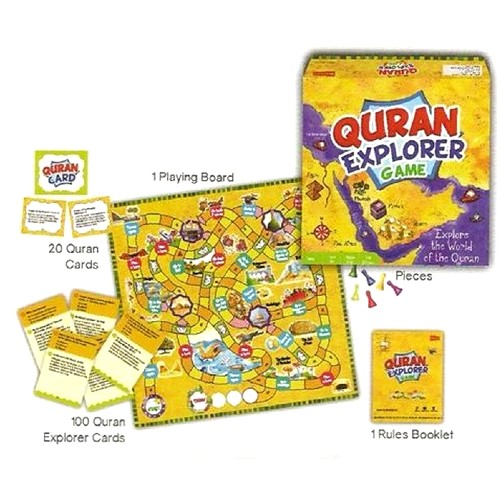
Quran Explorer Game
The Quran Explorer Game is a game based on the Quran. It is suitable for 2 to 6 players aged eight and above. It is a highly entertaining knowledge game to play with family and friends.
[GM] Arabic Alphabet Floor Puzzle (28cm x 44cm)
- 20 extra-thick cardboard pieces to piece together to explore the space
- Beautiful and child-friendly artwork
- Easy-Clean surface keeps the puzzle pieces looking new
- Promotes hand-eye coordination and problem-solving skill
Surah Al-Fatihah (Flash Card)
A set of 32 beautifully crafted flash cards to help children understand and memorize the true essence of Surah Al Fatihah.
- Vocabulary learning is made fun and exciting by picture-word association.
- Exercise cards to stimulate imagination and reinforce the concept behind each ayah for practical and linguistic understanding.
- Comes with instruction booklet – suggests various games to engage with children.
Suitable for 3+ years old.
Hadith Challenge Game
The Hadith Challenge Game is a unique game based on sayings of the Prophet Muhammad. The idea behind this game is to provide the children with both fun and education. All questions are based on the authentic sayings of the Prophet Muhammad. They have been creatively worked into this game and children will enjoy answering them. This game can be played at school or at home with all the family members. Begin your journey and find out what fun it is to learn from the Hadith.
Recently Viewed
Principles of Islamic Jurisprudence (2nd Revised Edition)
This book offers a detailed presentation of the theory of Muslim law (usul al-figh). Often regarded as the most sophisticated of the traditional Islamic disciplines, Muslim jurisprudence is concerned with the way in which the rituals and laws of religion are derived from the Qur’an and the Sunna – the precedent of the Prophet. Revelation, which is given to man to restore unity and help him achieve a just and devout order in society as well as in the soul, must be interpreted so as to render it practicable in every culture, while not betraying its spirit and immutable provisions. To achieve this, additional sources of legal authority are recognized, including consensus (ijma), analogical deduction (qiyas), public interest (maslaha) and local customary precedent (urf). In employing these, the jurist guards the five principles which it is the purpose of Islamic law to uphold, namely, the right to life, sound mind, property, lineage and religion.
Islamic Rulings on Menstruation and Postpartum Condition
The birth of human being is a most amazing phenomenon. The physical cycles that the body of woman must endure in order to maintain this act of creation should be respected to the highest degree. Allah mentions that our mothers have born us with difficulty and struggle and because of this are due the highest respect. one among many of the difficulties that women must brave, are the doubts that these conditions present to the correct obervance of her religion. How is her fassting affected, how are her prayers affected, how is her ability to pursue her studies, and how are her conjugal relations affected by her ever changing physical condition in relation to her as the sole vessel of the birth of man. A really valuable publication by Darussalam for all Muslim woman to study
The Islamic Awakening (H/B)
The Muslim Nation today is experiencing a blessed awakening in all aspects of its affairs, one that has been aroused by the efforts of Muslims throughout the globe. This is despite the onslaught of the disbelievers against Islam whether that be military or through their powerful media apparatus. In these often difficult times, we find many Muslims returning to their Din and embracing it with vigour and enthusiasm. However the astute observer will find that there are many problems that hinder its progress, problems that have caused some of the scholars to lay down some guidelines that the youth of this blessed awakening should adhere to and follow. It should also be noted that if the Islamic guidelines are not strictly adhered to, and the youth are left to be driven by their emotions alone, then surely this awakening will result in destroying more than it will build!
The Purification of the Soul (P/B)
The Purification of the Soul Imam Ghazali, Imam Jawziya and Iman ibn Hanbali
The Relief From Distress : An Explanation to the dua of Prophet Yunus (P/B)
Shaykh al-Islam Ibn Taymiyyah, may Allah sanctify his soul, was asked about the saying of the Prophet (pbuh),
The invocation of my brother Yunus, “none has the right to be worshipped save You; glory be to You, far removed are You from any imperfection; I have been amongst the wrong-doers,” none who is experiencing difficulty employs it except that Allah would relieve him of his difficulty.
What is the meaning of this du’a (prayer, supplication)?
Are their any unstated conditions that have to be met when one articulates it?
What is the connection between belief in the heart and the meaning of this supplication such that it leads to the removal of difficulty?
Why did he explicitly confess, ‘I have been amongst the wrong-doers’ when it is known that tawhid in itself leads to the removal of difficulty?
Is it sufficient to acknowledge ones’ sin alone, or must this be accompanied by repentance and the firm resolve not to repeat that sin in the future?
Why is it that difficulty and harm is removed only when a person relinquishes any hope, reliance and dependency upon the creation?
How can the heart relinquish the characteristic of putting hope in the creation and depending on them, and instead put its hope in Allah, Exalted is He, and turn to Him in its entirety?
What are the methods that would aid the heart in doing this?
The author replies to these questions in the form of this book.
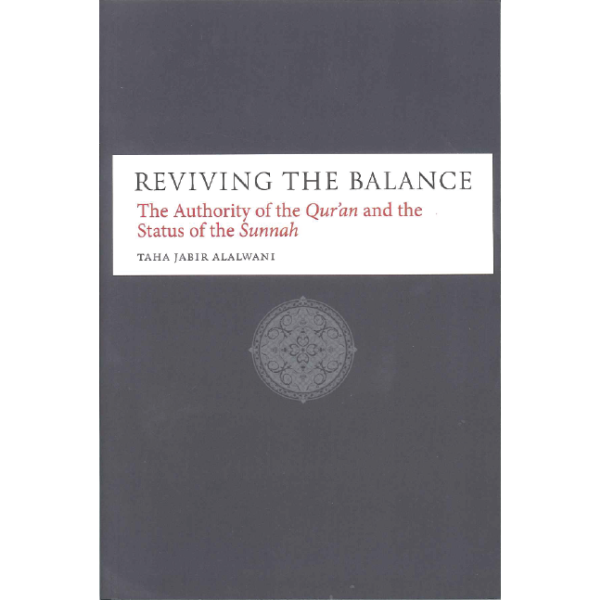
Reviving The Balance
This work studies the position of the Sunnah in Islam and its fundamental relationship to the Qur’an. The author carefully examines the sensitive issue of the development of the oral and written traditions, the problems scholars faced despite painstaking work verifying the authenticity of reports, the character of narrators, etc. and the ever growing complexity of a body of narratives that were making the simplicity and clarity of the Prophet’s life, words, and actions, a burgeoning maze of information. Taking the praiseworthy intention and effort to emulate the Prophet into account, the author nevertheless makes the case that once the Sunnah had been collected, the Muslim community began to neglect the Qur’an in favor of narrations of what the Prophet had done and said on the pretext that such narratives “contained” the Qur’an. Eventually they then abandoned the Sunnah narratives in favor of Islamic jurisprudence on the pretext that Islamic juristic texts tacitly included both the Qur’an and the Sunnah. It is with the aim of restoring the relationship between the two that this work has been written, that is, the Prophetic Sunnah must be tied inextricably to the Qur’an in a way that allows for no contradiction or conflict between the two, to avoid misapplication and abuse of hadith, and to meet the requirements and challenges of a new age.


There are no reviews yet.