


| Weight | 0.415 kg |
|---|---|
| Dimensions | 24.5 cm |
| Author | |
| Pages | 118 |
| Product Type | Book |
| Publisher | The Islamic Foundation UK |
In The Prophet’s Garden
RM62.00
Hurry up, Only 3 left.
somdn_product_page
Compare
SKU: HH67
Categories: Books Of Hadith, Noble Hadith and Hadith Sciences
Additional information
Reviews (0)
Be the first to review “In The Prophet’s Garden” Cancel reply
You must be logged in to post a review.
Related Products

The Sunnah And Its Role In Islamic Legislation (H/B)
Highlights:
The Sunnah and its Role in Islamic Legislation is a groundbreaking effort by Dr. Mustafa as-Siba’ee, for it has a completeness to it in two regards: first, the author manages to cover all topics related to the Sunnah—its status, its legislative force, the stages that led to its recording, just to mention a few—in a comprehensive and organized manner. Second, he presents the views of those that have attacked the Sunnah throughout history, detailing their arguments and then refuting them. Among those groups from the past were the Shi’aa and the Mu’tazilah; today, they are mainly the Orientalists and those that are influenced by them.
Sheikh as-Siba’ee takes us through the historical development of the Sunnah, from the early stages of revelation to the recording of the Sunnah during the era of the great Imams of Hadith. Throughout that account, he highlights the contributions of the scholars in preserving the Sunnah and cleansing it from fabrications and lies. Shaykh as-Siba’ee gives a clear account of the revolutionary methods and scholarly principles that were established in order to authenticate historical reports and narrations. The author shows us that the fruits of that endeavour were the preservation of the authentic Sunnah and the birth of the Hadith sciences.
This book has been a perennial source of knowledge for Arabic-speaking students of Islam, for its clarity, readability, and insightful research. New English-speaking students too have available to them this authoritative treatise on the Sunnah of our beloved Prophet Muhammad) may the peace and blessings of ALLAH be upon him).
RM62.00


44 Ways to Manhood (H/B)
5 ★
5 ★
1 Rating
5 ★
1
4 ★
0
3 ★
0
2 ★
0
1 ★
0
Highlights:
What does it mean for a Muslim man to have a personality that is in accordance with the Islamic guidelines? In this informative and enlightening book, based on the teachings of the Qur’an and Sunnah, Taymullah Abdur-Rahman presents 44 principles that Muslim men need to implement in their lives. This book will be a useful resource for Muslim men of all ages, as well as in study circles and family discussions.
RM50.00

Sunan Abu Dawud (5 Volumes) H/B
Highlights:
New edition of Sunan Abu Dawood in 5 volumes by Dar-us-Salam with commentary after each hadith. Unlike other prints, this edition has crisp and clear printing in deluxe 6×9″ bounding. Like the other translations of the six books of hadith, Dar-us-Salam Publications, has taken great care in correct translation, simple and clear modern English language, and high quality publishing.
Ahadith in the book are followed by comments to explain issues and to help readers derive lessons. To aid readers further, Dar-us-Salam, has added several features like section on how to benefit from Sunan Abi Dawud, about the Arabic and technical terms used, information about the hadith compilations and a glossary of Islamic terms in the last volume.
Each hadith is also followed by its status in regards to the authenticity. The status is explained more in detail in the Arabic text. The chain is also complete in the Arabic text while it is removed from the English to reduce the length and not being of much benefit to the English readers.
RM315.00

Usool Al-Hadeeth (H/B)
Highlights:
Dr. Bilal Philips writes: “The Prophet’s sayings and actions were primarily based on revelation from Allah and, as such, must be considered a fundamental source of guidance second only to the Qur’an.” According to Dr. Philips, the Hadith, the record of these sayings and actions, plays a vital role in that it transmits revelation, tafseer (exegesis of the Qur’an), Islamic law, and the Islamic moral ideal. For instance, the Prophet’s “…character and social interactions became prime examples of moral conduct for Muslims. Consequently, the daily life of the Prophet (blessings and peace of Allah be upon him) as recorded in the hadith represents an ideal code of conduct. It is largely due to the science of hadith that the final message of Islam has been preserved in its original purity for all times.” In Usool al-Hadeeth, the reader will embark on a course of study that will, Allah willing, enable him or her to make critical and intelligent use of the body of Hadith literature in his or her daily life.
RM50.00

Sahih Muslim (7 Volumes)
Highlights:
The authentic hadith collections of Bukhari and Muslim are excellent in respect to both chain of transmissions and the texts as well as their general utility in that they gave guidance in almost all walks of life. The collections won the praise and acclaim of of Hadith scholars so much that they themselves produced works containing the same Ahadith as found in the collection of both Bukhari and Muslim but with their own independent chains consisting of a lesser # of sub-narrators and called their works Mustakhraj.
Imam Muslim is one of the foremost preservers of ahadith of the Prophet. His book comes second only to Sahih al Bukhari in terms of authenticity according to majority of scholars. It is considered to be better than Sahih Bukhari in terms of organization and repetition according to some scholars of Islam. It is the second in the collection of 6 books called “Sihah Sittah” or “6 most authentic books”. Imam Muslim took painstaking efforts in preserving the words/actions/sayings & approvals of the Prophet. He has mostly used 4-5 narrators in the chain of transmission although there are a couple of hadith containing 3 narrators. Imam Muslim was a very good student of Imam Bukhari and some of his Shuyukhs, although he did not narrate from Imam Bukhari too much, thus reducing the # of narrators.
RM405.00

Approaching the Sunnah: Comprehension & Controversy (P/B)
Highlights:
The Sunnah still provides the stable moral framework – the grammar – that enables Muslims, by formal rules and inward sense, to know right from wrong. However, separation from the mainstream of life puts the Sunnah in danger of becoming rigid – an archaism. Addressing that danger, this book explains how the Sunnah can function as the grammar of a living, adaptive language, capable of guiding (and not shying from) the mainstream.
The first chapter sets out the qualities that characterize authentic application of the Sunnah: universality, coherence (so that different spheres of human responsibility are not split), compassionate realism, moderation, and humility. The second explains standards and procedures for determining the Sunnah in the fields of jurisprudence and moral instruction. The third chapter illustrates through detailed examples common errors in understanding the Sunnah – reading hadiths singly without sufficient context, confusing legal and moral injunctions, means and ends, figurative and literal meanings…–and it proposes remedies for these errors.
YUSUF AL-QARADAWI is one of the Islamic world’s most widely respected and prolific scholars. His works have remained popular over many decades. Among the best known of his books to appear in English is The Lawful and the Prohibited in Islam (first edition 1994).
RM75.00

40 Hadiths Relating to Islamic Finance
Highlights:
A comprehensive guide that every Muslim should possess, 40 Hadiths Relating to Islamic Finance by AbdulShaheed Drew untangles some of the intricacies of finance and economics, bringing forth a Sharia-compliant solution to earning and using wealth. This collection presents authentic hadiths and clear explanations, showing how they relate to contemporary circumstances. Read and study it to be empowered with general knowledge relating to wealth in Islam, so that you can earn and spend your money the halal way.
RM50.00


Forty Hadith on Islam (P/B)
Highlights:
This work covers, the Islamic creed, Pillars of Islam, Lawful & Unlawful, Piety and Righteousness, with commentary of Imam al-Ajurri. Anumber of scholars throughout Muslim history have penned their respective compilation of Forty Hadith books. Imam al-Ajurri’s kitab ularba` in Hadithan is among the earliest. It is a highly regarded text for Muslims to study and memorise, for it addresses fundamental aspects of religion, with particular focus on Creed, Pillars of Islam, the Halal and Haram as well as Piety and righteousness.
RM55.00

Authority of The Sunnah the Key to Paradise
Highlights:
Allah Most High Said, “And whatever the Messenger has given you, take it; and what he has forbidden you, refrain from it.” [Al-Hashr (59):7]
The Prophet said, “I have not left out anything of which Allah, The Most High has Commanded you with except I have apprised you of it. Likewise, I have not left out anything of which Allah has Prohibited you from it, except I have apprised you of it…” [Al Bayhaqi, 7/76 & others]
Together with the Qur’an, the Sunnah is the pivotal foundation and primary source of the Islamic faith. Following both of them is mandated by Allah Himself and obligated upon Muslims to adhere and live accordingly. Muslim theology is established upon them and remains defective and incomplete should either be forsaken for they both explain and interpret each other.
During his time, Imam al-Suyuṭi felt a genuine need to pen this compelling book in confuting those who either rejected the Sunnah altogether or did not grant it the status and respect it deserves in the religion. He primarily compiled from the works of Imam Al-Bayhaqi elucidating the position of Imam Shafi’i, and firmly laid out the arguments supporting the Sunnah of the Prophet by outlining its critical importance, its authority, and implication to one’s life.
Salvation, therefore, lies in embracing the Sunnah fully, for indeed it is the key to facilitating our worldly lives and thereafter, unlocking the doors of Paradise, as Shadh ibn Yaḥya said perfectly, “There is no better way to Paradise than the way of those who have followed the Sunnah.”
RM60.00

Fifty of the Counsels of the Prophet to the Women
Highlights:
Islam is very kind to women. The Prophet was very careful to respect their rights. Women \, in his times, possessed the religious knowledge, narrated ahadith. Nursed the sick and wounded on the battlefield and acquired knowledge. The home is the first madrasah of a child. This book shows women the path of Islam as shown by the prophet. The ahadith are explained on the pattern of great scholars like Ibn Hajar, Nawawi, Khattabi, Mubarakpuri, and others. A careful perusal will help the reader to understand the real message of Islam and to pattern her own life and her children’s on the right path.
RM18.00


Riyad-us-Saliheen (2 volumes)
Highlights:
Noble Hadith and Hadith Sciences
RM160.00
Recently Viewed

Makkah and Madinah Activity Book
Highlights:
Explore the wonders of Makkah and Madinah with this fun activity book. Features dot-to-dot drawings, coloring fun, puzzles to solve and 63 stickers to stick.
RM25.00
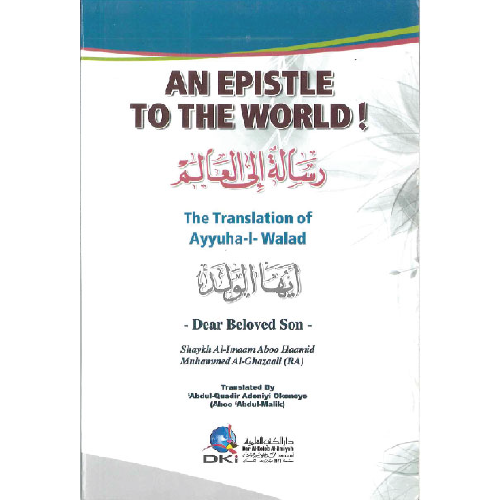

An Epistle To The World!
Highlights:
This book offers twenty-four pieces of valuable advice to seekers of knowledge. It touches on all aspects of life, from material wealth and the love of this life to Islamic etiquette and acquiring knowledge.
RM25.00

Development of Science & Technology In Islamic History (P/B)
Highlights:
The objectives of this book are:
1- To examine the argument that there is a contradiction between science and Islam.
2- To highlight some of the great contributionsmade by Muslims to science and technology over a period of 1000 years.
Science has never been separate from Islam. Objective study of this subject will reveal that Islamic texts – Qur’an and the Sunnah, provided a tremendous boost for study of the physical world and the laws that govern it. As a result, discoveries and inventions became the hallmarks of the Islamic civilization. Recently there has been a surge in the number of publications dealing with science and its relationship with Islam.
These books have focused on the various verses on the Qur’an that point to the physical world to prove that science is compatible with Islam. However, areas that are not covered enough for the English reader are the historical development of science and technology in the Muslim world, and the factors that led to its rise and decline. The decline has been so severe, that today’s Muslims are not even aware that their ancestors were the founding fathers of modern sciences. Just consider the common Arabic words used in the English language today like cotton, algebra, aorta, alcohol, chemistry, earth and alkaline. They are a living testimony to the pioneering work of the Muslims.
I am proud to introduce this inspiring book to our readers. It focuses on the strides made by the Muslims in various disciplines of science and technology from the early period of the Islamic State to its last days in the 20t’ century CE. The unique aspect of this book is that it sheds light on the key factors that led to the rapid advances in science and technology. Furthermore, it also analyses the reasons why Muslim World declined in this field, and last but not least, how the Muslim World can achieve the same kind of success as we already have in the past. Abdul Malik Mujahid About the Author Shabeer Ahmad, born in 1966, is a respected technologist by profession. He studied Avionics Engineering at University of London and he is currently an IT Consultant, having worked in Asia, Europe, Middle East and North America. The author has written widely on various subjects in Islam, including science, economics, politics and history.
The author is also a well respected speaker. The current book started as a lecture for a radio station in London. Given the massive interest it generated, and the little information available, the author began to research more into historical developments of science in the Muslim world. The author felt that the contributions of Muslims in this area have not been widely acknowledged, and that there is a need to counter the view that Islam is incompatible with science. The current book is a culmination of his research over the years.
RM26.00

Mapping The Secular Mind (IIIT)
Highlights:
The secular mind had a grand plan, to establish an earthly paradise, a utopia of the here and now, a modern civilization governed by human reason, rationality, and the triumph of progress. Whilst ideals are one thing, the means to realize them is something else. Away from the hype, emancipating humanity from the shackles of God and religion has proved no easy matter. Mapping the Secular Mind critically examines issues of reason, rationality, and secular materialism, to explore how these mental perceptions, or ways of mapping the world, have affected human interaction and sociological development. It does this by comparing and contrasting the ideas of Abdelwahab M. Elmessiri (1938 2008) a leading Arab intellectual, and Zygmunt Bauman (1925), one of the world s foremost sociologists. In the last few decades, an emergent Western critique of modernity has inspired Muslim intellectuals to develop new ideas, images, terms and concepts that state their positions towards the tendencies of secular modernity, its transformations and consequences, and how it manipulates perceptions of reality. The book challenges foundations of secular ideology to argue that its aspirations have deeply transformed human consciousness and man s sense of self, leaving him a creature of purposeless consumption, wearied by the search for fulfillment, and controlled by materialistic laws governing physical phenomena. It also offers a more darker thesis, that Fascist Germany and the Eugenics movement were a form of Social Darwinism taken to its logical course. These were not an aberration from the principles of modernity, Ali argues, but a consistent outcome of the modern worldview, with the seeds of self-destruction being woven into the very fabric of the philosophy.
RM86.00


The Excellence of Knowledge (Dar as-Sunnah Publishers)
Highlights:
The way and wisdom of the Salaf, all goodness lies in traversing the way of the Salaf, beneficial Knowledge with regards the ‘Inner Sciences’, the foundation of knowledge and many other branches of the beneficial knowledge.
RM39.00

Islamic Rules of Order (P/B)
Highlights:
Organizations must have rules of order to facilitate their debate and to fill in the procedures not detailed by their constitutional documents. While most American organizations are content to operate by Robert’s Rules of Order, Muslim organizations have often wrestled with questions over whether the rules of order systemized by a Western military figure are in accord with the Qur’an and the Sunnah.
This book tackles the matter directly and takes into account the Qur’an, the sunnah, Islamic manners and the history of Islamic consultation and leadership to provide a simple, practical guide to organizational procedure that can be incorporated into the governance of Muslim organizations. The book includes advice on writing bylaws and on complying with the best practices of the U.S. Dept. of Justice in a way that is Islamically authentic, transparent, and accountable. It provides a basic starting point for any Muslim organization while allowing for flexibility so that organizations may make any variations they require within their own bylaws and constitution, so that it can accommodate differing schools of thought on Islamic law. In its discursive approach it is an essential primer for understanding the value of rules of order and the Islamic context for their application. The Islamic Rules of Order has been adopted as the rules of order of the Association of Muslims Social Scientists.
RM50.00
There are no reviews yet.