| Weight | 0.58 kg |
|---|---|
| Product Type | Book |
| Author | |
| Publisher | UBD |
| Pages | 356 |
| ISBN | 9789991712703 |
Islamic Civilisation and The Modern World (P/B)
$14.77
This book presents a thematic treatment of Islamic civilisation. Each of the fourteen chapters comprising this book treats at least one of the major themes that are characteristic of this youngest religiously-based civilisation of the world.
Be the first to review “Islamic Civilisation and The Modern World (P/B)” Cancel reply
You must be logged in to post a review.
Related Products
The Sevens
A concise guide for lecturers and trainers. It includes 70 Sevens which are among the strongest assistant to you in life. They are the extract of the experiments and experiences of successful scholars, within intensified points and concentrated pivots
Contemplation: An Islamic Psychospiritual Study (IIIT) (Book in Brief Series)
IIIT Books-In-Brief Series is a valuable collection of the Institute’s key
publications written in condensed form to give readers a core under-standing of the main contents of the original.
The Dilemma of Muslim Psychologists (P/B) (IBT)
Psychology, with all its by-products and off shoots, has assumed in the West the status of religion, and for many people has replaced it. As in other areas of social sciences, some Muslim thinkers and scholars have developed an amazing skill for the unthinking repetition and blind copying of Western, non-Islamic ideas and practices. “In the Lizard’s Hole” is a Prophetic epitaph that describes this activity very well. Some Muslim psychologists insist dogmatically on prying even into lizard’s holes that have been partly or totally abandoned by their Western counterparts. But do Muslims really need modern psychology at all? Is modern psychology wholly Western? Is there a way in which it could be reconciled with Islam? These burning questions lie lurking behind the dilemma of Muslim psychologists.
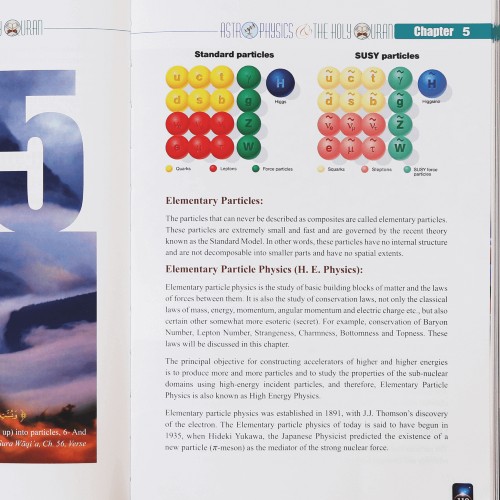
Astrophysics & The Holy Quran (H/B)
We are living now-a-days in the age of science. The intelligent human beings want to know where did they come from? Where did the universe come from? Will the universe come to an end, if so, how? Is the universe static or dynamic, if dynamic, is it expanding or contracting? What is time? When was it started? Will it come to an end? What are Black Holes? What are the forces of Nature? What is the smallest piece of matter? What is the status of man in the universe? Are there ultimate limits for human beings to know about something?
The majority of people especially in the third world are unable to answer these questions. When they are asked such questions, most of them answer with a shrug or with a vague and ambiguous knowledge. On the basis of Holy Qur’an as well as scientific knowledge, I have tried my level best to answer these questions in this book “Astrophysics and the Holy Quran”.
Cyber-Counseling For Muslim Clients
A Muslim psychologist addressing psychospiritual problems faced by Muslims
The Modernist Menace To Islam
Mind, Brain, & Free Will (P/B)
Mind, Brain, and Free Will presents a powerful new case for substance dualism (the idea that humans consist of two parts–body and soul) and for libertarian free will (that humans have some freedom to choose between alternatives, independently of the causes which influence them). Richard
Psychology From The Islamic Perspective
Islam offers a precise, uncomplicated, and comprehensive theory of our spiritual nature, our purpose and priorities in life, and how we can attain serenity and happiness in this life and the next. In Psychology from the Islamic Perspective, Dr. Aisha Utz Hamdan includes specific references to scientific research that corresponds to, or builds upon, what is already known from revelation.
Recently Viewed
Spiritual Disease and It’s Cure
The Imam was asked a long question of which a part was – What is the opinion of the scholars regarding a man who is afflicted by a disease, and knows that if it should continue it would damage his life? The Imam Quoted the Hadith from Sahih Bukhari The prophet (S) said: ‘Allah has appointed a remedy for every disease He has sent down’ Imam Ahmad reported on the authority of Usamah bin Shareek that the ‘ Prophet (S) said Allah has not made a disease without providing a remedy for it, wih the exception of one disease, namely old age’ This Applies to the medicine for the heart, soul and body. The well being of the servant’s heart, is far more important than that of his body, for while the well being of his body enables him to lead a life that is free from illnesses in this world, that of the heart ensures him both a fortunate life in this world and eternal bliss in the next.
Imam Ibn al-Qayyim al-Jawziyya was born into a scholarly and virtuous family in 691 AH/ 1292 A.D. At that time Damascus was a centre of literature and thought. Many schools were located there and he studied and graduated under the protection, direction and sponsorship of his father. He was particularly influenced by his Shaykh and teacher Imam Ibn Taymiyyah, and also by Ibn ash-Shirazi amongst others. Ibn al-Qayyim al-Jawziyya died in the city of Damascus the year 751 AH/1350 C.E.,when he was scarcely 60 years old, and was buried at the cemetery of Bab- al-Saghir, near the grave of his father – Rahimahuma Allah.
The Relief From Distress : An Explanation to the dua of Prophet Yunus (P/B)
Shaykh al-Islam Ibn Taymiyyah, may Allah sanctify his soul, was asked about the saying of the Prophet (pbuh),
The invocation of my brother Yunus, “none has the right to be worshipped save You; glory be to You, far removed are You from any imperfection; I have been amongst the wrong-doers,” none who is experiencing difficulty employs it except that Allah would relieve him of his difficulty.
What is the meaning of this du’a (prayer, supplication)?
Are their any unstated conditions that have to be met when one articulates it?
What is the connection between belief in the heart and the meaning of this supplication such that it leads to the removal of difficulty?
Why did he explicitly confess, ‘I have been amongst the wrong-doers’ when it is known that tawhid in itself leads to the removal of difficulty?
Is it sufficient to acknowledge ones’ sin alone, or must this be accompanied by repentance and the firm resolve not to repeat that sin in the future?
Why is it that difficulty and harm is removed only when a person relinquishes any hope, reliance and dependency upon the creation?
How can the heart relinquish the characteristic of putting hope in the creation and depending on them, and instead put its hope in Allah, Exalted is He, and turn to Him in its entirety?
What are the methods that would aid the heart in doing this?
The author replies to these questions in the form of this book.
Daily Wisdom: Sayings of the Prophet Muhammad (H/B)
This beautiful presentation of the Prophet Muhammad’s (s) teachings engages the reader in a moment of daily reflection. With 365 traditions covering the whole year, this is a must for every home. Apart from setting out the Islamic worldview, as reflected in the Prophet’s sayings, it is hoped that this work will serve as a useful volume for reflection, for soul-searching and for self -development as a single hadith appears on each of its pages, it has been designed to engage readers in a few moments of daily self-reflection throughout the year.
Abdur Raheem Kidwai is Professor of English at the Aligarh Muslim University in India and the well-known author of many works on the Qur’an and Islam.


There are no reviews yet.