


![[AC] Kitab Al Sunnah Li'abdullah Bin Ahmad / كتاب السنة لعبد الله بن أحمد](https://www.dakwahbookstore.com/wp-content/uploads/2024/07/website-500x500-2024-07-02T131158.898.jpg)
![[SJ] Thalathat Al Usul Wa Yaliha Shurut Alsalat Wa Arkanuha Wa Wajibatiha / ثلاثة الأصول و يليه شروط الصلاة و أركانها و واجباتها](https://www.dakwahbookstore.com/wp-content/uploads/2024/07/website-500x500-2024-07-04T222405.606.jpg)

Within the pages of Love Stories from the Qur’an by Yahya Ibrahim, the essence of love reverberates through narratives that embody birr, protection, qawwam, endearment, sacrifice, acceptance, and redemption. These stories unfurl as a testament to the power of transformation, turning the conventional on its head. With the tender embrace of an oxymoron, they offer solace and uplift those who’ve been pushed down, like an invigorating rain of barakah upon hearts and minds distanced from Allah (s.w.t.). From the first love story of Adam (a.s.) and Hawwa to the story of love for the ummah in Zakariyya’s (a.s.), prepare to be immersed in these timeless tales where love’s myriad facets transcend the ordinary and pave the way for extraordinary connections.
Love Stories from the Quran (H/B)
$18.16
Frequently Bought Together
| Weight | 0.295 kg |
|---|---|
| Dimensions | 18.5 × 12.7 × 1 cm |
| Author | |
| Binding | Hardcover |
| ISBN | 9789672420262 |
| Pages | 125 |
| Publisher | Tertib Publishing |
Be the first to review “Love Stories from the Quran (H/B)” Cancel reply
You must be logged in to post a review.
You may also like…

Love & Happiness A Collection of Personal Reflections and Quotes
Things fall apart. And they break sometimes. Like many of you, my journey hasn’t always been easy. Pain is very real. And so is loss.
Sometimes it’s hard not to let the weight of what we carry—or the memory of what we’ve lost—take over. Many of us know the reality
of struggle, and so many people suffer in silence. It’s hard. It’s hard not to give up when we face the repeated disappointments
of life. Like some of you, I’ve known loneliness. I’ve known defeat. I’ve fallen many times chasing mirages, and broken many bones
making castles in life’s fading sands. Sometimes, all it took was one solid wave to destroy what I had spent years building.
So I decided to give it a voice. All of it: the tears, the pain. And the lessons. The things I saw and learned and gained along my life
path needed a voice. I wanted to give back, in hopes of helping myself and others survive. But then it wasn’t just about surviving.
I didn’t just want people to survive inside their storms. I wanted people to thrive inside their storms. And so I wrote, as I walked through my own.
The words found in this book became my voice and my letter to the world. They became my deepest attempt to, not just pick myself up, but others along the way. I wrote because, just as we will fall in life, so will we rise. That’s the thing about this world. It never gives us only one kind of path. There is pain. Yes. And loss. And even darkness. But there is also light. There is hope. There is
beauty.
And there is also love and happiness.



A Sinner in Jannah: Stories of Repentance, Hope and Mercy (Tertib)
Every son of Adam sins, and the best of the sinners are the repentant. (Jamiʿ at-Tirmidhi 2499)
In A Sinner in Jannah, readers will discover the ultimate guide to repentance and Allah’s mercy. With a focus on the inevitable human nature of committing sin, Shaykh Yahya Ibrahim provides practical advice on how to identify and repent from different levels and categories of sins—major and minor.


My Unknown Future: Rejuvenating Faith and Reliance in Allah
People are so preoccupied with the process of planning their future, making the dunya their centre of attention, that they often forget their main task: to worship Allah.

With the Heart in Mind (TERTIB)
The Moral and Emotional Intelligence of the Prophet s.a.w.
This work is an inquiry into the nature of the intellect and how classical Islamic theologians understood the nature and function of the intellect.
With the Heart in Mind asks readers to consider an alternative understanding of intelligence in which the primary function of the intellect is to know God and lead others to Him as well. The author suggests that by studying the Emotional Intelligence of the Prophet Muhammad (S), we improve the quality of our relationships with the people around us and we, like the Prophet (S), can become catalysts for change around us. Emotional Intelligence within the author’s model of intelligence is a tool by which the message of God is transferred to humanity. With the Heart in Mind reminds us that “To be loved by people is half of intelligence.”
Related Products


Don’t Be Sad By Dr. A’id al-Qarni
At a time in which the Muslims are beset with trials from every periphery and within, comes this heartening book rooted in the commandments of Allah (swt), the Sunnah and the excellent guidance and examples of the Muslims that have come before us. Don’t Be Sad is an absolute must-read for all people. It is full of practical advice on how to replace sadness with a pragmatic and ultimately satisfying Islamic outlook on life. It exposes to the modern reader how Islam teaches us to deal with the tests and tribulations of this world. So, take heart and hold firmly onto the rope of Allah (swt)


Enjoy Your Life (B/W) – IIPH
Enjoy Your Life! Enjoy Your Life: The Art of Interpersonal Relations as Exemplified in The Prophet’s Biography is a comprehensive guide towards improving interpersonal skills and hence, enjoying life. The author, Dr. Muhammad ‘Abdur-Rahmân al-‘Areefy, writes: An enjoyable life entails learning and practicing multiple skills; the few who truly apply them savour the success that comes with it. Of course, atop the list of the successful is the chief of humanity, Muhammad (blessings and peace be upon him). His entire life was an ocean of pearls that I have scattered throughout the pages of this book.
Enjoy Your Life! is not the product of an effort of a month or a year. Rather, it has resulted from the research that I devoted myself to for twenty years. I inscribed it with my tears, pouring my soul and squeezing my memories into it. I penned down various incidents involving the joy of our eyes – our first teacher, Muhammad (blessings and peace be upon him). I highlighted his exceptional talents; his skills in dealing with people and enjoying his life. Enjoy Your Life! contains personal memories, real-life experiences, and incidents that I have publicised for the first time – praying that Allah, the Exalted, makes them a source of benefit for you.
Enjoy Your Life! contains words that are straight from my heart, hoping to find a place in yours. It is the dearest and most beloved of my books. I ask Allah, the Exalted, to benefit others with it, make this effort solely for His sake, and amply reward all those who have contributed to spread it.


Dutifulness To Parents
After dutifulness to Allah, dutifulness to our parents comes next for Muslims, but what does our duty to our parents entail? In this little book, Nidhâm Sakkijha gives examples and evidence from the Qur’an and the Hadith of Allah’s Messenger (blessings and peace be upon him) to explain, point by point, what these duties are, and how the fulfillment of these duties may lead us to Paradise, while their neglect may mean that we end up in Hell. This concise and very useful volume has been translated into English by Iman Zakaria Abu Ghazi.


A Child Reads (Successful Family Upbringing Series-06)
A Child Reads (Successful Family Upbringing Series-06)


Enjoy Your Life (Full Color) – Darussalam
This is an exquisite collection of incidents from the life of the Prophet (S), stories from our Islamic Heritage, and thought-provoking anecdotes from the life of the author. The aim of the book is to train the reader to enjoy living his life by practicing various self-development and inter-personal skills. What is so compelling and inspiring about this book is that, in order to highlight the benefit of using social skills, the author draws from the lives of the Prophet (S) and his Companions. This book is both a practical systematic guide to self-improvement and a treasure trove of historical incidents. It increases self-awareness, whilst nurturing the soul and strengthening the spirit. The books author is a prominent figure in the field of Islamic Dawah and has authored more than twenty published works.


Closer Than A Garment (P/B)

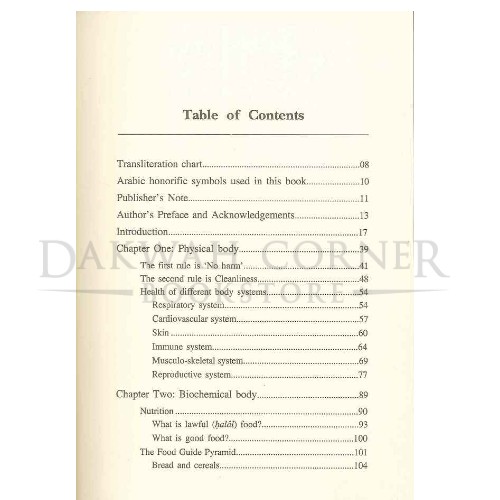
Healing Body and Soul : Your Guide to Holistic Wellbeing Following Islamic Teachings
Like other guides to good health, Healing Body & Soul advocates abandoning an unhealthy diet and altering a sedentary lifestyle, but this book goes beyond the mere physical aspects of health. Amira Ayad is a practitioner and researcher with a Master’s in Pharmaceutics and pursuing her Doctorate in Natural Health. She writes: During the course of this work, I try to explain how you can combine the rich tradition of Islamic teaching with beneficial contemporary scientific knowledge in order to lead a holistically healthy and happy life. The book is divided into five chapters, each concerning one of the five components that make up your body, mind and soul, clarifying in each chapter how to look after that part of you and keep it healthy. During the course of the book you will notice how these bodies are interconnected; the health of one is highly dependent on the wellbeing of the others, so that a happy, healthy life entails a balance between all of them. Healing Body & Soul presents holistic Islamic health science in a simple yet comprehensive user-friendly guide to better health. Healing Body& Soul is an invaluable reference that encourages and empowers people to take control of their health and their lives.


Difference Between Advising And Shaming ( Dar as-Sunnah)
[This book] beautifully illustrates the difference between advising that is encouraged and shaming that is not permitted.


Golden Morals (A Collection Of Stories From The Seerah) (H/B)
The Seerah of the Prophet (PBUH) is an everlasting topic. The Muslims are never fed up with its fragrance. It has been a topic for writing sine centuries and it will be a topic for writing till the Day of Judgment. Every author shows his love and affection for the Messenger of Allah in his own style and he tries to highlight every aspect of his life. No doubt, thousands of books have been written on the Seerah of the Messenger in different languages from the ancient.

Golden Words (H/B)
Islam has declared this world and life as a test case for human beings. To live a successful life, Allah SWT has sent His Divine Teachings to help humans understand what to do and what not. This book “Golden Words (Golden Stories) consists of short stories and incidents that occurred during the life time of Prophet (Peace be upon him), Rightly Guided Caliphs, Salf-us-Saleheen, renowned kings/ rulers and other shining stars of the Islamic history. The purpose of these short stories is simple; providing real-life lessons to the readers.
The book provides a clear understanding of our ancestors, their thorough and firm knowledge, their intelligence, proper comprehension, modesty, sacrifices and their endeavors to elevate the truth. This is particularly rewarding book for youngsters that will find it a helping hand in living as per Islamic principles.


One Hundred Pieces of Advice
One hundred treasured advices extracted from the writings of the illustrious scholar, Imām Ibn al-Qayyim (may Allāh have mercy upon him): Ten ways to acquire Allāh’s love Ten ways to be patient and avoid sins Ten ways to be patient during a calamity Ten benefits to lowering your gaze Ten ways sins are expiated Ten barriers between the slave and his Lord Ten reasons knowledge is not put into action Ten ways to open your heart Ten ways to protect against envy Ten ways to protect against the plots of the Shayṭān

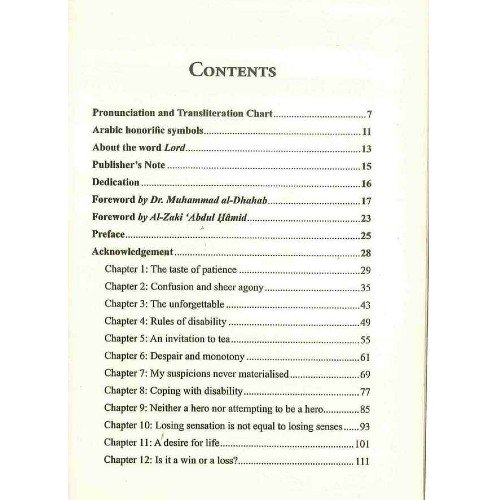
A Taste of Patience
The writer is a survivor of an accident that altered his life. He is a man who managed to overcome adversity and transform bitterness into personal success, as his literary gains outweighed his physical restrictions. Where his physical condition limited his movements, his creative writing opened up a new horizon that enabled him to freely interact with his readers.
This is a real-life account of how a human being can overcome obstacles, giving effect to the epithet: ‘What does not kill me makes me stronger.’ The autobiography defines patience in two ways: first, as a bitter experience and then second, as the ability to tolerate and turn one’s misfortune into investment. The accident that the writer suffered has paralysed his body, but at the same time it has unleashed his writing talents. (Yousef el-Sharoni, Egypt)
Recently Viewed


Divine Will and Predestination; Islamic Creed Series Vol. 8
The will and decree of Allah: Is this a matter which is directly relevant to the day-to-day life of the Muslim, or is it an obscure topic best left to the debates of philosophers and theologians? Does it imply that Muslims are ‘fatalists’ who see themselves as helpless in the hands of an indifferent fate? Attitudes towards divine will and predestination have always influenced Muslims’ daily activities. In this final volume of his eight-volume Islamic Creed Series, Dr. ‘Umar al-Ashqar explores this topic in depth, explaining it in clear terms for the ordinary Muslim. Drawing always on the Qur’an and the Sunnah, and on the words of the greatest scholars of Islam such as Ibn Taymiyah, he covers some of the historical debates that took place within the Ummah on this matter. The true Islamic concept of divine will and predestination is an empowering notion. While all that happens takes place within the framework of the divine will, people have freedom of choice within those parameters. This is a matter which is of interest and concern for all Muslims, one which will bring many benefits, both in this world and in the hereafter. This Islamic Creed Series of books has been translated into English by Nasiruddin al-Khattab.


Kaedah Rasulullah (saw) Menegur Kesilapan
Tegur Menegur adalah satu sikap dan perbuatan yang baik pada pandangan Islam. Pada masa kini teguran boleh dilakukan melalui pelbagai media dan cara. Namun begitu ramai yang tidak mengerti dan memahami adab serta cara-cara untuk menegur sesuatu kesilapan.
Menegur kesilapan adalan sebahagian dari wahyu dan metodologi Al-Quran menjelaskan perintah dan larangan, persetujuan dan pengencaman dan pembetulan kesilapan.
Mengajar orang lain juga merupakan amalan yang mana paling baik yang manfaatnya dapat disebarkan kepada yang lain. Ia merupakan perkongsian tentang peninggalan para Anbiya (as) dan Rasul (saw) oleh dai’yah dan para pendidik.
“Sesungguhnya Allah, para malaikatNya dan penduduk langit dan bumi sehingga semut dalam lubangnya dan sehingga ikan di dalam lautan momohonka rahmat kepada pengajar manusia kepada kebaikan.” (At-Tirmidhi)
Berpandukan al-Quran dan Hadis sahih, Sheikh Muhammad Salih al-Munajid menerangkan bagaimana pendekatan Rasulullah (saw) dalm mengajar serta menegur kesilapan.

Contemporary Approaches to The Qur’an
The Qur’an and Sunnah are the two primary sources of Muslim faith, life, law and morality. The Qur’an is for Muslims the foundation of their faith and the Sunnah is the framework of their morality. Together they constitute the two sources of the law (Shari ah) of God, a guide to prosperity and happiness in this life and to the bliss of the hereafter. Although the Qur’an and Sunnah are materially and formally two independent sources, they are inextricably bound in a dynamic relationship. The rulings and precepts (ahkam) of the Qur’an constitute the law (shar ) of God. They are supplemented by the precepts of the authentic Sunnah, which possess authority second only to the precepts of the Qur’an. The Qur’an commands Muslims, Whatever the Messenger gives you, that you must take, and whatever he forbids you, you must desist therefrom…. (59:7).


Child Upbringing (Successful Family Upbringing Series-02)
A presentation of ten important guiding principles in child upbringing and nurturing.

Slippery Stone : An Inquiry into Islam’s Stance on Music
What does Islam say about poetry, singing, musical instruments, musicians, and the business of music? How have Muslim societies historically looked at these questions and how have their attitudes changed in the media age? Why have mosques remained music-free while churches have not? What is the truth about the much-publicized €œmusic controversy€ in Islam? Why did Sufis call sama as the slippery stone? These are some of the questions explored in-depth in Slippery Stone: An Inquiry into Islam’s Stance on Music.
Of late, increasing attempts are being made to promote €œIslamic music,€ and the distinction between what is allowed and what is not has become hazy and unclear for many. This book demystifies the issue of music in Islam by going to original source books in Arabic, many of them brought to light for the first time in the English language. It traces the attitudes of the Muslim society about music and the musician throughout its history and quotes extensively from the deliberations of the Qur’an and Hadith scholars and jurists from all schools of Islamic Law, both Sunni and Shi’ah. Separate chapters are devoted to a discussion of the views of Sufi masters as well as the arguments of Ibn Hazm.
It examines in considerable depth the impact of colonialism and the media revolution (beginning with the gramophone) on the attitudes of Muslim societies regarding music. It also subjects the works of Orientalists to a scrutiny that was overdue.
By referring to it as a slippery stone, Sufis vividly pointed out the dangers associated with this enterprise and emphasized the need for caution. History is filled with the corpses of those who fell off the slippery stone by ignoring this advice. Combining historic, cultural, and jurisprudential perspectives this book brings the truth of that metaphor into sharp relief.
More than six hundred references and more than a hundred twenty biographical notes on the authorities quoted add to the value of a discussion that is comprehensive without being boring, and detailed without being confusing. This book has left no stone unturned in its examination of the slippery stone.


The Message of the Qur’an H/B (IBT)
The Message of the Qur’an is widely recognized as among the best English translations and commentaries of the Qur’an and comparable to the famous works of Pickthall, Yusuf Ali, and Daryabadi. Asad’s rendering is simple and straightforward. Although widely known as a proponent of conservative Islam, his translation departs from the traditional exegetic approaches and reflects his deep knowledge of Jewish and Christian scriptures. This edition boasts of a comprehensive index and uses the standard Uthmani Qur’anic script.
There are no reviews yet.