| Weight | 0.320 kg |
|---|---|
| Dimensions | 28 cm |
| Author | |
| Binding | Paperbound |
| ISBN | 9789386589651 |
| Publisher | Goodword |
Be the first to review “Madinah Arabic Reader Book 8” Cancel reply
You must be logged in to post a review.
Related Products
Teach Yourself MP3 Complete Arabic Step by Step A1-A2
Arabic Books – Arabic World – Arts & Crafts, Decoration – Biographies – Calligraphy – Children – Clothing – Companions – Computer – Cooking – Courses & Lectures – Culture & Leisure – Dictionaries – Dogma (‘Aqeedah) – Dreams interpretation – Economy – Education – Educational – Electronics – Ethics – Exhortation – Fast (Ramadan) – Geopolitics – Gift Ideas – Hadith – Halal Food – Health & Dietetics – History – Holy Quran Stories – Introduction to Islam – Invocations – Islam & Science – Islam & secularity – Islam and Modernity- Islamic songs – Jurisprudence – Learning Arabic – Learning English – Learning French – Literature & Poetry – Magazines – Marriage – Miscellaneous – Mystic and Sufism – Names- Natural Beauty Care – Other Religions – Paradise – Hell – Dead – Philosophy – Pilgrimage & Umrah – Propagation (Da’wah) – Prophet Life – Prophets – Quran Sciences – Quran Tafseer – Religious practice – Roqya & Protection – Sciences of Hadith – Society – Spirituality – Strories – Sunnah – Tajweed (Rules) – Tamazight Culture – The Holy Quran – The West and Islam – Tourism – Understanding Islam – Ussul Al-Fiqh – Various Accessories – Well-Being – Woman – Youth – Zakat & Charity
Madinah Arabic Reader (Book 6)
Professor Abdur Rahim, Director of the Translation Centre of the King Fahd Quran Printing Complex and former Professor of Arabic at the Islamic University of Madinah, Saudi Arabia, has authored texts designed to impart a knowledge of classical Arabic through applied grammar. Each lesson, based on a conversation, illustrates distinctive language patterns. These patterns are elucidated by a variety of helpful exercises. The vocabulary ranges from classical and Quranic Arabic to modern Arabic. This series of books is currently being utilized at various schools to prepare students for the University of London (UK) GCE O-Level and A-Level examinations.
[AR] Al-Arabiyyah Baynah Yadayk Book 4 Part 2
Al-’Arabiyyah bayna yadayk Means Arabic in Your Hands.
The great thing about these books is, that it covers a lot of vocabulary through pictures, Images and using Arabic Only, introduces the students to grammar later and gradually rather than pushing them at the deep end before they can swim.
Much like Arabic Course for English Speaking Students 3 Volumes Set, UKIA, it is more Islamic inclined and fulfils the desire for the student of knowledge to learn the language of the Qur’an.
Students who had completed all three books wanted something else to reach higher competency, which has given rise to volume 4 which is available in 2 Parts.
Al-’Arabiyyah bayna yadayk series comes in 3 Basic Student Books and a further study Book 4 Parts 1 & Book 4 Part 2
Arabic Grammar Made Easy (P/B)
An approach to teaching the Arabic language by introducing vocabulary and grammar in small doses, based on the most commonly used words in Arabic literature and the most frequently used grammatical constructions. Book One focuses on the rules of nominal sentences.
Let’s Speak Arabic
For business or pleasure you need Let’s Speak Arabic for useful vocabulary and phrases. The book is organized to make Arabic learning easy and accessible. Let’s Speak Arabic focuses exclusively on the most common, everyday situations you will encounter in Arabic-speaking countries. It is just what you need to communicate successfully in basic Arabic.
Madinah Arabic Reader (Book 1)
Arabic Learning
Recently Viewed
Tafseer Soorah Al-Hujurat (H/B)
Tafseer Soorah al-Hujurât: A Commentary on the 49th Chapter of the Qur’an is a treasury of divine advice, commandments, and prohibitions regarding common problems in social relations, including gossip, spying, arguing, and bigotry. To make the best use of this chapter, the believer needs a detailed explanation of the meanings of the verses.
Dr. Bilal Philips has based his tafseer (exegesis) on the methodology used in the classical works of tafseer. He has relied first of all on the explanations found within the Qur’an itself, then on explanations found in the Sunnah and related incidents which occurred at the time of the revelation of the verses in question. Beyond these primary sources, Dr. Philips has relied on the interpretations made by the Prophet’s Companions (may Allah be pleased with them) who were noted for their ability to interpret and comment on the Qur’an. ‘Abdullâh ibn ‘Abbâs, for example, was called ‘The interpreter of the Qur’an’ by Prophet Muhammad (blessings and peace of Allah be upon him). Finally, the author has made use of the grammatical explanations given in the classical tafseer works. Wherever possible, Dr. Philips has tried to apply the derived meanings of the verses to the problems of contemporary society.
365 Prophet Muhammad Stories
My Du’a Book
My Du’a Book: This excellent book contains selected supplications (du’a) for every child according to the Qur’an and the Sunnah. It tells the child which du’a to say when he begins something. Some examples are: what to do upon seeing a Muslim, when the name of the Prophet is mentioned, when one sneezes, when one is angry or when one enters the toilet, etc. The supplications are written in both Arabic and English and also include English transliterations to make learning easier for everyone! These are selected supplications (Du’a) for every child according to the Quran and the Sunnah in this small color full booklet includes many du’as from Bismillah to dua for entering the graveyard. Includes 15 beautiful du’as and brief mentioning for the occasion.”
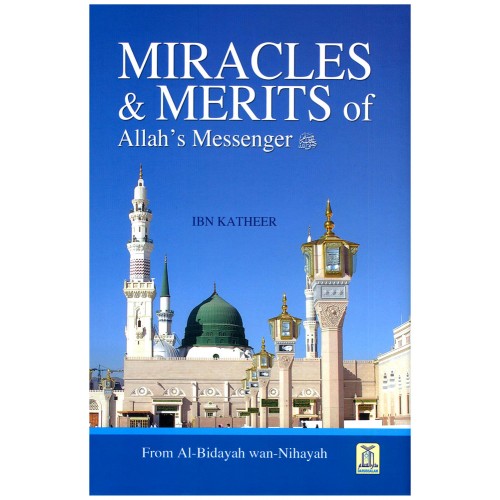
Miracles & Merits of Allah’s Messenger: from Al-Bidayah Wan-nihayah
Miracles & Merits of Allah’s Messenger By Ibn Katheer The book then discusses the blessed and beautiful characteristics and merits of the Prophet and then goes on to describe the miracles that he performed. Ibn Katheer than compares the miracles given to Prophet Muhammad with those that were given to the other Prophets; he then shows that Prophet Muhammad collectively received the same miracles that were granted to the other Prophets separately. AI-Bidayah wan Nihayah (The Beginning and The End), by the renowned scholar Abu Al-Fida ‘Imad ad-Deen Isma’eel bin ‘Umar ibn Katheer, is considered as one of the most authoritative sources on Islamic History.


There are no reviews yet.