The discussions in this book will, Allah willing, not only enlighten the readers about various natural remedies but also stimulate scientific research on the medicinal plants mentioned in authentic hadiths. We hope that this book serves as an invaluable reference guide for Muslims and non-Muslims in every home, country, and age, especially those working in health sciences, pharmacy, alternative medicine, and biomedical research.
Medicine And Pharmacy In The The Prophetic Traditions (H/B)
$19.32
Medicine and Pharmacy in the Qur’an and Prophetic Traditions aims to integrate the science of healing into the religion of Islam. It provides advice and guidance on maintaining sound health and preventing diseases and ailments in compliance with the Qur’an and the Sunnah of Prophet Muhammad (blessings and peace be upon him). It also discusses the Qur’anic verses related to health, sickness, and cure, as well as the spiritual and physical remedies recommended by the Prophet (blessings and peace be upon him) in light of modern knowledge.
Frequently Bought Together
| Weight | 0.6 kg |
|---|---|
| Dimensions | 22 × 14.7 × 2 cm |
| Product Type | Book |
| Author | |
| Pages | 409 |
| ISBN | 9786035014830 |
| Publisher | IIPH |
Be the first to review “Medicine And Pharmacy In The The Prophetic Traditions (H/B)” Cancel reply
You must be logged in to post a review.
Related Products
Mind, Brain, & Free Will (P/B)
Mind, Brain, and Free Will presents a powerful new case for substance dualism (the idea that humans consist of two parts–body and soul) and for libertarian free will (that humans have some freedom to choose between alternatives, independently of the causes which influence them). Richard
Islamic Verdicts on Medicine & Cosmetic Surgery
We had the honor of our eyes being gifted with seeing his eminence Imam Abdul Aziz Bin Baz may Allah bestow upon him immense mercy and of sitting with him when he delivered verdicts regarding rulings of the Shariah on many medical issues which have been increasingly asked about by patients and people working in the medical field. We focused ourselves, with success granted by Allah, on the authenticity of medical information to the best of our ability. We have applied our best efforts in its presentation while simplifying it as much as possible. This is so that it is easily understood by those who are not specialists in medical fields.
Contemplation: An Islamic Psychospiritual Study (IIIT) (Book in Brief Series)
IIIT Books-In-Brief Series is a valuable collection of the Institute’s key
publications written in condensed form to give readers a core under-standing of the main contents of the original.
The Problem Of Corruption (P/B) (IBT)
“Corruption is a disease that can sweep through society like a tidal wave, leaving in its wake a trail of negligence, lethargy, inefficiency and callous disregard of man’s inhumanity to man. What is it like to live inside such a society? Why has it taken such strong root in so many countries? Is there no sense of outrage and shame against such a phenomenon among our elite? What can be done to stem the tide? Is it corruption as it is known in the West? These disturbing questions and more are answered in this book. Corruption in all its forms, bribery nepotism, and extortion, is shown for what it is – a major cause of the dehumanization and victimization of innocent people. The corrupt have no aspirations for the betterment of their societies. For this reason, all decent people must be gravely concerned with the problem and nurture the next generation to confront the corrupt and disrupt their way of life.”
Islamic Civilisation and The Modern World (P/B)
This book presents a thematic treatment of Islamic civilisation. Each of the fourteen chapters comprising this book treats at least one of the major themes that are characteristic of this youngest religiously-based civilisation of the world.
The Dilemma of Muslim Psychologists (P/B) (IBT)
Psychology, with all its by-products and off shoots, has assumed in the West the status of religion, and for many people has replaced it. As in other areas of social sciences, some Muslim thinkers and scholars have developed an amazing skill for the unthinking repetition and blind copying of Western, non-Islamic ideas and practices. “In the Lizard’s Hole” is a Prophetic epitaph that describes this activity very well. Some Muslim psychologists insist dogmatically on prying even into lizard’s holes that have been partly or totally abandoned by their Western counterparts. But do Muslims really need modern psychology at all? Is modern psychology wholly Western? Is there a way in which it could be reconciled with Islam? These burning questions lie lurking behind the dilemma of Muslim psychologists.
Scientific Wonders on the Earth and in Space (H/B)
Every Prophet had a miracle which he showed to his people and challenged them with. Some of the Prophets even had more than one sign as a definite proof that. they were sent by Allah; challenging their nations to bring anything similar to it if they denied it. Every sign given to any of the Prophets was exclusively meant for his people and when he died, his signs ceased to exist.
However, one such miraculous sign shall remain, complete and preserved with the command of Allah, until the Day of Resurrection. This miracle is the inimitable Qur’an, the everlasting Book of Allah given to Prophet Muhammad (peace and blessings be upon him). Anyone who lives after the death of this Prophet of Mercy will be able to see it, read it, and realize for themselves the truth that it contains.
Who was the teacher who taught Prophet Muhammad the scientific facts described by the Qur’an? Did he possess tools of scientific research that enabled him to discover all that? Did he have airplanes and rockets that enabled him to discover what was beyond the sky?
The answer is that He possessed such knowledge that could never be affected by falsehood because it is the word of God. All that he informed us – of the past and present signs in the Universe and within ourselves – has been discovered by science as proven fact, and no doubt, the future signs will be discovered, just as he predicted.
The Sevens
A concise guide for lecturers and trainers. It includes 70 Sevens which are among the strongest assistant to you in life. They are the extract of the experiments and experiences of successful scholars, within intensified points and concentrated pivots
Recently Viewed
Ibn Taymiyyah’s Essay on Servitude
“An enlightening book written by one of the most famous scholars of Islaam on the important subject of servitude. In this book, Shaykh Ibn Taymiyyah defines the concept of worship in Islaam and explains that to be a true “slave of Allaah” is a status of both virtue and nobility. The author proves that the title “slave of Allaah” is one of great honor which Allaah bestowed upon the best of creation, Muhammad (pbuh). While elaborating on the issue of servitude, the author highlights the prevalent traps which people fall into, when becoming enslaved by, or allowing their hearts to become attached to worldly objects. The emphasis is on servitude to Allaah which is adorned with the true love we hold for Him in our hearts — a matter of central importance for every Muslim.
Zakat and Poverty Alleviation (P/B)
This edited book aims to raise issues pertaining to the topic of zakat and its primary goal of poverty alleviation. It portrays the dynamism of zakat by highlighting pertinent issues on the management of zakat institutions and innovative programmes that are designed as effective distribution mechanisms. Discussions include zakat payment motives, ways to measure the efficiency of zakat disbursement, economic development initiatives, housing programme, microfinancing, and actual impact on poverty alleviation. The discussions raised put emphasis on policy-orientation with dedicated sections on policy implications and recommendations. This approach is deemed necessary since it could guide the thought process of interested parties towards the creation of new ideas to actualize zakat as a very reliable tool in addressing the massive problem of poverty among Muslim communities. This special feature also significantly adds to the much-needed reference materials in courses on zakat at the intermediate level of undergraduate studies and introductory level of postgraduate programmes.
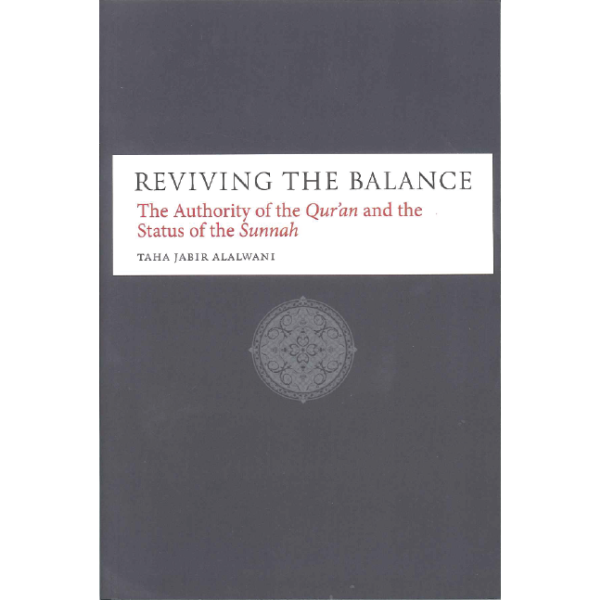
Reviving The Balance
This work studies the position of the Sunnah in Islam and its fundamental relationship to the Qur’an. The author carefully examines the sensitive issue of the development of the oral and written traditions, the problems scholars faced despite painstaking work verifying the authenticity of reports, the character of narrators, etc. and the ever growing complexity of a body of narratives that were making the simplicity and clarity of the Prophet’s life, words, and actions, a burgeoning maze of information. Taking the praiseworthy intention and effort to emulate the Prophet into account, the author nevertheless makes the case that once the Sunnah had been collected, the Muslim community began to neglect the Qur’an in favor of narrations of what the Prophet had done and said on the pretext that such narratives “contained” the Qur’an. Eventually they then abandoned the Sunnah narratives in favor of Islamic jurisprudence on the pretext that Islamic juristic texts tacitly included both the Qur’an and the Sunnah. It is with the aim of restoring the relationship between the two that this work has been written, that is, the Prophetic Sunnah must be tied inextricably to the Qur’an in a way that allows for no contradiction or conflict between the two, to avoid misapplication and abuse of hadith, and to meet the requirements and challenges of a new age.
Should A Muslim Follow A Particular Madhhab?
In this book, the author has widely described the main principle of Taqleed. He says that Allah and Prophet Mohammed (SAW) has not ordered us to follow any opinions and interpretations. So there’s a possibility of being correct or incorrect in the opinions because there are many issues on which the Imams had different views and they explain them according to their own reasons and speculations, but the real and true Islam is based on the book (Quran) and Prophet’s Sunnah.
Allah says: “But no, by your Lord, they can have no Faith until they make you judge in all disputed matters between them, and find in themselves no resistance against your decision, and accept them with full submission.” And the prophet said: “I leave you with two things as long as you hold them tightly, you never go astray: they are the book of Allah and my Sunnah.” In this sense, the author has described the difference between different Madhahib (madhabs/mazhabs), and their views and urged to follow only the Quran and Sunnah.


There are no reviews yet.