| Weight | 0.575 kg |
|---|---|
| Product Type | Book |
| Author | |
| Publisher | OXFORD University Press |
| Pages | 320 |
| ISBN | 9780190226831 |
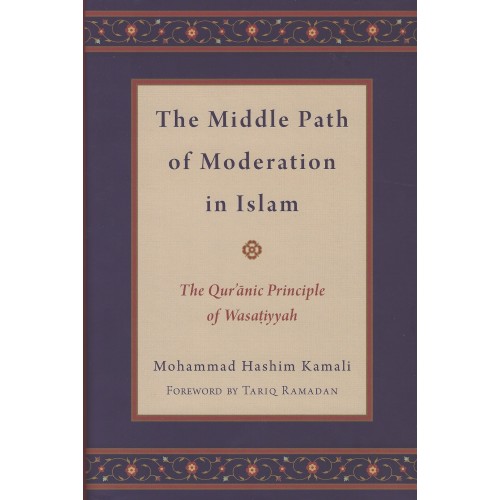
The Middle Path of Moderration in Islam (H/B)
RM189.00
In The Middle Path of Moderation in Islam, leading Islamic law expert Mohammad Hashim Kamali examines the concept of wasatiyyah, or moderation, arguing that scholars, religious communities, and policy circles alike must have access to this governing principle that drives the silent majority of Muslims, rather than focusing on the extremist fringe. Kamari explores wasatiyyah in both historical/conceptual terms and in contemporary/practical terms. Tracing the definition and scope of the concept from the foundational sources of Islam, the Qu’ran and Hadith, he demonstrates that wasatiyyah has a long and well-developed history in Islamic law and applies the concept to contemporary issues of global policy, such as justice, women’s rights, environmental and financial balance, and globalization.
Framing his work as an open dialogue against a now-decades long formulation of the arguably destructive Huntingtonian “clash of civilizations” thesis as well as the public rhetoric of fear of Muslim extremism since the attacks of September 11, 2001, Kamali connects historical conceptions of wasatiyyah to the themes of state and international law, governance, and cultural maladies in the Muslim world and beyond. Both a descriptive and prescriptive meditation on a key but often neglected principle of Islam, The Middle Path of Moderation in Islam provides insight into an idea that is in the strategic interest of the West both to show and practice for themselves and to recognize in Muslim countries.
Be the first to review “The Middle Path of Moderration in Islam (H/B)” Cancel reply
You must be logged in to post a review.
Related Products
Smoking Intoxicants & Narcotics (P/B)
This book deals with the epidemic of smoking, which enslaves many of today’s Muslims, and which is aggravated by that most victims belittle its dangers and deny its prohibition.
This book includes a discussions of intoxicants, establishing the prohibition of various practices associated with them, as well as penalties (in both lives) for those who partake in them.
This book also includes a discussion of narcotics, with an overview of marijuana and qaat (or khat). Based on their established effects and harms, we conclude that narcotics are strongly prohibited, except in very limited medical settings.
This book, we hope, will provide many Muslims with guidance toward a healthier, cleaner and worthies Islamic personality. My Allah grant us guidance and facilitation.
Fiqh According To The Quran & Sunnah (2 vol)
The complete set, ‘Al-Lubab Fee Fiqh As-Sunnah Wal-Kitab,’ contains all of the books of Islamic Fiqh and its chapters, accompanied by evidence and is presented in a clear and simple manner, in order that they may be understood by the young and the old, without blindly following any of the schools of Jurisprudence, but rather being subject to authentic proofs and following the most authoritative opinions, without fanatical adherence to any particular group. Rather the author agrees with each group when the truth is with them and contradicts them when they veer from that which is correct.
Fiqh is to achieve access to knowledge of that which is unclear through knowledge of that which is proven, so it is more specific than mere knowledge or learning. And fiqh is knowledge of the juristic law. It is said Faquha -A man has acquired understanding and so he has become a Faqeeh (A scholar of Islamic Jurisprudence); and it is said Faqiha – He has understood it, i.e he has attained understanding of it, and it is said Tafaqqaha – he has devoted himself to the acquisition of (Islamic) Knowledge and specialized in it. Fiqh has been a subject of contention among the scholars as well as layman throughout the history of Islam.
The Right to Education, Work and Welfare in Islam (P/B)
In The Right to Education, Work and Welfare in Islam Professor M.H. Kamali develops an Islamic perspective on three connected and complementary areas of rights and liberties. He urges that education is often a necessary ingredient of professional work even more so now than in earlier times when the range and variety of specialised knowledge were relatively limited. A person who acquires education, whether generally or at advanced levels of specialisation, is more likely to stand in a better position to enter the workforce and thus to contribute to the welfare of the community.
The author commences his discussions on education, work and welfare in Islam by focusing on how each is treated in the Qur’an; and follows this by the example of the Prophet and, after him, the Pious Caliphs who gave prominence to the education and welfare needs of people at times both of scarcity and affluence. Professor Kamali then moves forward to our time and discusses the right to education, the education of children, institutionalisation of learning, academic freedom and the debate between science and religion.
The section on work elaborates on the value of work, work ethics, workers’ and employers’ rights and responsibilities, and the role and responsibility of governments.
Finally, the section on welfare focuses on the importance in Islam of caring for those who are in need and the different forms of provision that can be made available by individuals, the state and charities.
Funeral Rites In Islam (H/B)
The purpose of this book is to provide English speaking Muslims a concise and authentic compilation of the instructions regarding funeral rites in Islam.
The Concise Presentation of the Fiqh of the Sunnah and the Noble Book
Written by Dr. Abdul-Azeem Badawi and translated by Jamal al-Din M. Zarabozo, The Concise Presentation of the Fiqh of the Sunnah and the Noble Book covers the fiqh of diverse topics like purity, prayer, fasting, zakah, pilgrimage, marriage, business transactions, foods, inheritance, criminal offenses, and jihad. Dr. Badawi relies only on the Quran and the Sunnah, making it an authentic Islamic book on fiqh and a collection of sound hadiths.
Getting the Best Out of Hajj
The book provides a realistic view of Hajj as it is today, with detailed explanations of all the rites. It provides Figh related issues about Hajj, Salah and personal behaviour according to the Quran and Sunnah, to enable you to obtain the best value for your time spent in the holy cities. It also provides information and suggestions about planning for the journey, what to expect and how to survive, so you can depart with full confidence. This is a must have for all those planning to go on Hajj!
Islamic Rules of Order (P/B)
Organizations must have rules of order to facilitate their debate and to fill in the procedures not detailed by their constitutional documents. While most American organizations are content to operate by Robert’s Rules of Order, Muslim organizations have often wrestled with questions over whether the rules of order systemized by a Western military figure are in accord with the Qur’an and the Sunnah.
This book tackles the matter directly and takes into account the Qur’an, the sunnah, Islamic manners and the history of Islamic consultation and leadership to provide a simple, practical guide to organizational procedure that can be incorporated into the governance of Muslim organizations. The book includes advice on writing bylaws and on complying with the best practices of the U.S. Dept. of Justice in a way that is Islamically authentic, transparent, and accountable. It provides a basic starting point for any Muslim organization while allowing for flexibility so that organizations may make any variations they require within their own bylaws and constitution, so that it can accommodate differing schools of thought on Islamic law. In its discursive approach it is an essential primer for understanding the value of rules of order and the Islamic context for their application. The Islamic Rules of Order has been adopted as the rules of order of the Association of Muslims Social Scientists.
Zakah According to the Quran & Sunnah (Darussalam)
Zakah, the third Pillar of Islam, is probably the first Pillar of its economic system. It represents the first and most important mechanism to implement economic justice and to provide sustenance to the economically unfortunate, two issues for which Islam is especially sensitive. These two issues are the essence of this book. This book consists of all the main issues of Zakat (i-e, Zakah on Gold, Silver, Paper Money, Livestock, Fruits, Grains, Rented Land, Buried treasures, Minerals, Trade, Shares, Stocks, and Exploited Assets etc). The main objective of this work is to serve an easy and authentic reference to the reader.
Having Fun The Halal Way Entertainment In Islam
With the advent of technology, the entertainment industry has flourished and become immensely popular. Combine this with the exponential advances in technology, and the result is an increasing number of ways to amuse ourselves. As a result of such advances, Muslim react in a variety of manners towards entertainment. Some label entertainment as completely forbidden. This sometimes includes parents who say no to almost everything that their young ones deem to be ‘fun’, without providing them with suitable alternatives. Others, who do not want to take this extreme approach, fall into the trap of excessive use of – and even addiction to – various sources of entertainment, without any limits.
In Having Fun the Halal Way, Ismail Kamdar explores the teachings of Islam regarding entertainment. Drawing upon the Quran, the Sunnah and the understanding of the righteous scholars of Islam, he provides a detailed and balanced analysis of the topic. He not only explains the detriments of the current entertainment industry, but also suggests alternative means to have a good time with friends and family members.
Hajj & Umrah (Pocket Guide) – English Version
A useful pocket guide that includes the rites of Umrah,Hajj, and visiting Madinah.
Shatibi’s Philosophy of Islamic Law (P/B)
Abu Ishaq al-Shatibi, who died in 1888, had sought an answer to the challenge posed by modernisation and change to Islamic law, by introducing maslahah, which forms the basis of his philosophy of Islamic law. In a fascinating way, the author leads us step by step to what he considers the true import of Shatibi’s views concerning jurisprudence.
The Ultimate Guide to Umrah by Darussalam


There are no reviews yet.