| Weight | 1.55 kg |
|---|---|
| Dimensions | 24 × 17 × 6 cm |
| Product Type | Book |
| Author | |
| Publisher | Dar Makkah International |
| Pages | 1256 |
| ISBN | 9782987457572 |
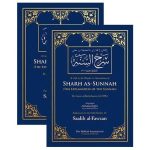
Sharh As-Sunnah : The Explanation of the Sunnah (2 Vol Set)
$45.45
About The Book This is the highly beneficial two volume work in explanation of the famous works by Imam al-Barbahari (d.329h) by the esteemed & noble Shaykh, Dr Saalih al- Fawzan. Its importance can be seen by virtue of its being compiled in the early times; as it is one of the books of the earliest Salaf – those who lived in the same period with the great Imams, acquired knowledge from them and reported their pure Aqidah(creed) About The Author Imaam Al-Barbahaaree, rahimahullaah was a formidable and imposing Imaam of the 4th centuty Hijri who spoke out with the truth and called to the Sunnah and to the following of narrations. He also had renown and the respect of the ruler. In his gatherings, various circles for the study of hadeeth, the narrations and Fiqh were held. These were attended by many of the scholars of hadeeth and fiqh. The scholar, Abu ‘Abdillaah said: “If you see a person of Baghdaad loving Abul-Hasan Ibn Bashshaar and Abu Muhammad Al-Barbahaaree, then know that he is a person of the Sunnah.” The Imam Died in 329 Hijri
Be the first to review “Sharh As-Sunnah : The Explanation of the Sunnah (2 Vol Set)” Cancel reply
You must be logged in to post a review.
Related Products
The Creed Of The Four Imaams (H/B)
The book proves the important, yet overlooked point: that despite whatever differences the Imaams had in their fiqh, their creed (aqidah) was one and the same in almost all issues. Many narrations are brought from the past and present day scholars showing that the path to Allaah is one. Detailed biographies have been provided for each of the four Imaams from ancient authentic sources. Additionally many doubts cast over the creed and lives of the Imaams have been uncovered, and the Creed of the Ahlus-Sunnah wal-Jama’ah has been exonerated.
Time is Running Out (P/B)
Discusses the following topics:
- What is the Hour? When will it be? What are its signs?
- Meaning of al fitnah
- Near coming of the Hour
- Fitan affecting the Muslim Ummah
- Certain Fitan which have already passed
- Major signs before the day of judgment
- Appear of ad Dajjal
- Descent of Jesus, son of Mary
- Appearance of Gog and Magog
- Rising of the sun from the west
- Emergence of the beast from the Earth
- Ad Dukhan (The Smoke)
- The Pleasant Wind
- The Last major sign will be a fire
A Concise Presentation Of The Creed Of Ahlul Sunnah Wal Jama’ah
A Concise presentation of THE CREED OF AHLUS SUNNAH WAL-JAMA’AH: is an explanation on the beliefs of the Pious Predecessors of this Ummah. They include the companions, their followers and successors who have followed them in goodness and those who upheld the real and true Islam brought by the last Prophet Muhammad SAW.
Knowing The Last Day (P/B) (Eeman Made Easy Series)
This is a simplified series of books dealing with the fundamental Islaamic beliefs. The material is well-founded on authentic proofs from the Qur’aan and Sunnah. The books are written in easy language, making them accessible to individuals with limited vocabulary.
Each book is structured into chapters, sections, and subsection to organize learning and facilitate grasping the concepts by elementary-level readers. Furthermore, each chapter includes exercises to review and emphasize these concepts. All of this makes the Eemaan Made Easy series a valuable source of reliable study material for schools and individuals.
Islamic Beliefs
In this era of confusion, innovation, and division, it is essential for Muslims to monitor their beliefs and their approach to Islam, so that they may be certain that they are following the path of the Prophet (blessings and peace of Allah be upon him) and the early generation of pious Muslims (the salaf). Without careful attention, a Muslim may live his or her whole life following a deviant path filled with innovation, thinking that he or she is doing the right thing, only to find out – when it is too late – that this path only leads to hell. Islamic Beliefs: A Brief Introduction to the ‘Aqeedah of Ahl as-Sunnah wal-Jamâ‘ah is written in a straightforward style, distilling the knowledge of the scholars and making it accessible to the ordinary Muslim. It touches on the main points of ‘aqeedah (fundamental Islamic beliefs or creed) and explains the main features of the path of the Prophet (peace be upon him) and the early generation, with brief references to deviant groups in order to show the contrast between the path of the Prophet (peace be upon him) and the paths of the deviant groups, between light and darkness, guidance and misguidance. The straightforward approach of this book will allow the reader to follow its arguments and develop a clear picture of the proper approach to and interpretation of the Qur’an and the Sunnah. This is a book which should be on every Muslim’s bookshelf, so that they will have at their fingertips a concise and readily-accessible reference for the basic issues of their religion.
Explanation of Important Lessons (For Every Muslim) (H/B)
This book is a short work to explain what every Muslim needs to know about the religion of Islam. It covers many lessons under 18 chapters.
Indispensable Implication of Sunnah (P/B)
The author has discusses the topic of innovation in Islam. For example, he proves that celebrating the Prophet’s birthday is not right according to the Qur’an and Sunnah.
Paradise Its Blessings and How To Get There (P/B)
Paradise and its inhabitants as portrayed in the Qur’an and the Hadith, then discusses the various rewards and blessings that are promised to those who make it there. Finally, the author lists the many and myriad deeds that a Muslim can do that will help him or her to achieve the Garden of Eden.
The Beautiful Names and Attributes of Allah- Important Principles To Remember
The pristine beliefs of the early Muslims are preserved in this vitally important masterpiece written by one of the most outstanding scholars of our time, Shaykh Muhammad Ibn Saalih al Uthaymeen. This new revised edition by Dar-us-Salam has been printed in full color with hardback bounding for an excellent presentation.
Seven clear principles and their evidences from the Book and the Sunnah guide the reader through the confusion and false claims of the ignorant to the clarity of belief in Allah’s Names accomplished by the righteous early scholars of Islam. Principle 6 contains the shaikh’s compilation of the ninety-nine (99) names of Allah. The names have been compiled into 2 categories: first from the Book of Allah & second from the Sunnah of the Prophet (S). All the names have been printed in Arabic with transliteration and English translation. Each name is printed beautifully in a square box with 6 boxes on a page.
Seven more principles and their evidences follow, giving the reader firm understanding of the correct beliefs about Allah’s Attributes. Four more principles outline the correct approach in studying the related proofs and evidences.
All of this leads the reader into an enthralling series of refutations of the false notions of the Ash’aree sect, a text-by-text breakdown of how and why they went wrong in a careful and precise study of fifteen texts from the Book and the Sunnah. The beliefs of the Ash’aree sect are destroyed and the origins of their deviation are exposed for all to see.
‘A magnificent book a clarification of the creed of the righteous Salaf concerning the Names and Attributes great principles and collective benefits concerning the topic’ – Shaykh Ibn Baaz
Recently Viewed
The Purification of the Soul (P/B)
The Purification of the Soul Imam Ghazali, Imam Jawziya and Iman ibn Hanbali
The First Caliph of Islam: Abu Bakr As-Siddeeq (P/B)
Most people have a best friend who they favour amongst all of the people. The best friend of Prophet Muhammad was Abu Bakr As-Siddiq (R). He was the only person, other than the Prophet’s own wife, who accepted Islam immediately and believed in Muhammad (S) from the first movement that he announced his Prophethood. Abu Bakr (R) always remained at the Prophet’s side and he had no reservations about spending his wealth for the sake of Islam and the Muslims. The Prophet’s Companions all recognized his superiority, yet he always remained humble and sincere towards all. This is the story of Abu Bakr (R) and his rise to leadership of the Muslim Ummah.
Islamic Dynasties A Celebration of Islamic History and Culture
The Book of Islamic Dynasties presents in one concise volume an introduction to the many great Islamic dynasties that have arisen, shone and faded – like stars in the firmament – but have left the Muslim world all the richer. The subtitle, A Celebration of Islamic History and Culture, reflects the importance of the inspiring cultural legacies bequeathed to us by our Muslim ancestors and the enormous contributions made by Muslims to world civilization.
Filled with beautiful hand painted illustrations to bring the text to life. This book will be a pleasure to read for both adolescents and adults and will insha’Allah enable the reader to better comprehend the complexities of life in today’s Dar al-Islam.
Luqman Nagy was born and raised in Vancouver, Canada. He graduated from the University of British Columbia with graduate degrees in Library Science and Education and subsequently pursued Middle Eastern language studies at Ankara University (Turkish), Pahlavi [Shiraz] University (Persian), and Umm al-Qur’a University, Makkah (Arabic). Since 1970, he has traveled the length and breadth of Dar al-Islam several times always in search of traditional Islamic societies. He currently resides with his family in Dhahran, Saudi Arabia where he teaches at King Fahd University.
Principles of Islamic Jurisprudence (2nd Revised Edition)
This book offers a detailed presentation of the theory of Muslim law (usul al-figh). Often regarded as the most sophisticated of the traditional Islamic disciplines, Muslim jurisprudence is concerned with the way in which the rituals and laws of religion are derived from the Qur’an and the Sunna – the precedent of the Prophet. Revelation, which is given to man to restore unity and help him achieve a just and devout order in society as well as in the soul, must be interpreted so as to render it practicable in every culture, while not betraying its spirit and immutable provisions. To achieve this, additional sources of legal authority are recognized, including consensus (ijma), analogical deduction (qiyas), public interest (maslaha) and local customary precedent (urf). In employing these, the jurist guards the five principles which it is the purpose of Islamic law to uphold, namely, the right to life, sound mind, property, lineage and religion.
The Decisive Criterion Between The Friends of Allah & The Friends of Shaytan (P/B)
The Decisive Criterion between the Awliyaa of The Most Merciful and the Awliyaa of Shaytaan Indeed the enmity between man and Shaytaan is old, commencing from the time that Adam (alayhi as-salaam) was created � from the time he was ordered to prostrate to him. Shaytaan refused, become arrogant and hence disobeyed his Lord. His arrogance and pride let him to commit a whole host of sins, it made him expend every effort in misleading the children of Adam and made him beautify and embellish sins such that they accepted them and eagerly committed them. Books sent the Messenger and enjoined His servants to various injunctions and admonitions in order to secure them from the evil of Shaytaan.
In the light of His advice, profound injunctions and admonitions in order to secure them from the evil of Shaytaan. In the light of His advice, profound injunctions and sever warnings, mankind becomes separated into two groups: a group who were guided and a group who deserved to be misguided. The groups who were guided are the inhabitants of Paradise and the groups who were misguided are the denizens of the Fire. The inhabitants of Paradise are the Awliyaa of the Most Merciful and the denizens of the Fire are the Awliyaa of Shaytaan


There are no reviews yet.