


| Weight | 0.24 kg |
|---|---|
| Dimensions | 23 × 15 cm |
| Product Type | Book |
| Author | |
| Publisher | Amana Publications |
| ISBN | 9781590080290 |
Parenting Skills Based On The Qur’an And Sunnah
$16.14
Out of Stock

Highlights:
somdn_product_page
Compare
Motivational & Manners
Additional information
Reviews (0)
Be the first to review “Parenting Skills Based On The Qur’an And Sunnah” Cancel reply
You must be logged in to post a review.
Related Products


The Muslim Marriage Guide (P/B)
Highlights:
A much needed manual, this marvelous book that draws from Islamic sources to provide practical advice for a Muslim couple. Far from the sociological analysis or list of rules that fill other books about Islamic marriage, this book draws from the wisdom of the Sunnah to show how to love your partner in this life and prepare each other for the next. Written with plenty of real life experience (and even humor) from Muslims living in the West, the author balances the issues of male-female differences, respect for each others rights and needs and raising God-conscious children. A must read for anyone interested in marriage.
Modern life brings strains and pressures which can upset even the most compatible relationship. This means that nowadays, to protect the spirit of cooperation and happiness which is the sign of the true Islamic marriage, careful thought needs to be given to the mechanisms which help husband and wife to live together and respect each others rights.
This highly readable book takes the reader through the relevant passages in the Quran and Hadith (Islamic sources), and goes on to discuss the main social and economic problems that can afflict relationships, suggesting many practical ways in which these can be resolved.


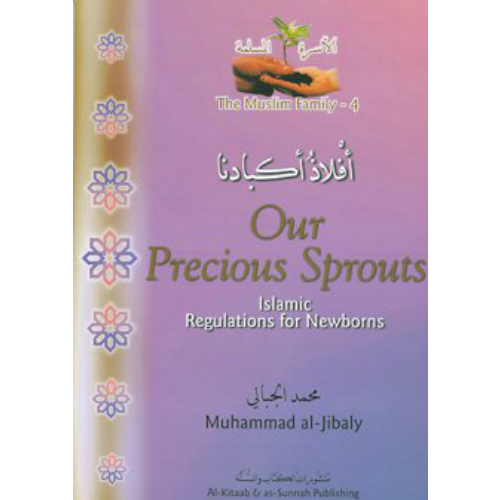
Our Precious Sprouts (H/B)
Highlights:
This sequel deals with the normal fruit of marriage: babies. It covers the Islamic regulations relating to a newborn. This includes welcoming the baby, naming it, shaving its hair, circumcising it, and slaughtering the sacrificial ‘aqiqah.

Winning the Heart of your Husband (P/B)
Highlights:
Table of Contents:
HOW TO WIN YOUR WIFE’S HEART ………………..5
INTRODUCTION …………………….5
HOW TO WIN YOUR WIFE’S HEART………………..6
TREATING WONAN WITH KINDNESS ………………..10
THE WIFE’S RIGHT ………………………………………12
RIGHTS COMMON TO HUSBAND AND WIFE …………15
THE CAUSES OF MARRIAGE PROBLEMS……………….16
THE EPIDEMIC OF SINS ……………………………………18
AN IMPORTANT FATWA …………………………………..20
THE EXUBERANT HUSBAND ………………………………22
IMPORATNT QUESTIONS …………………………………..23
A HUSBAND THREATENS WITH DIVORCE ………………27
A WIFE PLEADING WITH HER HUSBAND NOT TO TRAVEL………29
CONCLUSION………………………….32
A MESSAGE FROM THE PUBLISHER ……………..35
STORIES FROM THE PREDECESSORS ……………36
HOW THE COMPANIONS FEARED ALLAH………..50
EXHORTATION OF THE PREDECESSOR TO TAQWA………….58
THE QUALITIES OF THOSE WITH TAQWA………….61
ALI’S DESCRIPTION OF THOSE WITH TAQWA ……..61


Children’s Problems (Successful Family Upbringing Series-05)
Highlights:
The 10 most common challenges of children and how to resolve them.


Healing Hearts: Better Wedded
Highlights:
Healing Hearts: Better Wedded is an invaluable guide through the more complex issues that affect marriages written by a qualified and experienced Islamic relationship counsellor. Following the success of her first book, “Secrets of a Successful Marriage”, Afshan Khan brings us further into her journey to discover why many Muslim marriages are breaking down and how we can try to fix them insha’Allah. In this second book, we look into the past experiences of spouses and how these experiences affect marriages, to move forward with greater understanding; resolving conflict, healing hearts and insha’Allah, being better wedded. This highly topical book offers advice on how to deal with issues such as narcissism, depression, emotional distance in marriages, addictions and their causes, domestic violence, bullying and abuse amongst others. The author does not shy away from confronting these problems – problems that we as a Muslim community often ignore, deny or dismiss, but that we must discuss and deal with, treating those who suffer with compassion and understanding.


Child Upbringing (Successful Family Upbringing Series-02)
Highlights:
A presentation of ten important guiding principles in child upbringing and nurturing.


Answers to Frequently Asked Questions on Parenting (Part 1)
5 ★
5 ★
1 Rating
5 ★
1
4 ★
0
3 ★
0
2 ★
0
1 ★
0


A Guide to Parenting in Islam: Addressing Adolescence
4 ★
4 ★
1 Rating
5 ★
0
4 ★
1
3 ★
0
2 ★
0
1 ★
0
Highlights:
| Addressing Adolescence is a parent-to-parent handbook outlining how to tackle the challenges of parenting adolescents within an Islamic ethos in a pluralist society.
It covers: |


Nurturing Eeman In Children (H/B)
Highlights:
A plethora of parenting books on the market these days covers every aspect of dealing with your children. From the terrible twos to the troublesome teens, you will have no problem finding multitudes of books claiming to point you in the right direction when it comes to raising a child. Whether you’re aiming to raise a baby Einstein, or just looking for some hints on how to handle an unruly tyke or teen, you will no doubt find plenty of advice. Nurturing Eemân in Children, however, addresses an aspect of child-rearing that is vitally important and is not touched upon in the mainstream selections that we are so familiar with. In her book, Dr. Aisha (Hamdan) Utz clearly and in no uncertain terms explains the importance of instilling in our children a strong connection to their Creator and a love for the religion that He has chosen for us and for them. From this book, you will learn the what, the why, and the how of raising a righteous Muslim child.


The Fragile Vessels (P/B)
4.5 ★
4.5 ★
2 Ratings
5 ★
1
4 ★
1
3 ★
0
2 ★
0
1 ★
0
Highlights:
This is one of a 3-book series covering various aspects of marriage according to the authentic Sunnah. Marriage plays a most central role in the human life, and has been largely discussed by the scholars of Islaam through the ages, resulting in numerous writings and treatises. Some of those writings, mostly by contemporary scholars, have been translated into English. However, we find them restricted in scope, addressing Muslims who live in predominantly Islaamic countries, or overlooking important real issues that have developed under modern civilization. This leaves quite a large gap that needs to be filled for the benefit of the Muslims in English-speaking countries, and this is what we attempt to fulfill over the span of three books.”
Covers the obligations of the two spouses, the wife’s rights, and the husband’s rights. Contains biographies of the Mothers of the Believers, paints a very realistic picture from the life of the Prophet (pbuh) with his wives, and presents a complete discussion of the hadeeth of Ummar Zar’.


Recently Viewed

I Want to Repent, But…
Highlights:
One might say, “I want to repent, but who can guarantee that Allah will forgive me if I do so? I want to follow the Straight Path, but I feel very hesitant. If I know for sure that Allah would forgive me, I would definitely repent.” Shaykh Muhammad Sâlih al-Munajjid, may Allah reward him, gives a clear-cut response to such doubts and questions in this booklet. In order that the response reassures everybody concerned, it is based on the Noble Qur’an and the honourable Sunnah, quoting many verses and hadiths confirming that Allah’s mercy and forgiveness embrace all creation and are greater than any and all sins. The Shaykh then goes on to explain the preconditions and necessary steps for achieving true repentance, at which Allah is just waiting to forgive any of His penitent servants.

History of Islam: Ali ibn Abi Taalib (H/B)
Highlights:
This is the fourth volume from this series, which deals with the life of the last of the Four Rightly-Guided Caliphs, Ali ibn Abi ?alib . He was the first male to accept Islam at the young age of approximately nine years. He was the Prophet’s cousin, the son of Abu Talib, the Prophets supportive and loving uncle who protected him during the worst trials of his early Prophethood. Alis devotion to the Prophet is best evidenced during the Hijrah (migration) when he acted as the Prophet’s decoy in Makkah while the Prophet left under the cover of night and migrated to Madinah, accompanied by Abu Bakr. Darussalam presents the entire History of Islam to our youth in language that appeals to them, in a simple yet lucid manner. The first four volumes in this series explore Islamic history during the period of the first Four Rightly-Guided Caliphs. Later volumes would be devoted to the History of Islam, down through the ages to modern times, inshaAllah. volumes would be devoted to the History of Islam, down through the ages to modern times, inshaAllah.

The Higher Objectives of Humanity
Highlights:
A video summary of this book can be found here: https://www.youtube.com/watch?v=YdNQxv_ODdc&t=26s This book discusses the why, what and how of Rahmatan lil-Alamin as the higher objective of humanity. It presents a practical understanding of the purpose of creation and humanity to improve the individual and collective well-being of Muslims and society. The intention is to re-introduce and re-emphasize the correct Islamic perspective of humanity. The first five chapters revisits the common understanding among Muslims as to why mankind is created. We show that the prevalent view that we are created to worship Allah (SWT) is incomplete. There is a higher and more noble purpose; Rahmatan lil-Alamin (mercy to the worlds). We next describe the what of Rahmatan lil-Alamin. The best role model of Rahmatan lil-Alamin is undoubtedly Prophet Muhammad (SAW), the last and final prophet and messenger, whom Allah (SWT) sent with a very clear purpose, “And We have not sent you but as a mercy to the worlds.” [21:107]. We present many examples from the history of Prophet Muhammad (SAW) and a collection of his (SAW) sayings and advice on being the best. The final chapters of the book deal with the how of Rahmatan lil-Alamin. We describe in detail how the Muslim can apply Rahmatan lil-Alamin daily in his or her life. We propose a practical model of Rahmatan lil-Alamin that we induced from the Quran. We also addressed how to apply Rahmatan lil-Alamin to a broader society by proposing a decision-making tool that can guide us as persons and as communities to make decisions that conform to the foundations and priorities of Rahmatan lil-Alamin. We present case studies from the history of the Companions using this decision-making model. This book seeks to establish a connection between Islam and civilization within a civilizational and ethical framework. We believe that a more proper and complete understanding of the Islamic view about humanity may present to us new perspectives of Islam and how Muslims should engage with fellow Muslims and people of other faiths. In fact, the implication of this new reinterpretation framework goes even further in that: any human civilization built on this framework is the most prosperous for the whole and also for the individuals in it.
There are no reviews yet.