| Weight | 1 kg |
|---|---|
| Dimensions | 23 × 16 × 3 cm |
| Product Type | Book |
| Author | |
| Publisher | Ilmiah Publishers |
| Pages | 432 |
| ISBN | 9789832092001 |
Principles of Islamic Jurisprudence (2nd Revised Edition)
RM75.00
This book offers a detailed presentation of the theory of Muslim law (usul al-figh). Often regarded as the most sophisticated of the traditional Islamic disciplines, Muslim jurisprudence is concerned with the way in which the rituals and laws of religion are derived from the Qur’an and the Sunna – the precedent of the Prophet. Revelation, which is given to man to restore unity and help him achieve a just and devout order in society as well as in the soul, must be interpreted so as to render it practicable in every culture, while not betraying its spirit and immutable provisions. To achieve this, additional sources of legal authority are recognized, including consensus (ijma), analogical deduction (qiyas), public interest (maslaha) and local customary precedent (urf). In employing these, the jurist guards the five principles which it is the purpose of Islamic law to uphold, namely, the right to life, sound mind, property, lineage and religion.
Be the first to review “Principles of Islamic Jurisprudence (2nd Revised Edition)” Cancel reply
You must be logged in to post a review.
Related Products
Preservation of Health in Islamic Law (P/B)
Preservation of health (hifz al-sihhah) is the most important branch of Islamic medicine since it is primarily concerned with the prevention of illness rather than cure. This book represents one of the few attempts to introduce the role of Islamic medicine, although Chapter One provides information about a historical background of the preservation of helath in Islam, its aim is to provide fresh ant timely overview of the major aspects of legal, ritual and spiritual structures of teh Islamic law (shariah). These include the laws related to Ibadah, Islamic family laws, foods and drinks as well as environmental laws, for maintaning and preserving human health. Findings indicated that prevention of any diseases from Islamic medical law presentive cannot attain any real success unless it emanates from an Islamic fundamental teaching, namely: the pillars of Islam. Iman and observance of the Islamic rituals such as Salah, zakah, Sawm and Hajj, have played an important role in shaping the attitude, behavior and model personality of the Muslim, in boosting the spiritual motivation or attitude change, and in disseminating the message of prevention. This indicates that bodily and spiritual health goes hand in hand and that pyscho-spritual balance and health is a primary consideration whereas physical health is a secondary one.
The Problems of the Illegitimate Child (P/B)
This book addresses the views of the Sunni scholars regarding the importance of genealogical relationship (nasab) in Islamic family law and examines the role of legitimacy on the basis of the legal maxim “al-walad li al-firash”, evidence (al-bayyinah), and doubtful intercourse (wat’ shubhah). It also elucidates the views of the Sunni schools of law on how to establish illegitimacy. For the Sunni jurists, there are several situations that determine the illegitimacy of the child. A child is considered illegitimate if its birth is the outcome of adultery (zina) or the result of legitimate union but accompanied with imprecation (li‘an). Other circumstances include the birth of the child taking place in less than six lunar months, the father of the child being categorized as one who is incapable of begetting, or the birth as a result of marital relationship considered unlawful because of consanguinity. The book also deals comprehensively with the moral, religious, legal and other aspects of the illegitimate child and the foundling in the works of the Sunni jurists. The status and rights of the illegitimate child and the foundling in the Islamic family law of Malaysia and Brunei are also discussed by referring to some provisions from Federal Territory Act 1984 (Act 303) and Brunei law.
Zakah According to the Quran & Sunnah (Darussalam)
Zakah, the third Pillar of Islam, is probably the first Pillar of its economic system. It represents the first and most important mechanism to implement economic justice and to provide sustenance to the economically unfortunate, two issues for which Islam is especially sensitive. These two issues are the essence of this book. This book consists of all the main issues of Zakat (i-e, Zakah on Gold, Silver, Paper Money, Livestock, Fruits, Grains, Rented Land, Buried treasures, Minerals, Trade, Shares, Stocks, and Exploited Assets etc). The main objective of this work is to serve an easy and authentic reference to the reader.
Worship In Islam: An In-depth Study of Ibadah, Salah and Sawm (P/B)
Worship in Islam is in-depth study of the nature and significance of Islamic spirituality by Abul A‘la Mawdudi (1903–79), one of the leading Muslim intellectuals of the twentieth century, with special reference to the concepts of God’s Oneness (tawhid), the finality of Prophethood (risalah) and the Islamic system of worship (‘ibadah) with a focus upon prayer (salah) and fasting (sawm) and their role in the development of the Islamic personality and Islam’s social order. The distinguishing feature of Mawdudi’s approach is his elaboration of the social dimension of worship, which extends the traditional approach found in Islamic jurisprudence, with its focus upon ritual and self-purification, to consider worship’s transformative role in social life. Presenting a holistic view of the Islamic system, Mawdudi highlights Islam’s social, economic and political dimensions, which he argues has the capacity to resolve emergent issues and problems that humankind faces.
This historic text should be of wider interest to both students and specialists in contemporary Islamic thought, and includes an introduction by Professor Anis Ahmad.
Edited and translated into accessible English by Ahmad Imam Shafaq Hashemi, this book is an authoritative compilation by a leading Islamic twentieth-century revivalist on the central matter of worship’s role in Islam.
The Concise Presentation of the Fiqh of the Sunnah and the Noble Book
Written by Dr. Abdul-Azeem Badawi and translated by Jamal al-Din M. Zarabozo, The Concise Presentation of the Fiqh of the Sunnah and the Noble Book covers the fiqh of diverse topics like purity, prayer, fasting, zakah, pilgrimage, marriage, business transactions, foods, inheritance, criminal offenses, and jihad. Dr. Badawi relies only on the Quran and the Sunnah, making it an authentic Islamic book on fiqh and a collection of sound hadiths.
Remembrance & Prayer: The way of Prophet Muhammad s.a.w
Remembrance and Prayer: The Way of Prophet Muhammad, was one of the first works of Shaykh al Ghazali’s to be translated into English. The book describes in vivid prose how the Prophet, upon him be peace, used to remember Allah and pray to Him. Not only are the exquisitely beautiful, deeply moving and penetrating words of the Prophet given in the English translation, but in the original Arabic as well, thus allowing those desirous of memorizing Arabic access to the original texts. The intimate relationship with Allah, which was the hallmark of the Prophet’s life, becomes clear and vivid. The book’s contents are immensely relevant. to the life and concerns of modern man, whose life has been made barren by the present secularist machinery.
Funerals Regulations and Exhortations (H/B)
Our soul inevitably follows a route starting from birth, passing through death, and ending with our resurrection in the next life. The inevitable journey discusses over a sequence of titles: sickness, inheritance, funerals, Life in Barzakh and so on…
Getting the Best Out of Hajj
The book provides a realistic view of Hajj as it is today, with detailed explanations of all the rites. It provides Figh related issues about Hajj, Salah and personal behaviour according to the Quran and Sunnah, to enable you to obtain the best value for your time spent in the holy cities. It also provides information and suggestions about planning for the journey, what to expect and how to survive, so you can depart with full confidence. This is a must have for all those planning to go on Hajj!
Islamic Rules of Order (P/B)
Organizations must have rules of order to facilitate their debate and to fill in the procedures not detailed by their constitutional documents. While most American organizations are content to operate by Robert’s Rules of Order, Muslim organizations have often wrestled with questions over whether the rules of order systemized by a Western military figure are in accord with the Qur’an and the Sunnah.
This book tackles the matter directly and takes into account the Qur’an, the sunnah, Islamic manners and the history of Islamic consultation and leadership to provide a simple, practical guide to organizational procedure that can be incorporated into the governance of Muslim organizations. The book includes advice on writing bylaws and on complying with the best practices of the U.S. Dept. of Justice in a way that is Islamically authentic, transparent, and accountable. It provides a basic starting point for any Muslim organization while allowing for flexibility so that organizations may make any variations they require within their own bylaws and constitution, so that it can accommodate differing schools of thought on Islamic law. In its discursive approach it is an essential primer for understanding the value of rules of order and the Islamic context for their application. The Islamic Rules of Order has been adopted as the rules of order of the Association of Muslims Social Scientists.
Ibn Ashur Treatise on Maqasid al-Shariah (P/B)
Ibn Khaldun, the fourteenth century Arab historiographer and historian, is viewed as a founder of modern historiography, sociology and economics. He lived during a turbulent part of history, and out of his experiences, he ?conceived and created a philosophy of history that was undoubtedly the greatest work ever created by a man of intelligence…?. This work tells of the period of unrest in Ibn Khaldun?s life marked by political rivalries. It is during this turbulent period which provided him with the opportunity to write the Muqaddimah (or Prolegomena), earning him an immortal place among historians, sociologists and philosophe
A Guide to Male-Female Interaction
Are Muslim men allowed to interact with female students, and vice versa, in a virtual classroom? Can a Muslim woman pursue a professional career that necessitates her interaction with men? Is it appropriate for a woman to serve her husband’s guests? Do mixed wedding ceremonies comply with the Sharia? Read this bilingual book to find the answers and more!
The Ruling concerning the Celebration of Mawlid an-Nabi
In this book, is an explicit CLARIFICATION of the MAJOR DOUBTS raised by the proponents of Mawlid an-Nabi, including;
- Mawlid an-Nabi is honoring the Prophet.
- Mawlid an-Nabi is celebrated by a large number of people in many towns and cities
- Commemorating Mawlid an-Nabi renews the memories of the Prophet
- Celebration of Mawlid an-Nabi is out of love for the Prophet and and an expression of one’s love, which is permissible.
- awlid an-Nabi is a Bidah Husna (good innovation) because it is a means of showing gratitude towards Allah for sending the Prophet.
- The saying of Umar, ‘What a good Bidah is this?’
Additional quotes by Shaikh Muhammad ibn Ibraheem Aal-Shaikh have been added to further clarify these issues.
The booklet also has 2 valuable appendixes:
Appendix 1: Explanation of the Hadeeth, “He, who establishes/initiates a Sunnah Husna in Islam, ” in the words of Shaikh Sales al-Fawzan and Shaikh Muhammad ibn al-Uthaimeen (rahimahullah)
Appendix 2: A Dialogue between Shaikh al-Albaani (rahimahullah) and a proponent of Mawlid.
Recently Viewed
How to Make It in Today’s World (H/B)
Muslims today, especially – but not exclusively – those living in the West, are faced with a variety of problems. There are the internal struggles of living an Islamic lifestyle in a world dominated by Western culture, the conflicts between parents and children, the challenge of being single in a society where one is surrounded by temptations, the frustration caused by parents who refuse to allow their children to get married, the strains on marriages, the repercussions of terrorist actions perpetrated by Muslims, the effects of racism, the confusion among the various ideologies of Muslims today, and various other trials confronting our communities. We need a book for English readers that tackles these issues, explaining the reasons for these problems and providing specific recommendations for handling them, based on the Qur’an and the authentic Sunnah of the Prophet Muhammad (blessings and peace be upon him). How to Make It in Today’s World is such a book.
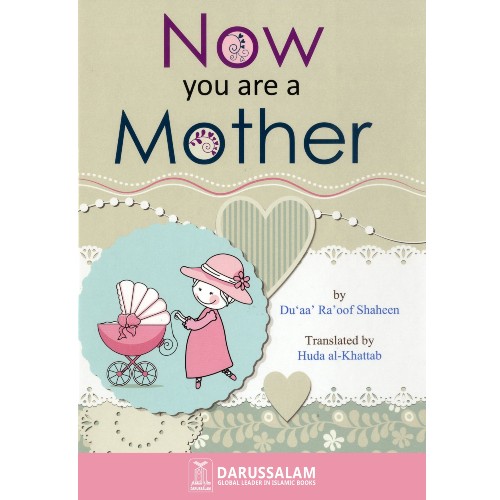
Now You Are A Mother (H/B)
This book has given an overview of the mother’s role and touched on the basics of raising babies and small children. Whilst motherhood is one of the most rewarding of roles, it is also a very complex role that brings many trials and challenges that cannot be covered fully in a single volume.
It is a very good preparation guide for expectant/expecting mothers who are pregnant/in pregnancy as it will teach many useful practical tidbits on how to prepare and what to expect. It is also a very good parenting guide book for concerned fathers/husbands who will also have take care of their children.
It is hoped that having read this book, readers will go beyond its parameters to learn all they can about how to care for their infants. In the teachings of Islam, the voices of experience provided by our own mothers and grandmothers, and the exchange of ideas and tips with other parents, new mothers can find guidelines to follow as they embark upon the journey of motherhood. The help and advice of doctors, public health nurses and other professionals may also be added to the mother’s “support system.”
Over and above all that, the Muslim mother can and must put her trust in Allah and seek His help and guidance.
Paradise Its Blessings and How To Get There (P/B)
Paradise and its inhabitants as portrayed in the Qur’an and the Hadith, then discusses the various rewards and blessings that are promised to those who make it there. Finally, the author lists the many and myriad deeds that a Muslim can do that will help him or her to achieve the Garden of Eden.


There are no reviews yet.