| Weight | 0.1 kg |
|---|---|
| Product Type | Book |
| Author | |
| Publisher | DCP |
| Pages | 60 |
| ISBN | 9789675699436 |
The Ruling concerning the Celebration of Mawlid an-Nabi
RM9.00 RM11.00
In this book, is an explicit CLARIFICATION of the MAJOR DOUBTS raised by the proponents of Mawlid an-Nabi, including;
- Mawlid an-Nabi is honoring the Prophet.
- Mawlid an-Nabi is celebrated by a large number of people in many towns and cities
- Commemorating Mawlid an-Nabi renews the memories of the Prophet
- Celebration of Mawlid an-Nabi is out of love for the Prophet and and an expression of one’s love, which is permissible.
- awlid an-Nabi is a Bidah Husna (good innovation) because it is a means of showing gratitude towards Allah for sending the Prophet.
- The saying of Umar, ‘What a good Bidah is this?’
Additional quotes by Shaikh Muhammad ibn Ibraheem Aal-Shaikh have been added to further clarify these issues.
The booklet also has 2 valuable appendixes:
Appendix 1: Explanation of the Hadeeth, “He, who establishes/initiates a Sunnah Husna in Islam, ” in the words of Shaikh Sales al-Fawzan and Shaikh Muhammad ibn al-Uthaimeen (rahimahullah)
Appendix 2: A Dialogue between Shaikh al-Albaani (rahimahullah) and a proponent of Mawlid.
Be the first to review “The Ruling concerning the Celebration of Mawlid an-Nabi” Cancel reply
You must be logged in to post a review.
Related Products
Should A Muslim Follow A Particular Madhhab?
In this book, the author has widely described the main principle of Taqleed. He says that Allah and Prophet Mohammed (SAW) has not ordered us to follow any opinions and interpretations. So there’s a possibility of being correct or incorrect in the opinions because there are many issues on which the Imams had different views and they explain them according to their own reasons and speculations, but the real and true Islam is based on the book (Quran) and Prophet’s Sunnah.
Allah says: “But no, by your Lord, they can have no Faith until they make you judge in all disputed matters between them, and find in themselves no resistance against your decision, and accept them with full submission.” And the prophet said: “I leave you with two things as long as you hold them tightly, you never go astray: they are the book of Allah and my Sunnah.” In this sense, the author has described the difference between different Madhahib (madhabs/mazhabs), and their views and urged to follow only the Quran and Sunnah.
Principles of Islamic Jurisprudence (2nd Revised Edition)
This book offers a detailed presentation of the theory of Muslim law (usul al-figh). Often regarded as the most sophisticated of the traditional Islamic disciplines, Muslim jurisprudence is concerned with the way in which the rituals and laws of religion are derived from the Qur’an and the Sunna – the precedent of the Prophet. Revelation, which is given to man to restore unity and help him achieve a just and devout order in society as well as in the soul, must be interpreted so as to render it practicable in every culture, while not betraying its spirit and immutable provisions. To achieve this, additional sources of legal authority are recognized, including consensus (ijma), analogical deduction (qiyas), public interest (maslaha) and local customary precedent (urf). In employing these, the jurist guards the five principles which it is the purpose of Islamic law to uphold, namely, the right to life, sound mind, property, lineage and religion.
War and Peace in Islam : The Uses and Abuses of Jihad (P/B)
Written by a number of Islamic religious authorities and Muslim scholars, this work presents the views and teachings of mainstream Sunni and Shi’i Islam on the subject of jihad. It authoritatively presents jihad as it is understood by the majority of the world’s 1.7 billion Muslims in the world today, and supports this understanding with extensive detail and scholarship. No word in English evokes more fear and misunderstanding than “jihad.” To date the books that have appeared on the subject in English by Western scholars have been either openly partisan and polemical or subtly traumatized by so many acts and images of terrorism in the name of jihad and by the historical memory of nearly 1,400 years of confrontation between Islam and Christianity. Though jihad is the central concern of War and Peace in Islam: The Uses and Abuses of Jihad, the range of the essays is not confined exclusively to the study of jihad. The work is divided into three parts: War and Its Practice, Peace and Its Practice, and Beyond Peace: The Practice of Forbearance, Mercy, Compassion and Love. The book aims to reveal the real meaning of jihad and to rectify many of the misunderstandings that surround both it and Islam’s relation with the “Other.”
Reviews:
“A dynamic myth-busting clarification of the real position of mainstream orthodox Islam on the whole question of violence and jihad.” —T. J. Winter, University of Cambridge
“This is the best book on the subject in English. It will be of inestimable value.” —Shaykh Mustafa Ceric, Grand Mufti Emeritus of Bosnia
Al-Jumu’ah: The Day of Congregation
In our busy lives, Friday comes around once a week. It often comes and goes without our being really aware of it. For many Muslim men, it may be punctuated by the congregational prayer that they make special efforts to attend. For many Muslim women, it may go by just like any other day. This ought not to be the case. In this unique book, Dr. Gowher Yusuf gives us reason to stop and think about how special Friday (al-Jumu‘ah) really is, and what we should be doing to achieve the many bounteous blessings it holds for those who observe it. Drawing constantly from the Qur`an and the Sunnah and the great works of the scholars of Islam, Dr. Gowher Yusuf explores this topic in depth and presents it to the reader in simple language for them to understand and ponder over. This book travels through the various issues pertaining to the Friday prayer and its Khutbah, or sermon. These issues are explained within the Islamic framework, thus abolishing any myths and misunderstandings and clarifying the topic for the reader. Dr. Yusuf writes: The day of the week known as al-Jumu‘ah, or simply Jumu‘ah, is Friday, and it is special. Compared to the other days of the week, Friday has been accorded the largest amount of merit, so much so that the father of all humankind, Prophet Âdam (peace be upon him), was created on this day and a particular prayer was ordered for this day. It was from the guidance given to Prophet Muhammad (blessings and peace of Allah be upon him) to magnify this day, honour it, and designate it for acts of worship. …On a Friday, we all will be gathered and will stand congregated in front of Allah, the Exalted, on the Day of Resurrection, also called the Day of Accountability or the Day of Judgement.
Remembrance & Prayer: The way of Prophet Muhammad s.a.w
Remembrance and Prayer: The Way of Prophet Muhammad, was one of the first works of Shaykh al Ghazali’s to be translated into English. The book describes in vivid prose how the Prophet, upon him be peace, used to remember Allah and pray to Him. Not only are the exquisitely beautiful, deeply moving and penetrating words of the Prophet given in the English translation, but in the original Arabic as well, thus allowing those desirous of memorizing Arabic access to the original texts. The intimate relationship with Allah, which was the hallmark of the Prophet’s life, becomes clear and vivid. The book’s contents are immensely relevant. to the life and concerns of modern man, whose life has been made barren by the present secularist machinery.
Preservation of Health in Islamic Law (P/B)
Preservation of health (hifz al-sihhah) is the most important branch of Islamic medicine since it is primarily concerned with the prevention of illness rather than cure. This book represents one of the few attempts to introduce the role of Islamic medicine, although Chapter One provides information about a historical background of the preservation of helath in Islam, its aim is to provide fresh ant timely overview of the major aspects of legal, ritual and spiritual structures of teh Islamic law (shariah). These include the laws related to Ibadah, Islamic family laws, foods and drinks as well as environmental laws, for maintaning and preserving human health. Findings indicated that prevention of any diseases from Islamic medical law presentive cannot attain any real success unless it emanates from an Islamic fundamental teaching, namely: the pillars of Islam. Iman and observance of the Islamic rituals such as Salah, zakah, Sawm and Hajj, have played an important role in shaping the attitude, behavior and model personality of the Muslim, in boosting the spiritual motivation or attitude change, and in disseminating the message of prevention. This indicates that bodily and spiritual health goes hand in hand and that pyscho-spritual balance and health is a primary consideration whereas physical health is a secondary one.
Islamic Fatawa Regarding Women (H/B)
Women face a lot of special problems regarding their menses, postpartum bleeding, istihada, hijab, mixing with men, rights & duties with respect to their husband, husband’s household, children, inheritance, marriage, divorce, etc
More than 350 of such problems & issues have been answered in this book by Grand Mufti of Saudi Arabia Sheikh Ibn Baz, and the eminent scholars like Sheikh Ibn Uthaimin, Sheikh Ibn Jibreen and others.
.
Funerals Regulations and Exhortations (H/B)
Our soul inevitably follows a route starting from birth, passing through death, and ending with our resurrection in the next life. The inevitable journey discusses over a sequence of titles: sickness, inheritance, funerals, Life in Barzakh and so on…
Shatibi’s Philosophy of Islamic Law (P/B)
Abu Ishaq al-Shatibi, who died in 1888, had sought an answer to the challenge posed by modernisation and change to Islamic law, by introducing maslahah, which forms the basis of his philosophy of Islamic law. In a fascinating way, the author leads us step by step to what he considers the true import of Shatibi’s views concerning jurisprudence.
Hajj & Umrah (Pocket Guide) – English Version
A useful pocket guide that includes the rites of Umrah,Hajj, and visiting Madinah.
The Ultimate Guide to Umrah by Darussalam
Islamic Rulings on Menstruation and Postpartum Condition
The birth of human being is a most amazing phenomenon. The physical cycles that the body of woman must endure in order to maintain this act of creation should be respected to the highest degree. Allah mentions that our mothers have born us with difficulty and struggle and because of this are due the highest respect. one among many of the difficulties that women must brave, are the doubts that these conditions present to the correct obervance of her religion. How is her fassting affected, how are her prayers affected, how is her ability to pursue her studies, and how are her conjugal relations affected by her ever changing physical condition in relation to her as the sole vessel of the birth of man. A really valuable publication by Darussalam for all Muslim woman to study
Recently Viewed
The Ruling concerning the Celebration of Mawlid an-Nabi
In this book, is an explicit CLARIFICATION of the MAJOR DOUBTS raised by the proponents of Mawlid an-Nabi, including;
- Mawlid an-Nabi is honoring the Prophet.
- Mawlid an-Nabi is celebrated by a large number of people in many towns and cities
- Commemorating Mawlid an-Nabi renews the memories of the Prophet
- Celebration of Mawlid an-Nabi is out of love for the Prophet and and an expression of one’s love, which is permissible.
- awlid an-Nabi is a Bidah Husna (good innovation) because it is a means of showing gratitude towards Allah for sending the Prophet.
- The saying of Umar, ‘What a good Bidah is this?’
Additional quotes by Shaikh Muhammad ibn Ibraheem Aal-Shaikh have been added to further clarify these issues.
The booklet also has 2 valuable appendixes:
Appendix 1: Explanation of the Hadeeth, “He, who establishes/initiates a Sunnah Husna in Islam, ” in the words of Shaikh Sales al-Fawzan and Shaikh Muhammad ibn al-Uthaimeen (rahimahullah)
Appendix 2: A Dialogue between Shaikh al-Albaani (rahimahullah) and a proponent of Mawlid.
BBC Speak and Learn Arabic : Phrasebook and Dictionary (P/B)
Compact and easy to use, this handy guide includes travel and language tips plus a two-way mini-dictionary, so you’ll never be stuck for the right word. It is arranged by topic in clear, colour-coded sections, and offers phrases for every eventuality. Its simple-to-read format allows you to build your own sentences and develop your language skills. Also featuring a comprehensive menu-reader and pronunciation guide, it is the ideal companion to any trip.
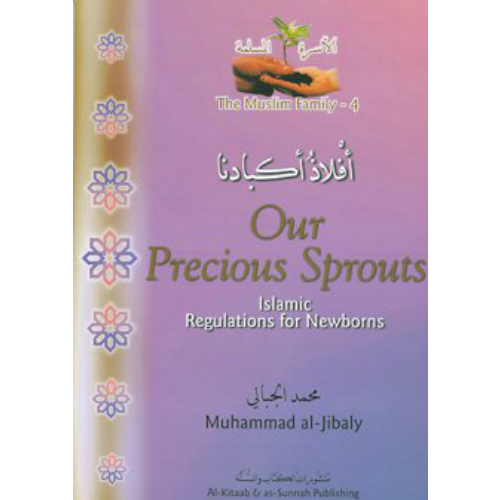
Our Precious Sprouts (H/B)
This sequel deals with the normal fruit of marriage: babies. It covers the Islamic regulations relating to a newborn. This includes welcoming the baby, naming it, shaving its hair, circumcising it, and slaughtering the sacrificial ‘aqiqah.


There are no reviews yet.