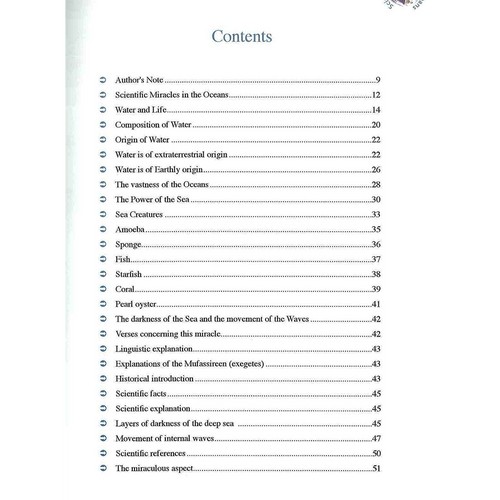
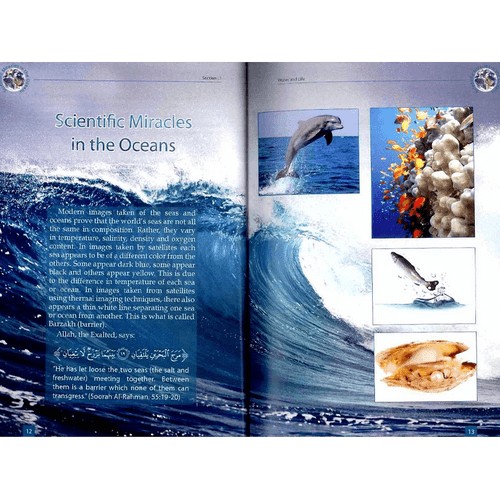



Water is the substance of life the magic elixir without which life on this planet would be impossible. The Quran not only mentions that the creation of all living things began from water, it also talks about various phenomena related to water like the sending of rainfall the layers of darkness and internal waves in the oceans the different colours of the seas , could and the barrier between fresh water and salt-water. Professor Schroeder one of the greatest oceanographers in west Germany used to say, “When science progresses, Religion must inevitably retreat”.
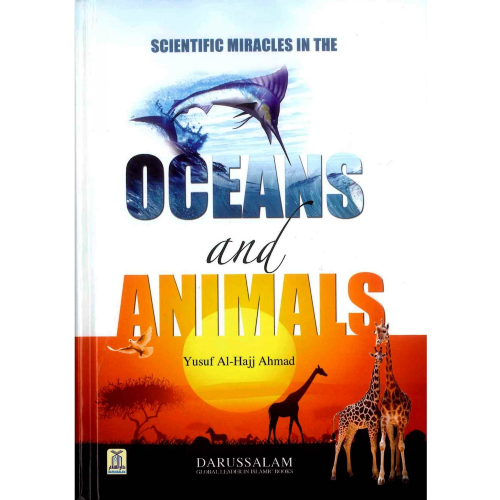
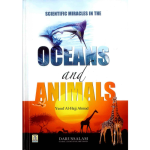
Scientific Miracles In The Oceans And Animals (H/B)
$17.50
| Weight | .800 kg |
|---|---|
| Dimensions | 24.5 × 17 × 1.4 cm |
| Author | |
| Binding | Hardbound |
| ISBN | 9786035000413 |
| Pages | 256 |
| Publisher | Darussalam |
Be the first to review “Scientific Miracles In The Oceans And Animals (H/B)” Cancel reply
You must be logged in to post a review.
Related Products
The Modernist Menace To Islam
Contemplation: An Islamic Psychospiritual Study (IIIT) (Book in Brief Series)
IIIT Books-In-Brief Series is a valuable collection of the Institute’s key
publications written in condensed form to give readers a core under-standing of the main contents of the original.
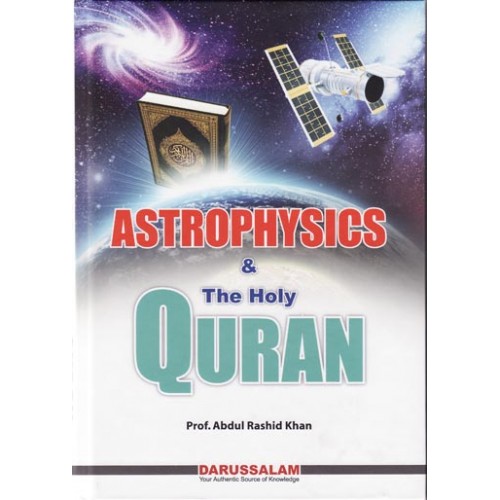
Astrophysics & The Holy Quran (H/B)
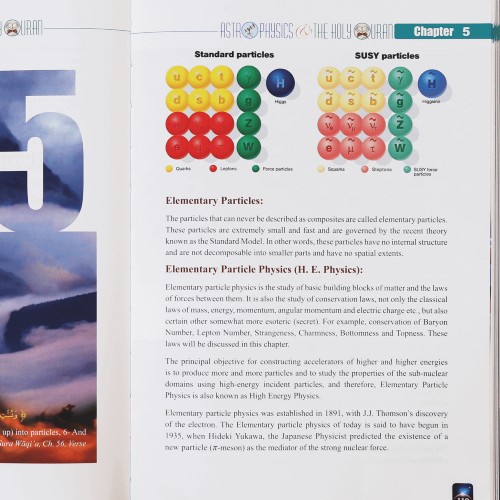
We are living now-a-days in the age of science. The intelligent human beings want to know where did they come from? Where did the universe come from? Will the universe come to an end, if so, how? Is the universe static or dynamic, if dynamic, is it expanding or contracting? What is time? When was it started? Will it come to an end? What are Black Holes? What are the forces of Nature? What is the smallest piece of matter? What is the status of man in the universe? Are there ultimate limits for human beings to know about something?
The majority of people especially in the third world are unable to answer these questions. When they are asked such questions, most of them answer with a shrug or with a vague and ambiguous knowledge. On the basis of Holy Qur’an as well as scientific knowledge, I have tried my level best to answer these questions in this book “Astrophysics and the Holy Quran”.
The Sevens
A concise guide for lecturers and trainers. It includes 70 Sevens which are among the strongest assistant to you in life. They are the extract of the experiments and experiences of successful scholars, within intensified points and concentrated pivots
Islamic Verdicts on Medicine & Cosmetic Surgery
We had the honor of our eyes being gifted with seeing his eminence Imam Abdul Aziz Bin Baz may Allah bestow upon him immense mercy and of sitting with him when he delivered verdicts regarding rulings of the Shariah on many medical issues which have been increasingly asked about by patients and people working in the medical field. We focused ourselves, with success granted by Allah, on the authenticity of medical information to the best of our ability. We have applied our best efforts in its presentation while simplifying it as much as possible. This is so that it is easily understood by those who are not specialists in medical fields.
Mind, Brain, & Free Will (P/B)
Mind, Brain, and Free Will presents a powerful new case for substance dualism (the idea that humans consist of two parts–body and soul) and for libertarian free will (that humans have some freedom to choose between alternatives, independently of the causes which influence them). Richard
Scientific Wonders on the Earth and in Space (H/B)
Every Prophet had a miracle which he showed to his people and challenged them with. Some of the Prophets even had more than one sign as a definite proof that. they were sent by Allah; challenging their nations to bring anything similar to it if they denied it. Every sign given to any of the Prophets was exclusively meant for his people and when he died, his signs ceased to exist.
However, one such miraculous sign shall remain, complete and preserved with the command of Allah, until the Day of Resurrection. This miracle is the inimitable Qur’an, the everlasting Book of Allah given to Prophet Muhammad (peace and blessings be upon him). Anyone who lives after the death of this Prophet of Mercy will be able to see it, read it, and realize for themselves the truth that it contains.
Who was the teacher who taught Prophet Muhammad the scientific facts described by the Qur’an? Did he possess tools of scientific research that enabled him to discover all that? Did he have airplanes and rockets that enabled him to discover what was beyond the sky?
The answer is that He possessed such knowledge that could never be affected by falsehood because it is the word of God. All that he informed us – of the past and present signs in the Universe and within ourselves – has been discovered by science as proven fact, and no doubt, the future signs will be discovered, just as he predicted.
Recently Viewed
Slippery Stone : An Inquiry into Islam’s Stance on Music
What does Islam say about poetry, singing, musical instruments, musicians, and the business of music? How have Muslim societies historically looked at these questions and how have their attitudes changed in the media age? Why have mosques remained music-free while churches have not? What is the truth about the much-publicized €œmusic controversy€ in Islam? Why did Sufis call sama as the slippery stone? These are some of the questions explored in-depth in Slippery Stone: An Inquiry into Islam’s Stance on Music.
Of late, increasing attempts are being made to promote €œIslamic music,€ and the distinction between what is allowed and what is not has become hazy and unclear for many. This book demystifies the issue of music in Islam by going to original source books in Arabic, many of them brought to light for the first time in the English language. It traces the attitudes of the Muslim society about music and the musician throughout its history and quotes extensively from the deliberations of the Qur’an and Hadith scholars and jurists from all schools of Islamic Law, both Sunni and Shi’ah. Separate chapters are devoted to a discussion of the views of Sufi masters as well as the arguments of Ibn Hazm.
It examines in considerable depth the impact of colonialism and the media revolution (beginning with the gramophone) on the attitudes of Muslim societies regarding music. It also subjects the works of Orientalists to a scrutiny that was overdue.
By referring to it as a slippery stone, Sufis vividly pointed out the dangers associated with this enterprise and emphasized the need for caution. History is filled with the corpses of those who fell off the slippery stone by ignoring this advice. Combining historic, cultural, and jurisprudential perspectives this book brings the truth of that metaphor into sharp relief.
More than six hundred references and more than a hundred twenty biographical notes on the authorities quoted add to the value of a discussion that is comprehensive without being boring, and detailed without being confusing. This book has left no stone unturned in its examination of the slippery stone.


There are no reviews yet.