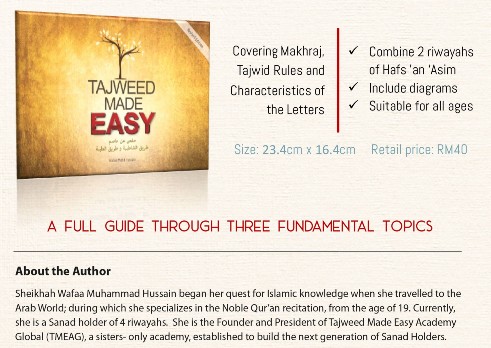
| Weight | 0.28 kg |
|---|---|
| Product Type | Book |
| Author | |
| Publisher | TIMEAG |
| Pages | 50 |
Be the first to review “Tajweed Made Easy (English)” Cancel reply
You must be logged in to post a review.
Related Products
The Iqra’ Series Rules Guide
- This guide is a must for anyone studying or teaching from the IQRA’ Series! Aimed at children and adults to be used by schools, mosques and learning centres.
- This guide contains all the Tajwīd rules needed throughout the IQRA’ series. It introduces each rule based on the same structure and patterns of the IQRA’ Series.
- This guide has been designed to make it as easy as possible to achieve a beautiful and elegant recitation, whilst also having a firm grasp of all the required theory.
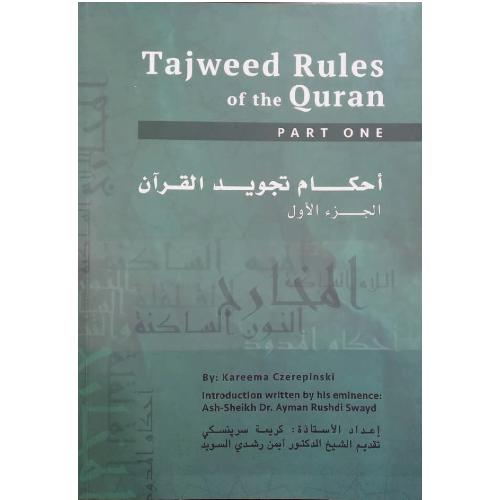
Tajweed Rules of the Quran (Part One)
This is a guide for studying tajweed. The student who uses this book is expected to have a basic grasp of Arabic before starting this course. The student should know all the Arabic letters and vowels and be able to read at an elementary level.
This book is either for an English-speaking student studying the Qur’an in an Arabic environment, but needing explanation of the Arabic terms in English, or a student studying the explanations of tajweed in English, but learning the basic concepts in Arabic so they may integrate into the Arabic terms and definitions throughout the book, since the science of tajweed is an Arabic science. This book explains the articulation points of the Arabic letters, the rules of noon saakinah, meem saakinah, and lam saakinah. It explains all of the different lengths (mudood), and how voweled, and non-voweled letters are formed. The qalaqah mechanism is explained in the last chapter. Terms are introduced in Arabic, and the translated into English. Explanations are done in English, but with integration of Arabic terms, as they are learned.
A student of the Qur’an cannot expert to learn tajweed simply by studying this book. The learning of proper Qur’anic recitation can only be done by listening to a qualified Qur’an teacher recite, then reciting to them and receiving corrections from the teacher.
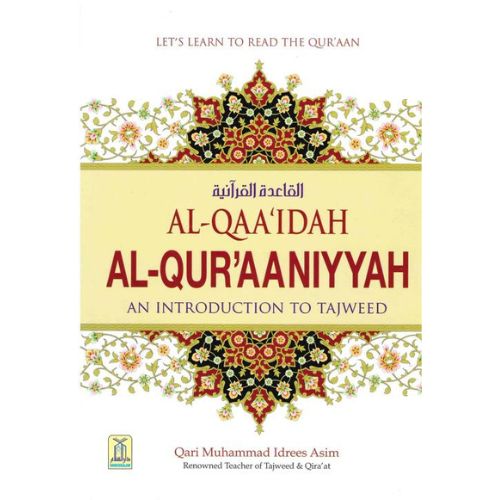
Al-Qaa’idah Al-Qur’aaniyah (An Introduction to Tajweed)
Learning to read the Qur’an properly is one of the many obligatory duties of a Muslim. Recitation gets better and more beautiful as one continues to read the Qur’an, meticulously following the rules and techniques Qur’anic recitation (tajweed).
If you want to learn the art of Qur’anic recitation in the most beautiful and sublime manner, then this is the book for you. Al-Qaaidah Al Quraaniyyah is a good book to learn tajweed easily with lessons, extensive notes, and exercises for the English-speaking students.
Juz Amma (Learning Roots)
How to Get Your Child’s Quran Relationship off to Flying Start. Does your child struggle to progress in their Quran reading? Are they bored in their lessons? Are they taking forever to memorise even the simplest Surahs? Are you worried your child is not building a loving relationship with the book of Allah?
Noted: Price without Kiitab Pen.
Learn to Read the Holy Qur’an in 7 Days (Alpha Mahmoud Bah)
If you are a university student, a businessperson, a homemaker, or any busy adult desiring to learn to read the Holy Qur’an, then this guidebook is exactly what you need. With it, you can study alone or with help of an aid.
Tajweed Made Easy Mind Maps
This mind map provides an overview of the different tajwid topics with the aim to:
- Encourage readers to see the bigger picture of the important areas of tajwid by making use of key words.
- Help readers to understand the inter-relationships between the various subject matters in a topic.
- Provide an attractive, fun and enjoyable format of learning tajwid, which could be remembered easily.
- Summarise information relating to tajwid knowledge efficiently.
Recently Viewed
Abu Bakr Siddiq: The First Caliph of Islam
This book is about the life and teachings of Abu Bakr Siddiq (may Allah be pleased with Him)-The First Caliph of Islam.
Answers to Frequently Asked Questions on Parenting (Part 3)
This book is the third in a series that contains detailed answers to Frequently Asked Questions (FAQs) on the hot topic of parenting in North America. Because some of these questions have been raised more than once in recent years, we feel that they represent crucial issues of concern occupying the minds of many parents. Making these answers available in a written format would hopefully provide Muslim parents with the proper advice supported by the Qur’an as well as the teachings of the prophet Muhammad SAW.
The methodology used in answering these questions draws heavily on verses of the Qur’an, teachings of the prophet Muhammad SAW, and events in his Seerah, as well as the authors’ wealth of practical experience, gained from their countless parenting counseling sessions over the years, and their knowledge of child psychology.
Al-‘Ubudiyyah: Being a True Slave of Allah
Shaykh Ibn Taymiyyah defines the concept of worship in Islam and explains that to be a true “slave of Allah” is a status of both virtue and nobility. The title “slave of Allaah” is one of great honor which Allah bestowed upon the best of creation, Muhammad (SAW). Ibn Taymiyyah highlights the prevalent traps which people fall into, when becoming enslaved by, or allowing their hearts to become attached to worldly objects. The emphasis is on servitude to Allah which is adorned with the true love we hold for Him in our hearts — a matter of central importance for every Muslim.
Highly Recommended for the young blooded who Want to Run before they can Walk and even the Old timers ‘Who sometimes are so comfortable Walking that they have forgotten that there is sometimes a need to run’ in the Path Towards Allah.


There are no reviews yet.