| Weight | 0.145 kg |
|---|---|
| Dimensions | 23 × 15 × 0.07 cm |
| Author | |
| ISBN | 9781565646650 |
| Pages | 94 |
| Product Type | Book |
| Publisher |
The Miraculous Language of the Qur’an (IIIT)
$10.91
This study illustrates why the language of the Qur’an is miraculous, unique, and evidence of divine authority. The author compares the language of the Qur’an with the language of pre-Islamic poetry, the Prophet’s words (hadith), and the language of the Arabs both past and present, to demonstrate that although the Qur’an was revealed in Arabic it was at the same time an Arabic which was entirely new. Original and early Muslim audiences viewed this as miraculous and responded to the Qur’an’s words, sounds, rhythms, etc. in a manner consistent with a deeper appreciation of its beauty and majesty which modern ears, trained by familiarity, and despite being surrounded by all manner of dictionaries and studies, are at a loss to capture. The author attempts to remove this veil and present the Qur’an to readers as if hearing it for the first time, to bring to life some of this wonder. In doing so he guides readers to appreciate the beauty of the Qur’an, to become more immersed in it, and to have a clearer understanding of its structure and flow. Devoting special attention to Surah Al Muddaththir, to underpin his analysis, Saeh thus brings the Revelation to life, to demonstrate that each surah has distinct features and characteristics that make it stand out uniquely within the design and sweep of the whole.
Be the first to review “The Miraculous Language of the Qur’an (IIIT)” Cancel reply
You must be logged in to post a review.
Related Products
The Spiritual Cure An Explanation to Surah al-Fatihah (P/B)
Surah al Fatiha is the greatest chapter of the Qur’an, its like is not found in the rest of the Book or in the previous scriptures. It is a
Light that was granted to Prophet Muhammad (S) which had not been granted to any other Prophet or Messenger before him; indeed
some of the Salaf stated that when this chapter was revealed, Shaytãn l let out a great cry of lament.
It holds a central position in the daily Prayer hence the daily life of the Muslim.
The underlying theme, of al-Fatiha is one of contemplation and serenity; pondering the Names and Attributes of Allah, pondering the creation , and acknowledging that He Alone deserves praise and Worship, that He Alone should be asked for help, that He Alone Should be feared and hoped in, that He Alone should be invoked, that there is indeed a Day of Judgment, and that guidance has come to us and we are required to follow it.
It calls us to carefully scrutinise our relationship with our Lord: are we living according to the dictates of ‘none has the right to be worshipped save of Allah’ or not? This opening chapter, despite its brevity, calls man to fulfil the rights of Tawhid, the right that Allah has over us to worship Him Alone without any partner
A Summary of numerous Classical Commentaries of the Qur’an
at-Tabari, al-Baghawi, Az-Zamakhshari, ibn Atityyah, Ibn Jawzi, Al-Qurtubi, Ibn Qayyim, Ibn Kathir, as-Suyuti, Alusi, ash-Shawkani, as-Sa’di, ash-Shaqiti and many Others
Four Key Concept of the Qur’an
Four Key concepts oF the Qur’An elucidates these basic Qur’anic concepts Ilah, Rabb, Ibadah and Din in order to bring out fully the Islamic way of life, as distinct from other perspectives. This elaboration goes a long way in developing a sound understanding of the Qur’an. It also explains the man-God relationship in Islam, guiding Muslims on how to lead their lives in total surrender to Allah.
The Noble Quran (Tall Version English Text Only) (RANDOM COLOR)
Interpretion of the meanings of The Noble Quran in the English Language.
What is the Holy Quran & How to Recite it? (H/B)
This book guides readers to pronunciate the Arabic alphabet from their correct point of articulations. It also guides them to recite the Holy Qur’an according to the laws and principles of the art of recitation and intonation.
The correct pronunciation of the Arabic words and alphabet was difficult to some extent for the people living in the West as compared to those of East. So they need some more efforts to solve this problem and to make it easy for them.
By the grace of Allah, this book will do the job successfully and in a very convenient way.
The Sources of the Qur’an
“Who is the author of the Qur’an?” On this subject scholars have flagrantly contradicted each other. This work attempts to make a critical review of the major ‘authorship’ theories by pressing into service logical arguments, historical evidence, textual analysis and scientific data. Probably, the only point of agreement about the Qur’an is that it was uttered for the first time by a man who was born in Makkah (Mecca), a city of Arabia, in the sixth century—a man by the name of Muhammad (blessings and peace be upon him). As to the source of the Qur’an, scholars are divided into three main groups: those who believe that Muhammad (blessings and peace be upon him) himself was the author; those who believe that he was not the author himself but learned it from another human author or authors; and those who believe that the Qur’an has no human author but is rather a word-for-word revelation from God. Hamza Njozi examines the three theories and comes to a firm and logical conclusion.
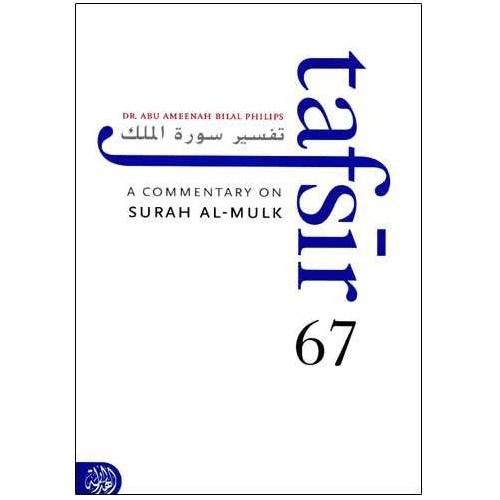
Tafsir 67 : A Commentary on Surah al Mulk (P/B)
The beauty of the Qur’an is such that its miracles cannot truly be understood until one contemplates every verse of every surah; this alone makes tafsir one of the most amazing sciences of Islam. Surah Al-Mulk is a chapter of the Quran which would be recited every night by the Prophet (peace be upon him), in its midst are deep meanings which highlight the purpose of our creation, as well as entailing the message of Islam. In this book, the author takes the reader on a wonderful journey through the gardens of the first surah in the 29th Juzz of the Qur’an.
About the Author: Dr. Philips was born in 1947 in Jamaica, but grew up in Canada, where he converted to Islam in 1972. He completed a diploma in Arabic language and a B.A. degree in 1979 from the College of Islamic Disciplines at the Islamic University of Madinah, an Islamic university in Saudi Arabia. At the University of Riyadh College of Education he completed his M.A. in Islamic Theology in 1985, and in 1994 he completed his Ph.D in Islamic Theology in the department of Islamic studies at the University of Wales. He later taught Islamic education and Arabic language in private schools in Riyadh for over ten years. Because of his opposition to Saudi Arabia’s position in the Gulf War, he had to leave the country and for three years he lectured M.Ed. students in the Islamic Studies department of Shariff Kabunsuan College (SKC) in Cotabato City, Mindanao, the Philippines. Islamic Information Center Since 1994, he has founded and directed the Islamic Information Center (which is now known as Discover Islam) in Dubai, United Arab Emirates, and is known as a prolific speaker and author on topics relating to Islam, including audio lectures and books. Presently, he is a lecturer of Arabic language and Islamic Studies at the American University in Dubai and ‘Ajman University in Ajman, United Arab Emirates. He frequently appears at the Islamic Research Foundation in Mumbai, India, on lecture tours. He has also founded the Distance Learning Program called Islamic Online University, which offers a four year degree in Islamic Studies plus a variety of short courses. Dr. Philips is something of a pioneer as a person of Western origin achieving the status of a scholar of Islam inside the tradition.
Divine Speech
The Quran, the sacred scripture of Islam, is revered as the spoken word of God by approximately one-fifth of the world’s population. Since its inception, the power of the Quran has derived not only from its message, but also from the inimitable literary style and rhetorical impact that the Arabic scripture has on its audiences. Divine Speech: Exploring the Quran as Literature attempts to make some of the most recent Arabic and European-language scholarship on its literary features accessible to a wider, English-speaking audience. These features include its language and word choice, its use of figures of speech and other rhetorical devices, its manner of narrating parables and stories, and the structure, coherence, and the order of its “chapters”-aspects that typically remain mysterious to readers of English translations of the text. Divine Speech furnishes its readers with a better appreciation of the Quran from a literary perspective, and in the process stimulates interest in, and provides tools and resources for, further study of the scripture.
Tafsir As-Sadi (Parts 28-29-30) Methodical Interpretation Of The Noble Quran (H/B)
Tafsir As-Sa’di is a straightforward, easy to read, easy to understand explanation of the meaning of Qur’anic Ayat and statements. In addition to the simplicity of Ibn Sa’di’s writing, it is also articulate and eloquent.
Consequently, for those newly acquainted with Tafsir and those new to Islam, this Tafsir provides an uncomplicated, deep and insightful comprehension into the meaning and explanation of the Qur’an.
The uniqueness of this Tafsir is in the style the Shaikh used to explain the Ayat in a way that it is similar to everyday writing, without listing the various prophetic sayings or statements of the scholars of Tafsir, which Shaikh Ibn Sa’di used as a basis of his Tafsir.
The Noble Qur’an pocket size H/B (Arabic/English)
The Noble Qur’an is a widely popular translation by Islamic University – Madina scholars Dr. Muhsin Khan and Dr. Taqi-ud-Din Hilali. It features frequent footnotes gleaned by the translators from Tafsir At-Tabari, Tafsir Ibn Kathir, and Sahih-al-Bukhari. Arabic-English format with detailed index.
Interpretation of the meanings of the Noble Qur’an with Arabic text in the modern English language. A summarized version of At-Tabari, Al-Qurtubi and Ibn Kathir with comments from Sahih Al-Bukhari.
This summarized 1 volume version offers brief commentary and Ahadith wherever necessary. This unique combination of commentary and relevant Ahadith makes this a very useful study reference tool. The Arabic text is taken from Mushaf al Madinah.
Atlas of the Qur’an (Darussalam)
This Atlas is new in its subject, a subject that has not been touched before. It helps whoever recites the Qur’an or studies it to specify the locations mentioned by the Noble Verses, and to mark those places of ancient people mentioned in the Qur’Gn. This is besides locating areas where the incidents of the prophetic Seerah occurred.
Eventually the diligent reader will easily recognize those places, learn about them, and take heed of them while reciting.
Eventually the diligent reader will easily recognize those places, learn about them, and take heed of them while reciting. The Atlas has also revealed obscure places we used to pass through inattentively, like the site where Nuh’s Ark settled, the site of the curved Sand-hills {Al Ahqah}, the cave of the young faithful men, the houses of median, the site of Sodom and other places determined by the Atlas depending on reliable sources.
Thus the Atlas eliminates all the guessing and the fantasies we used to encounter when reciting the Noble Quran, and takes us to the specific place.
Recently Viewed
The Miraculous Language of the Qur’an (IIIT)
This study illustrates why the language of the Qur’an is miraculous, unique, and evidence of divine authority. The author compares the language of the Qur’an with the language of pre-Islamic poetry, the Prophet’s words (hadith), and the language of the Arabs both past and present, to demonstrate that although the Qur’an was revealed in Arabic it was at the same time an Arabic which was entirely new. Original and early Muslim audiences viewed this as miraculous and responded to the Qur’an’s words, sounds, rhythms, etc. in a manner consistent with a deeper appreciation of its beauty and majesty which modern ears, trained by familiarity, and despite being surrounded by all manner of dictionaries and studies, are at a loss to capture. The author attempts to remove this veil and present the Qur’an to readers as if hearing it for the first time, to bring to life some of this wonder. In doing so he guides readers to appreciate the beauty of the Qur’an, to become more immersed in it, and to have a clearer understanding of its structure and flow. Devoting special attention to Surah Al Muddaththir, to underpin his analysis, Saeh thus brings the Revelation to life, to demonstrate that each surah has distinct features and characteristics that make it stand out uniquely within the design and sweep of the whole.
Golden Stories of Muslim Women (H/B)
All aspects of woman’s personality that reflect her intelligence, courage, piety, abstinence and chivalry are mentioned in this book. Their study inculcates a new spirit and motivation for betterment among all women and girls. It would also help men fully understand how women also possess qualities like bravery, intelligence and patience.
Kepribadian Wanita Muslimah (IIPH)
Kepribadian Wanita Muslimah: menurut al-qur’an danas-sunnah. Wanita mempunyai peran yang sangat penting dalam keluarga, masyarakat dan negara, baik buruknya suatu bangsa sangat erat kaitannya dengan baik buruknya wanita. Wanita muslimah berbeda dengan wanita-wanita lainnya, ia mempunyai kepribadian yang ideal dan karakter yang istimewa, karena islam telah memberikan petunjuk dan ajaran bagaiman semestinya wanita muslimah dalam kehidupan ini, ia harus bisa memainkan perannya agar ia menjadi orang yang berguna bagi dirinya, keluarga, masyarakat dan bangsanya. Dalam buku ini, penulis menjelaskan bagaimana seharusnya wanita muslimah terhadap tuhannya, terhadap dirinya, kedua orang tuanya, suaminya, anak-anaknya, saudaranya, teman-temannya, tetangganya, dan masyarakatnya, sebagaimana yang diajarkan dalam Al Qur’an dan Hadits-hadits nabi. Ini semua beliau kaji dengan luas dan mendalam, lalu dituangkan dalam bahasa yang mudah, lugas dan jelas. Oleh karena itu buku ini pantas dimiliki dan dibaca oleh setiap wanita muslimah yang ingin menjadi sosok wanita muslimah sejati.
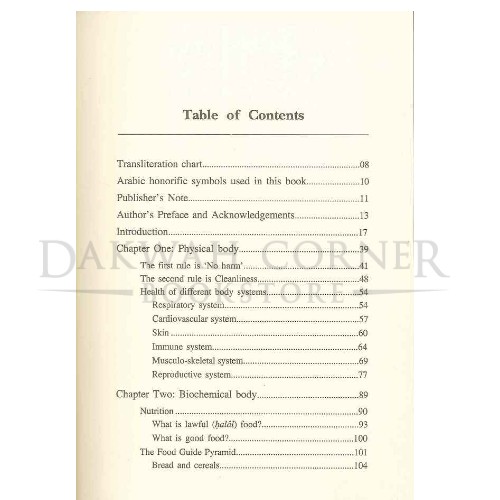
Healing Body and Soul : Your Guide to Holistic Wellbeing Following Islamic Teachings
Like other guides to good health, Healing Body & Soul advocates abandoning an unhealthy diet and altering a sedentary lifestyle, but this book goes beyond the mere physical aspects of health. Amira Ayad is a practitioner and researcher with a Master’s in Pharmaceutics and pursuing her Doctorate in Natural Health. She writes: During the course of this work, I try to explain how you can combine the rich tradition of Islamic teaching with beneficial contemporary scientific knowledge in order to lead a holistically healthy and happy life. The book is divided into five chapters, each concerning one of the five components that make up your body, mind and soul, clarifying in each chapter how to look after that part of you and keep it healthy. During the course of the book you will notice how these bodies are interconnected; the health of one is highly dependent on the wellbeing of the others, so that a happy, healthy life entails a balance between all of them. Healing Body & Soul presents holistic Islamic health science in a simple yet comprehensive user-friendly guide to better health. Healing Body& Soul is an invaluable reference that encourages and empowers people to take control of their health and their lives.


There are no reviews yet.