| Weight | 0.145 kg |
|---|---|
| Dimensions | 23 × 15 × 0.07 cm |
| Author | |
| ISBN | 9781565646650 |
| Pages | 94 |
| Product Type | Book |
| Publisher |
The Miraculous Language of the Qur’an (IIIT)
RM48.00
This study illustrates why the language of the Qur’an is miraculous, unique, and evidence of divine authority. The author compares the language of the Qur’an with the language of pre-Islamic poetry, the Prophet’s words (hadith), and the language of the Arabs both past and present, to demonstrate that although the Qur’an was revealed in Arabic it was at the same time an Arabic which was entirely new. Original and early Muslim audiences viewed this as miraculous and responded to the Qur’an’s words, sounds, rhythms, etc. in a manner consistent with a deeper appreciation of its beauty and majesty which modern ears, trained by familiarity, and despite being surrounded by all manner of dictionaries and studies, are at a loss to capture. The author attempts to remove this veil and present the Qur’an to readers as if hearing it for the first time, to bring to life some of this wonder. In doing so he guides readers to appreciate the beauty of the Qur’an, to become more immersed in it, and to have a clearer understanding of its structure and flow. Devoting special attention to Surah Al Muddaththir, to underpin his analysis, Saeh thus brings the Revelation to life, to demonstrate that each surah has distinct features and characteristics that make it stand out uniquely within the design and sweep of the whole.
Be the first to review “The Miraculous Language of the Qur’an (IIIT)” Cancel reply
You must be logged in to post a review.
Related Products
The Sources of the Qur’an
“Who is the author of the Qur’an?” On this subject scholars have flagrantly contradicted each other. This work attempts to make a critical review of the major ‘authorship’ theories by pressing into service logical arguments, historical evidence, textual analysis and scientific data. Probably, the only point of agreement about the Qur’an is that it was uttered for the first time by a man who was born in Makkah (Mecca), a city of Arabia, in the sixth century—a man by the name of Muhammad (blessings and peace be upon him). As to the source of the Qur’an, scholars are divided into three main groups: those who believe that Muhammad (blessings and peace be upon him) himself was the author; those who believe that he was not the author himself but learned it from another human author or authors; and those who believe that the Qur’an has no human author but is rather a word-for-word revelation from God. Hamza Njozi examines the three theories and comes to a firm and logical conclusion.
The Noble Quran Word-By-Word Translation & Color Coded Tajweed A4 (Arabic-English) – RANDOM COLOR
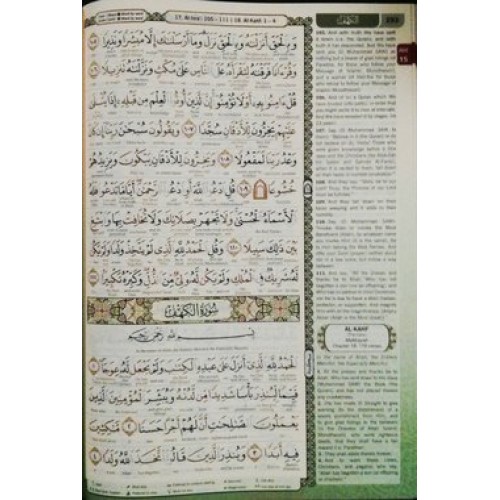
The Noble Quran (Al-Quran Al-Kareem Maqdis) is a translation learning method of word-by-word Al-Quran with every word and sentence is colored differently, in Arabic and English.
Every word in the Quran was translated literally so that the reader could understand the meaning of every single word. It needs to be remembered that not all literal translation represents the exact meaning of the word since the Quran uses varied Arabic language style and sometimes metaphor.
Accordingly, to understand the full or intended meaning of the word or the verse, Muhsin Khan’s the Holy Quran Translation had been included in this edition. However, to comprehend more of the meaning of the Quran, reading the commentary of the Quran from trusted scholars would be necessary.
Approved by the Department of Islamic Development of Malaysia (JAKIM) and Malaysian Ministry of Home Affairs (KDN).
Features:
● Rasm Uthmani script in English
● Word-by-word translation Arabic-English
● Color coded tajweed
● Asbab al-Nuzul
● Authentic Hadiths
● Riyad-us-Saliheen
● Al-Quran Language Dictionary (Mu’jam)
Size A4 Large
SPECIFIC COLOR PLEASE DM US.
Tafseer Soorah Al-Hujurat (H/B)
Tafseer Soorah al-Hujurât: A Commentary on the 49th Chapter of the Qur’an is a treasury of divine advice, commandments, and prohibitions regarding common problems in social relations, including gossip, spying, arguing, and bigotry. To make the best use of this chapter, the believer needs a detailed explanation of the meanings of the verses.
Dr. Bilal Philips has based his tafseer (exegesis) on the methodology used in the classical works of tafseer. He has relied first of all on the explanations found within the Qur’an itself, then on explanations found in the Sunnah and related incidents which occurred at the time of the revelation of the verses in question. Beyond these primary sources, Dr. Philips has relied on the interpretations made by the Prophet’s Companions (may Allah be pleased with them) who were noted for their ability to interpret and comment on the Qur’an. ‘Abdullâh ibn ‘Abbâs, for example, was called ‘The interpreter of the Qur’an’ by Prophet Muhammad (blessings and peace of Allah be upon him). Finally, the author has made use of the grammatical explanations given in the classical tafseer works. Wherever possible, Dr. Philips has tried to apply the derived meanings of the verses to the problems of contemporary society.
Study The Noble Qur’an Word for Word (3 volumes) – Colour
Available NOW only for online shopping.
Complete Qur’an in 3 volumes Colour Version (10 Parts per book). Individual volumes are available from the related items section. The first coloured Word-for-Word English translation to understand the meanings of the Arabic verses along with grammatical terms. Read more below…
An Introduction to The Sciences of The Qur’an (H/B) Al-Hidaayah UK
An introduction to the Sciences of the Qur’aan presents a detailed and thorough explanation of the sciences related to the history, understanding and implementation of the Qur’aan. The book provides the English reader with a detailed analysis of classic Muslim scholarship regarding: the process on Inspiration (Wahy); the various means of classifying verses of the Qur’aan; the history of the compilation of the Qur’aan; the meaning of the seven ahruf and the ten qira’aat of the Qur’aan; the miraculous nature of the Qur’aan; the concept of abrogation in the Qur’aan; the procedure and methodology of tafseer; and many other topics. The work has a number of sections dedicated to explaining the traditional Muslim refutations of certain belief of the Ash’arees with regards to the Qur’aan.
This book also includes detailed discussions on modern Western scholarship of the Qur’aan. After presenting a history of the English translation of the Qur’aan, along with a critical review of some translations, the author discusses and refutes common Orientalist polemic literature on the Qur’aan.
The work is unique in that it presents classical material in a simple and modern style, while maintaning a hight academic level. It is the most advanced work of its kind in the English language, and a necessary reference for all serious students of Islamic knowledge.
Quranic Wisdom
Daily Wisdom: Selections from the Holy Qur’an (H/B)
This beautiful presentation of a selection from the Holy Qur’an engages the reader in a moment of daily reflection. Edited for ease of comprehension, English-speaking readers will find this compilation both spiritually enriching and easy to understand. With 365 verses covering the whole year, this is a must for every home.
An introduction to the Qur’an and its eternal message for humanity is included, giving the reader an insight into its origin, purpose, and style.
Abdur Raheem Kidwai is professor of English at the Aligarh Muslim University in India and the well-known author of many works on the Qur’an and Islam.
114 Tips to Help You Finally Memorize The Qur’an (P/B)
“114 Tips to Help You Finally Memorize the Qur’an is a concise book that aims to equip readers of all backgrounds with the information and techniques necessary in order to begin, continue with, and complete the memorization of the Qur’an, eliminating thereby the common excuse and reasons for not memorizing.”
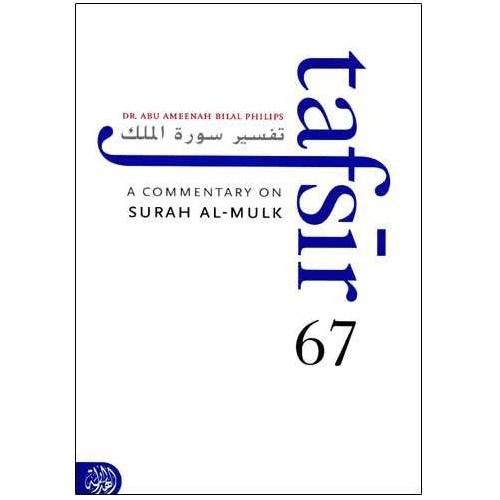
Tafsir 67 : A Commentary on Surah al Mulk (P/B)
The beauty of the Qur’an is such that its miracles cannot truly be understood until one contemplates every verse of every surah; this alone makes tafsir one of the most amazing sciences of Islam. Surah Al-Mulk is a chapter of the Quran which would be recited every night by the Prophet (peace be upon him), in its midst are deep meanings which highlight the purpose of our creation, as well as entailing the message of Islam. In this book, the author takes the reader on a wonderful journey through the gardens of the first surah in the 29th Juzz of the Qur’an.
About the Author: Dr. Philips was born in 1947 in Jamaica, but grew up in Canada, where he converted to Islam in 1972. He completed a diploma in Arabic language and a B.A. degree in 1979 from the College of Islamic Disciplines at the Islamic University of Madinah, an Islamic university in Saudi Arabia. At the University of Riyadh College of Education he completed his M.A. in Islamic Theology in 1985, and in 1994 he completed his Ph.D in Islamic Theology in the department of Islamic studies at the University of Wales. He later taught Islamic education and Arabic language in private schools in Riyadh for over ten years. Because of his opposition to Saudi Arabia’s position in the Gulf War, he had to leave the country and for three years he lectured M.Ed. students in the Islamic Studies department of Shariff Kabunsuan College (SKC) in Cotabato City, Mindanao, the Philippines. Islamic Information Center Since 1994, he has founded and directed the Islamic Information Center (which is now known as Discover Islam) in Dubai, United Arab Emirates, and is known as a prolific speaker and author on topics relating to Islam, including audio lectures and books. Presently, he is a lecturer of Arabic language and Islamic Studies at the American University in Dubai and ‘Ajman University in Ajman, United Arab Emirates. He frequently appears at the Islamic Research Foundation in Mumbai, India, on lecture tours. He has also founded the Distance Learning Program called Islamic Online University, which offers a four year degree in Islamic Studies plus a variety of short courses. Dr. Philips is something of a pioneer as a person of Western origin achieving the status of a scholar of Islam inside the tradition.
Four Key Concept of the Qur’an
Four Key concepts oF the Qur’An elucidates these basic Qur’anic concepts Ilah, Rabb, Ibadah and Din in order to bring out fully the Islamic way of life, as distinct from other perspectives. This elaboration goes a long way in developing a sound understanding of the Qur’an. It also explains the man-God relationship in Islam, guiding Muslims on how to lead their lives in total surrender to Allah.
Recently Viewed
( E-Book) A Child Reads (Successful Family Upbringing Series-06)
Let me say, with full conviction, that there is no chance for us, nor for any nation, to occupy a respectable place among the advanced nations without raising our cultural awareness – we are living in the age of knowledge, and we cannot do without information and books. Therefore, raising children who are really fond of reading is our first and foremost challenge – and it will take all our commitment to succeed there. Having this in mind I propose to tackle this issue in a book; and, as in the previous volumes in the series, I try to come upon solutions for the difficult dilemma – giving special attention to being true to the requirements of accuracy and reliability; maintaing, at the same time, an accessible and smooth reading. In which I hope to bring these concepts within the comprehension of a wide readership as possible.
The Miraculous Language of the Qur’an (IIIT)
This study illustrates why the language of the Qur’an is miraculous, unique, and evidence of divine authority. The author compares the language of the Qur’an with the language of pre-Islamic poetry, the Prophet’s words (hadith), and the language of the Arabs both past and present, to demonstrate that although the Qur’an was revealed in Arabic it was at the same time an Arabic which was entirely new. Original and early Muslim audiences viewed this as miraculous and responded to the Qur’an’s words, sounds, rhythms, etc. in a manner consistent with a deeper appreciation of its beauty and majesty which modern ears, trained by familiarity, and despite being surrounded by all manner of dictionaries and studies, are at a loss to capture. The author attempts to remove this veil and present the Qur’an to readers as if hearing it for the first time, to bring to life some of this wonder. In doing so he guides readers to appreciate the beauty of the Qur’an, to become more immersed in it, and to have a clearer understanding of its structure and flow. Devoting special attention to Surah Al Muddaththir, to underpin his analysis, Saeh thus brings the Revelation to life, to demonstrate that each surah has distinct features and characteristics that make it stand out uniquely within the design and sweep of the whole.
Kepribadian Wanita Muslimah (IIPH)
Kepribadian Wanita Muslimah: menurut al-qur’an danas-sunnah. Wanita mempunyai peran yang sangat penting dalam keluarga, masyarakat dan negara, baik buruknya suatu bangsa sangat erat kaitannya dengan baik buruknya wanita. Wanita muslimah berbeda dengan wanita-wanita lainnya, ia mempunyai kepribadian yang ideal dan karakter yang istimewa, karena islam telah memberikan petunjuk dan ajaran bagaiman semestinya wanita muslimah dalam kehidupan ini, ia harus bisa memainkan perannya agar ia menjadi orang yang berguna bagi dirinya, keluarga, masyarakat dan bangsanya. Dalam buku ini, penulis menjelaskan bagaimana seharusnya wanita muslimah terhadap tuhannya, terhadap dirinya, kedua orang tuanya, suaminya, anak-anaknya, saudaranya, teman-temannya, tetangganya, dan masyarakatnya, sebagaimana yang diajarkan dalam Al Qur’an dan Hadits-hadits nabi. Ini semua beliau kaji dengan luas dan mendalam, lalu dituangkan dalam bahasa yang mudah, lugas dan jelas. Oleh karena itu buku ini pantas dimiliki dan dibaca oleh setiap wanita muslimah yang ingin menjadi sosok wanita muslimah sejati.
( E-Book) Child Upbringing (Successful Family Upbringing Series-02)
It is noteworthy that there exist today, many educational books of good value as well as inferior ones; a fact that has caused many people to be confused in the choice of books to enrich their ability to train their children wisely and successfully.
One the other hand, the list of needs that are considered necessary for education has now expanded very greatly. And we know well that when things considered to be crucial needs have reached a hundred or two, one naturally feels a weakness to confront the challenge of providing them; which may even cause one to turn away partly or completely.
From this standpoint, my thoughts have been arrested by the need for me to discuss the master key in interacting with young people and training them, which is the mother. Perhaps by this, I will help my reader to possess and expand his latitude in understanding the psychology of child upbringing and methodology.


There are no reviews yet.