| Weight | 0.14 kg |
|---|---|
| Dimensions | 21 cm |
| Author | |
| ISBN | 9789960717173 |
| Pages | 102 |
| Product Type | Book |
| Publisher | Darussalam |
Understanding Ramadan
RM20.00
This book covers important aspects regarding Ramadan. The book is a collection of Ahadith from Sahih Al-Bukhari, with guided translations. The topics which are covered are Fasting, Salat at-Tarawih, Lailat Al-Qadr and Itikaf. Also, the section of two Eid Prayers and the chapter on Sadaqat Al-Fitr are included for the thematic purpose. This book is a must-read for all.
Be the first to review “Understanding Ramadan” Cancel reply
You must be logged in to post a review.
Related Products
An Nawawi’s 40 Hadith (Revise Edition)
Edition Revised and Improved
Imam Nawawi had a very short life of 44 years, but even during this short period, he wrote a large number of books on various subjects. Nearly every work is a masterpiece and a treasure of knowledge. Hundreds of thousands of people have benefited from these works. Among the prestigious works of Imam Nawawi is the compilation of the ” 40 Hadith ” which is what you have in your hands right now. These selected 40 Hadith comprises the essential fundamental concepts of Islam, which in turn construct the minimum level of required revealed knowledge for every single Muslims.
Daily Wisdom: Sayings of the Prophet Muhammad (H/B)
This beautiful presentation of the Prophet Muhammad’s (s) teachings engages the reader in a moment of daily reflection. With 365 traditions covering the whole year, this is a must for every home. Apart from setting out the Islamic worldview, as reflected in the Prophet’s sayings, it is hoped that this work will serve as a useful volume for reflection, for soul-searching and for self -development as a single hadith appears on each of its pages, it has been designed to engage readers in a few moments of daily self-reflection throughout the year.
Abdur Raheem Kidwai is Professor of English at the Aligarh Muslim University in India and the well-known author of many works on the Qur’an and Islam.
The Sunnah And Its Role In Islamic Legislation (H/B)
The Sunnah and its Role in Islamic Legislation is a groundbreaking effort by Dr. Mustafa as-Siba’ee, for it has a completeness to it in two regards: first, the author manages to cover all topics related to the Sunnah—its status, its legislative force, the stages that led to its recording, just to mention a few—in a comprehensive and organized manner. Second, he presents the views of those that have attacked the Sunnah throughout history, detailing their arguments and then refuting them. Among those groups from the past were the Shi’aa and the Mu’tazilah; today, they are mainly the Orientalists and those that are influenced by them.
Sheikh as-Siba’ee takes us through the historical development of the Sunnah, from the early stages of revelation to the recording of the Sunnah during the era of the great Imams of Hadith. Throughout that account, he highlights the contributions of the scholars in preserving the Sunnah and cleansing it from fabrications and lies. Shaykh as-Siba’ee gives a clear account of the revolutionary methods and scholarly principles that were established in order to authenticate historical reports and narrations. The author shows us that the fruits of that endeavour were the preservation of the authentic Sunnah and the birth of the Hadith sciences.
This book has been a perennial source of knowledge for Arabic-speaking students of Islam, for its clarity, readability, and insightful research. New English-speaking students too have available to them this authoritative treatise on the Sunnah of our beloved Prophet Muhammad) may the peace and blessings of ALLAH be upon him).
Fifty of the Counsels of the Prophet to the Women
Islam is very kind to women. The Prophet was very careful to respect their rights. Women \, in his times, possessed the religious knowledge, narrated ahadith. Nursed the sick and wounded on the battlefield and acquired knowledge. The home is the first madrasah of a child. This book shows women the path of Islam as shown by the prophet. The ahadith are explained on the pattern of great scholars like Ibn Hajar, Nawawi, Khattabi, Mubarakpuri, and others. A careful perusal will help the reader to understand the real message of Islam and to pattern her own life and her children’s on the right path.
Sunan An-Nasa’i (6 Vol) (H/B)
Sunan An-Nasai has the fewest weak ahadith after the two Sahih collections. This Sunan is one of the six is al-Mujtaba or as-Sunan as-Sughara, which is a synopsis of a large collection of ahadith which he considered to be fairly reliable. In the smaller collection, only those ahadith which he considered to be reliable have been included.
It was compiled by the great scholar of hadith, Abu Abdur-Rahman Ahmad bin Shu’aib bin Bahr An-Nasae (Nasa’ of Khurasan) (214-303AH). Imam An-Nesai, like other great scholars of hadith traveled to Baghdad, Ash-Sham, Egypt, Mecca, and many other cities to seek knowledge. He received the praises of many scholars including Ad-Daraqutni who said about him: “He is given preference over all others who are mentioned with this knowledge from the people of his time”. Some scholars consider his compilation to have the least number of defective or weak narrations among the four Sunan. This great book of his contains 5761 ahadith, making it as an invaluable addition to anyone’s library.
Hadith Course
Hadith Course is essential reading for all English speaking students of Hadith, presenting fifty hadiths in Arabic and English in an easy-to-understand manner. Vocabulary and an explanation of each hadith are given, along with the lessons learned from it. All of the hadiths have been carefully chosen for authenticity and cover a wide range of topics, including belief, jurisprudence, social matters, business and much more. This book is an invaluable handbook for schools and self-learners.
200 Golden Hadiths from the Messenger of Allah swt (P/B)
Islam is based on two major souces : the Quran and the Sunnah, and the latter is available to us in the form of hadiths. The Prophet said, “Whoever comes to know one hadith of mine should spread it.”
I have come to the realization that many youth from among the Muslims have not memorized even one hadith of the Prophet. For this reason I have chosen smaller hadiths so that they can be easily memorized by them and they can spread them to others.
I supplicate to Allah to make this book a source of light on the Day of Judgment for us.
Forty Hadith on Islam (P/B)
This work covers, the Islamic creed, Pillars of Islam, Lawful & Unlawful, Piety and Righteousness, with commentary of Imam al-Ajurri. Anumber of scholars throughout Muslim history have penned their respective compilation of Forty Hadith books. Imam al-Ajurri’s kitab ularba` in Hadithan is among the earliest. It is a highly regarded text for Muslims to study and memorise, for it addresses fundamental aspects of religion, with particular focus on Creed, Pillars of Islam, the Halal and Haram as well as Piety and righteousness.
Forty Hadiths On Good Moral Values (H/B)
The statements and actions of our Prophet Muhammad (s) contain much that we need: rules and advice, reminders, examples, warnings and encouragement. The collection of hadiths in Forty Hadiths on Good Moral
Values by Yahya Ondigo contains some of the Prophet?s statements on positive ethics and attributes that all people-Muslims and non-Muslims-should strive to adopt in the way we deal with others; we need to work to incorporate these morals and principles into our daily habits.
Scholars of Hadith (P/B)
This book presents an extensive, in-depth analysis of great Muhaddithun (scholars of the science of Hadith). Each chapter presents detailed biographies of Malik b. Anas, Ibn Hanbal, al-Bukhari, Muslim, al-Tirmidhi, Abu Dawud, an-Nasai, Ibn Majah, ad-Darimi and al-Bayhaqi along with the methods they used in Hadith collection and classification. This work is especially important in today’s world where many Muslims have a dire need to connect with the great corpus of work that was produced by the scholars or traditional Islam. A work such as Scholars of Hadith has been long overdue in the English language and it will certainly make for productive reading for all interested in deepening their knowledge of Islam.
Recently Viewed
Zainab: Daughter of the Prophet
“Zainab (ra), the eldest daughter of Prophet Muhammad saw and Khadija (ra) was born about five years after their marriage…”
The Third Caliph of Islam: Uthman bin Affan (P/B)
Uthman bin Affan (R) was one of the early men who accepted Islam in Makkah. From the first moment he became a Muslim, he put all his wealth under the service of Islam. He spent most of his resources to satisfy the needs of poor Muslims. Recognizing his generosity and devotion to Islam, the Prophet (S) told him that his place would be in Paradise on the Hereafter. He married Ruqayah (R),the Prophet’s daughter. After she died, he married her sister Um Kulthum ;for that, the people at that time called him Dhun Nurain, “The Man with the Two Lights.”
Commentary on Kitab At-Tawheed – 2 Volumes (H/B)
The title of the Arabic explanation by the shaykh is Al Qawl Al Mufeed Alaa Kitaab at-Tawheed.
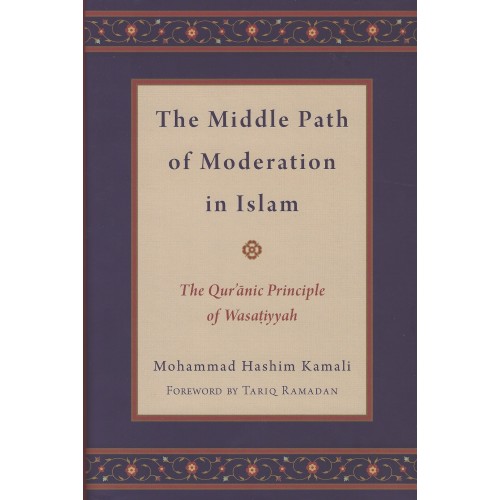
The Middle Path of Moderration in Islam (H/B)
In The Middle Path of Moderation in Islam, leading Islamic law expert Mohammad Hashim Kamali examines the concept of wasatiyyah, or moderation, arguing that scholars, religious communities, and policy circles alike must have access to this governing principle that drives the silent majority of Muslims, rather than focusing on the extremist fringe. Kamari explores wasatiyyah in both historical/conceptual terms and in contemporary/practical terms. Tracing the definition and scope of the concept from the foundational sources of Islam, the Qu’ran and Hadith, he demonstrates that wasatiyyah has a long and well-developed history in Islamic law and applies the concept to contemporary issues of global policy, such as justice, women’s rights, environmental and financial balance, and globalization.
Framing his work as an open dialogue against a now-decades long formulation of the arguably destructive Huntingtonian “clash of civilizations” thesis as well as the public rhetoric of fear of Muslim extremism since the attacks of September 11, 2001, Kamali connects historical conceptions of wasatiyyah to the themes of state and international law, governance, and cultural maladies in the Muslim world and beyond. Both a descriptive and prescriptive meditation on a key but often neglected principle of Islam, The Middle Path of Moderation in Islam provides insight into an idea that is in the strategic interest of the West both to show and practice for themselves and to recognize in Muslim countries.


There are no reviews yet.