| Weight | 0.36 kg |
|---|---|
| Product Type | Book |
| Author | |
| Publisher | IIUM |
| Pages | 222 |
| ISBN | 9789674180119 |
Zakat and Poverty Alleviation (P/B)
RM66.00
This edited book aims to raise issues pertaining to the topic of zakat and its primary goal of poverty alleviation. It portrays the dynamism of zakat by highlighting pertinent issues on the management of zakat institutions and innovative programmes that are designed as effective distribution mechanisms. Discussions include zakat payment motives, ways to measure the efficiency of zakat disbursement, economic development initiatives, housing programme, microfinancing, and actual impact on poverty alleviation. The discussions raised put emphasis on policy-orientation with dedicated sections on policy implications and recommendations. This approach is deemed necessary since it could guide the thought process of interested parties towards the creation of new ideas to actualize zakat as a very reliable tool in addressing the massive problem of poverty among Muslim communities. This special feature also significantly adds to the much-needed reference materials in courses on zakat at the intermediate level of undergraduate studies and introductory level of postgraduate programmes.
Be the first to review “Zakat and Poverty Alleviation (P/B)” Cancel reply
You must be logged in to post a review.
Related Products
A Mini Guide to Accounting for Islamic Financial Products – A Primer (Pocket size) (P/B)
This “A Mini Guide to Accounting for Islamic Financial Products” starts with the development of Islamic finance as well as accounting standards and development of AAOIFI which aims to develop standards on accounting, auditing, ethics and governance and disseminate them on the target market.
The guide also highlights selected accounting issues addressed by AAOIFI : substance over form, prudence, mudarabah investment accounts and asset valuation. This is followed by how information of financial statement of an Islamic bank helps its major users, like equity holders, holders of investment accounts, regulatory agencies and others.
The guide also points out the main differences in the presentation of financial statements of Islamic Financial Institutions. Among them are: how assets are defined and inclusion of equity of unrestricted investment account holders. The differences arise as a result of utilizing a Shari’ah compliant contract to bring into effect a particular product.
The last section discusses some of the more popular contracts such as murabahah, istisna’, ijarah, mudarabah and musharakah. A few case studies are also incorporated for different contracts to give more understanding on the topic to the readers.
The Hard Truth of Islamic Finance
What is the book all about? It seeks to strike a balance between objectives and expectations. While expectations are easy, meeting objectives is hard.
The book also aims at unlocking the real face of Islamic finance without any make-up or cosmetic touch-up. The moment it is linked to something external and artificial, it becomes cluttered.
For all intents and purposes, every discipline has its core torso and fabric. Islamic finance should have its own ‘DNA’ and identity. The book is simply about bringing Islamic finance back to its basics. You may add on additional verticals and layers but it cant be on the expense of its core foundation.
States Do Not Go to Heaven: Towards a Theory of Islamic Agency in International Relations
This book compares and contrasts Islamic world views and Western theoretical perspectives on international relations to suggest that a combination of the two could lead to a mutually beneficial redefinition of contemporary international relations utilizing Western theoretical tools and incorporating an Islamic perspective. Particular focus is given to the Islamic concept of istikhlaf as an ontological and normative foundation. The reasoning being that all man-made social arrangements on “earth”, as well as international society, should be considered a realm of istikhlaf. This allows for return to an eternal and critical first principle, linking all social roles to this principle, which is that man as designated by the Qur’an, is God’s khalifah or Vicegerent on earth. It’s a statement of great magnitude.
Sukuk: Principles & Practices (P/B)
Sukuk are an important asset class which has captured the attention of a wide range of issuers and investors, regulators and sovereigns, and academics and market players. The sukuk industry has made remarkable leaps since its modern inception in the 1990s. It has grown in size and volume, evolved in structural possibilities, and successfully expanded the boundaries of the Islamic capital market to far-flung jurisdictions worldwide. Its promising future has led the International Shari’ah Research Academy for Islamic Finance (ISRA) and Securities Commission Malaysia (SC Malaysia) to collaborate to provide essential and comprehensive knowledge on this key instrument of the Islamic capital market.
Economic Security In Islam
This book is an English rendering of a popular Arabic book entitled Mushkala al-Faqr wa Kaifa ‘Aljiha al-Islam by the renowned Muslim Scholar ‘Yusuf al-Qaradawi. The author depicts the basic principles of the Islamic Economic System in the light of the Holy Qur’an and the Sunnah.
Economic concepts of Ibn Taimiyah
This valuable work presents Ibn Taimiyah’s thoughts on the concept of Islamic economics, the state in the economy, on public finance, money, interest, prices, partnership, and profit-sharing, and offers a comparison of his ideas with those of some medieval scholars in Europe, along with a study of his influence on Islamic thinkers in later periods.
Public Policy: Beyond Traditional Jurisprudence A Maqasid Approach (IIIT)
This work charts new territory in Islamic scholarship by attempting to address the field of public policy from a maqasid (higher objectives of the Shariah) perspective. Public Policy is an independent discipline from both law and politics. Thus, Public Policy in Islam is introduced here as a qualitatively different enterprise from both fiqh (Islamic jurisprudence) and siyasah shar’iyyah (Shariah-oriented politics). The book deals with a number of critical topics that include methodology, governance, human rights, ethics, political power, and reform and renewal. It highlights how the maqasid approach is indispensable to the theory and practice of public policy in Islam, how it could resolve some of the most persistent governance dilemmas throughout Muslim history, but more significantly, how it forces a re-conceptualization of the wealth of knowledge available in Islam s primary sources to introduce Public Policy in Islam to mainstream policy studies.
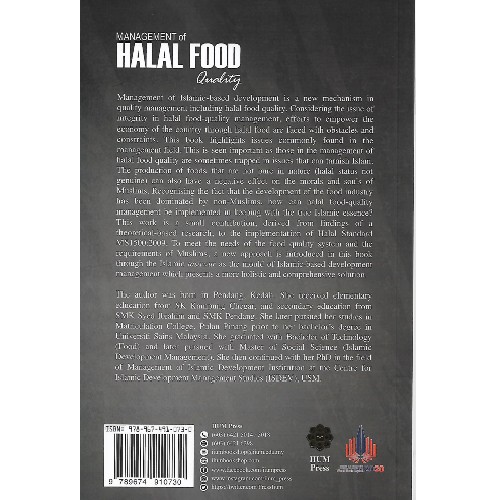
Management of Halal Food Quality
Management of Islamic-based development is a new mechanism in quality management including halal food quality. Considering the issue of integrity in halal food-quality management, efforts to empower the economy of the country through halal food are faced with obstacles and constraints. This book highlights issues commonly found in the management field. This is seen important as those in the management of halal food quality are sometimes trapped in issues that can tarnish Islam. The production of foods that are not pure in nature (halal status not genuine) can also have a negative effect on the morals and souls of Muslims.
Islamic Legal Maxims & Their Application in Islamic Finance (2nd Ed.)
Islamic Legal Maxims and Their Application in Islamic Finance is one of the most comprehensive compilations of Islamic legal maxims available in English. The most important feature of this book is that it explains each maxim in a way comprehensible to both Shari’ah experts and Islamic finance practitioners. Another feature is its emphasis on the application of the maxims in the actual practice of Islamic finance.
Recently Viewed
Having Fun The Halal Way Entertainment In Islam
With the advent of technology, the entertainment industry has flourished and become immensely popular. Combine this with the exponential advances in technology, and the result is an increasing number of ways to amuse ourselves. As a result of such advances, Muslim react in a variety of manners towards entertainment. Some label entertainment as completely forbidden. This sometimes includes parents who say no to almost everything that their young ones deem to be ‘fun’, without providing them with suitable alternatives. Others, who do not want to take this extreme approach, fall into the trap of excessive use of – and even addiction to – various sources of entertainment, without any limits.
In Having Fun the Halal Way, Ismail Kamdar explores the teachings of Islam regarding entertainment. Drawing upon the Quran, the Sunnah and the understanding of the righteous scholars of Islam, he provides a detailed and balanced analysis of the topic. He not only explains the detriments of the current entertainment industry, but also suggests alternative means to have a good time with friends and family members.
Kiamat Kecil ; Serial Aqidah Islam – 5
Kiamat Kecil: menurut al-Qurán dan hadits – Serial Aqidah Islam 5/ Dr. Umar Sulaiman al-Asyqar. Apa yang terjadi setelah kematian? Bagaimana kehidupan manusia setelah kehidupan dunia ini? Kapan dan bagaimana dunia ini berakhir? Ini adalah pertanyaan-pertanyaan yang menyangkut semua orang, tidak peduli apa latar belakang nya. Banyak yang telah mencoba menjawab pertanyaan-pertanyaan ini, dan menghasilkan teori-teori yang berkisar dari aneh ke nihilistik. Tapi teori-teori buatan manusia tidak dapat menjawab pertanyaan di luar batas kemampuan manusia. Dalam buku ini Dr. Umar al-Asyqar memaparkan secara apik dan membahas dengan tajam tentang kematian, perjalanan roh menuju langit, alam kubur dan kiamat sughra (kiamat kecil) dan tanda-tandanya, baik yang sudah terjadi maupun yang belum terjadi. Semua itu beliau sampaikan dengan ketajaman analisa nalar dan kekuatan dalil yang otentik dari ayat-ayat Al-Qur’an dan hadits-hadits shahih.
Abu Bakr As-Siddeeq His Life And Times (IIPH)
The life of the first Rightly-Guided Caliph, Abu Bakr as-Siddeeq (may Allah be pleased with him) is a valuable roadmap for the Muslims of today. One of the first people to believe and embrace the Prophet’s Message of Islam, Abu Bakr remained a close companion of the Prophet (blessings and peace be upon him) throughout the Prophet’s life. Appointed as the Prophet’s successor on the basis of consultation, Abu Bakr proved to be a great leader who, with Allah’s help, steered the Ummah through difficult times. He faced numerous challenges within Arabia: some people apostatized, others refused to pay zakâh, and quite a few individuals emerged as false prophets, attracting many followers. Outside Arabia, the Persians and Byzantines keenly observed these developments, looking for an opportunity to crush the new state. Abu Bakr employed effective strategies to deal with these challenges and had remarkable success in doing so. Thus, he paved way for the Islamic conquests that toppled tyrants and carried the message of Islam to the entire world. His leadership should be a great source of inspiration for the Muslims today.
Divine Will and Predestination; Islamic Creed Series Vol. 8
The will and decree of Allah: Is this a matter which is directly relevant to the day-to-day life of the Muslim, or is it an obscure topic best left to the debates of philosophers and theologians? Does it imply that Muslims are ‘fatalists’ who see themselves as helpless in the hands of an indifferent fate? Attitudes towards divine will and predestination have always influenced Muslims’ daily activities. In this final volume of his eight-volume Islamic Creed Series, Dr. ‘Umar al-Ashqar explores this topic in depth, explaining it in clear terms for the ordinary Muslim. Drawing always on the Qur’an and the Sunnah, and on the words of the greatest scholars of Islam such as Ibn Taymiyah, he covers some of the historical debates that took place within the Ummah on this matter. The true Islamic concept of divine will and predestination is an empowering notion. While all that happens takes place within the framework of the divine will, people have freedom of choice within those parameters. This is a matter which is of interest and concern for all Muslims, one which will bring many benefits, both in this world and in the hereafter. This Islamic Creed Series of books has been translated into English by Nasiruddin al-Khattab.
Fifty of the Counsels of the Prophet to the Women
Islam is very kind to women. The Prophet was very careful to respect their rights. Women \, in his times, possessed the religious knowledge, narrated ahadith. Nursed the sick and wounded on the battlefield and acquired knowledge. The home is the first madrasah of a child. This book shows women the path of Islam as shown by the prophet. The ahadith are explained on the pattern of great scholars like Ibn Hajar, Nawawi, Khattabi, Mubarakpuri, and others. A careful perusal will help the reader to understand the real message of Islam and to pattern her own life and her children’s on the right path.
Pakaian yang Paling Indah (Jibaly Rumah Tangga Siri)
Melalui ketiga-tiga buku dalam siri ini, kami berusaha membincangkan perkahwinan menurut Sunnah yang sahih.
Selected Invocations (Pocket Size) (P/B)
This small booklet has many excellent invocations to read during prostration, witr prayer, and at the end of Qur’anic recitation.


There are no reviews yet.