| Weight | 0.71 kg |
|---|---|
| Product Type | Book |
| Author | |
| Publisher | Arabic For All |
| Pages | 240 |
| ISBN | 9786030140817 |
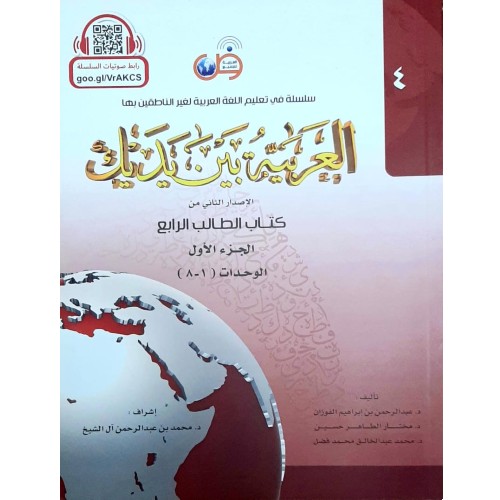
[AR] Al-Arabiyyah Bayna Yadayk Book 1 Part 2
RM85.00
Al-Arabiyyah Bayna Yadayk, Arabic At Your Hands Series (Students Level 1- Book 2) – With QR
This series is designed for the non-Arab speaking, senior level student. It helps the student learn Arabic through listening and conversation along with reading and writing. The series stresses communication and also offers glimpses into the Arabic culture, both Islamic and national.
The first level consists of two parts (books), each of which includes 8 units (total of 16 units). Each unit consists of 9 lessons, constituting a total of 144 basic lessons in this level.
Frequently Bought Together
Be the first to review “[AR] Al-Arabiyyah Bayna Yadayk Book 1 Part 2” Cancel reply
You must be logged in to post a review.
Related Products
I Love Arabic: Arabic Numbers
Arabic Numbers, the third book in the I Love Arabic series, introduces young learners to identifying, counting and writing Arabic numbers. This colourful book presents each number along with delightful illustrations, which the young learner has to identify, count, say aloud and then practice writing. Arabic Numbers is an exciting first book for young learners who want to master Arabic numbers. Arabic Numbers develops these skills: * Identifying numbers * Counting numbers * Writing numbers.
Morphology Made Easy P/B (Part 1-4)
Prepared by the teachers of Madrasa Islamiyah Benoni, South Africa.
Arabic Verbs: Fully Conjugated All Forms Bilingual Edition
This update, easy-to-use reference book gives you:
- The 501 most common Arabic verbs in a table format
- Both the Arabic characters and their English infinitive form at the top of each page
- Exemplary essay that discusses Arabic verb formation and usage
- Common idioms with example sentences to demonstrate verb usage
- A grammar review and a pattern index
- Indexes that list verbs in both root order and strict alphabetical order
Madinah Arabic Reader (Book 7)
Professor Abdur Rahim, Director of the Translation Centre of the King Fahd Quran Printing Complex and former Professor of Arabic at the Islamic University of Madinah, Saudi Arabia, has authored texts designed to impart a knowledge of classical Arabic through applied grammar. Each lesson, based on a conversation, illustrates distinctive language patterns. These patterns are elucidated by a variety of helpful exercises. The vocabulary ranges from classical and Quranic Arabic to modern Arabic. This series of books is currently being utilized at various schools to prepare students for the University of London (UK) GCE O-Level and A-Level examinations.
Teach Yourself MP3 Complete Arabic Step by Step A1-A2
Arabic Books – Arabic World – Arts & Crafts, Decoration – Biographies – Calligraphy – Children – Clothing – Companions – Computer – Cooking – Courses & Lectures – Culture & Leisure – Dictionaries – Dogma (‘Aqeedah) – Dreams interpretation – Economy – Education – Educational – Electronics – Ethics – Exhortation – Fast (Ramadan) – Geopolitics – Gift Ideas – Hadith – Halal Food – Health & Dietetics – History – Holy Quran Stories – Introduction to Islam – Invocations – Islam & Science – Islam & secularity – Islam and Modernity- Islamic songs – Jurisprudence – Learning Arabic – Learning English – Learning French – Literature & Poetry – Magazines – Marriage – Miscellaneous – Mystic and Sufism – Names- Natural Beauty Care – Other Religions – Paradise – Hell – Dead – Philosophy – Pilgrimage & Umrah – Propagation (Da’wah) – Prophet Life – Prophets – Quran Sciences – Quran Tafseer – Religious practice – Roqya & Protection – Sciences of Hadith – Society – Spirituality – Strories – Sunnah – Tajweed (Rules) – Tamazight Culture – The Holy Quran – The West and Islam – Tourism – Understanding Islam – Ussul Al-Fiqh – Various Accessories – Well-Being – Woman – Youth – Zakat & Charity
Madinah Arabic Reader (Book 5)
Professor Abdur Rahim, Director of the Translation Centre of the King Fahd Quran Printing Complex and former Professor of Arabic at the Islamic University of Madinah, Saudi Arabia, has authored texts designed to impart a knowledge of classical Arabic through applied grammar. Each lesson, based on a conversation, illustrates distinctive language patterns. These patterns are elucidated by a variety of helpful exercises. The vocabulary ranges from classical and Quranic Arabic to modern Arabic. This series of books is currently being utilized at various schools to prepare students for the University of London (UK) GCE O-Level and A-Level examinations.
Arabic Course for English-Speaking Students -3 Vols (H/B)
Easy Arabic Course (Durus al-Lughat al-Arabiyah) – For English-Speaking Students. As per the curricula and norms pescribed by the Islamic University of Madinah.
Combines Modern Arabic vocabulary with Islamic terminology as used in the Qur’an and hadith. Assists in learning Arabic grammar and essential language skills Uses a conversational approach to help understand grammatical usages in its perfect form. Contains Multi-skil exercises to improve vocabulary and language
[AR] Al-Arabiyyah Bayna Yadayk Book 4 Part 1
Al-’Arabiyyah bayna yadayk Means Arabic in Your Hands.
The great thing about these books is that it covers a lot of vocabulary through pictures, Images and using Arabic Only, introduces the students to grammar later and gradually rather than pushing them at the deep end before they can swim.
Much like Arabic Course for English Speaking Students 3 Volumes Set, UKIA, it is more Islamic inclined and fulfils the desire for the student of knowledge to learn the language of the Qur’an.
Students who had completed all three books wanted something else to reach higher competency, which has given rise to volume 4, which is available in 2 Parts.
Al-’Arabiyyah bayna yadayk series comes in 3 Basic Student Books and a further study Book 4 Parts 1 & Book 4 Part 2
Madinah Arabic Reader (Book 2)
Professor Abdur Rahim, Director of the Translation Centre of the King Fahd Quran Printing Complex and former Professor of Arabic at the Islamic University of Madinah, Saudi Arabia, has authored texts designed to impart a knowledge of classical Arabic through applied grammar. Each lesson, based on a conversation, illustrates distinctive language patterns. These patterns are elucidated by a variety of helpful exercises. The vocabulary ranges from classical and Quranic Arabic to modern Arabic. This series of books is currently being utilized at various schools to prepare students for the University of London (UK) GCE O-Level and A-Level examinations.
Arabic Through The Qur’an
Whether used as a means of self-instruction or as part of higher learning coursework, this language primer is ideally suited for those wishing to learn classical Arabic and for Muslims who wish to learn Arabic exclusively for use in their religious and spiritual practice. Designed to enhance the understanding of the Qur’an and its vocabulary that has infiltrated the whole of Arabic and Islamic literature, this workbook provides 40 easy-to-follow lessons for learning Qur’anic rather than modern Arabic. Beginning with a section on the Arabic alphabet, the text moves on to individual lessons that address one or more grammatical topics, ranging from the basics of nouns, adjectives, and prepositions to the more complex concepts of the imperative, the passive, and conditional sentence, introducing new vocabulary in the process. Accompanying translation exercises, a glossary of technical terms, and an index supplement the main text.
Recently Viewed
Lawful Wives or Unlawful Girlfriends
In the Name of Allah, the Most Beneficent, the Most Merciful
Allah (SWT) says: (If you fear that you will not be able to deal justly with the orphans, marry women of your choice, two or three or four; but if you fear that you shall not be able to deal justly (with them), then only one or (the captives or the slaves) that your right hands possess. That will be more suitable to prevent you from doing injustice) (An-Nisa’: 3).
Praise be to Allah (SWT) who has prescribed for His Servants a religion (Islam) that is beneficial to them in this world and the Hereafter, and Peace and Blessing be upon His Messengers and Prophets who were guided by His Guidance and conveyed His Religion. The last and seal of His Messengers was Muhammad Ibn Abdillah (SAW). He (SAW) was the best to advise his Ummah and convey the True Message, by words, deeds and his character. He (SAW) was the best model and example for the believers.
Pioneers of Islamic Scholarship
Over the fourteen centuries of its existence, Islamic scholarship has produced numerous individuals who have distinguished themselves by acquiring broad knowledge and deep insight.
- However, true distinction is only achieved through a lasting influence, particularly when the area of scholarship is a religion that presents itself as being suited to all communities at all times.
- The selection has to start with the founders of the eight schools of jurisprudence who have had a continuous following over the centuries up to the present day.
- This book introduces nine scholars from these schools and adds two more from a much later era whose influence extended far beyond the area of pure scholarship.
- In simple language, this book gives a clear picture of how the Islamic schools of jurisprudence differ in their methodologies, showing at the same time how much interaction they project.
- It serves as a primary source for those who wish to follow a course in Islamic studies, this book is indispensable for others who wish to have a fair but concise idea about the most important personalities who have shaped Islamic scholarship for centuries.
Islam The Straight Path
This updated version of Islam: The Straight Path includes a new Epilogue by John Esposito in which he addresses the impact 9/11 and its aftermath have had on both the Muslim and non-Muslim world, discussing Islam’s relationship to democracy and modernity and focusing more sharply on the origins and growth of extremism and terrorism in the name of Islam. This exceptionally successful survey text introduces the faith, belief, and practice of Islam from its earliest origins up to its contemporary resurgence. Esposito, an internationally renowned expert on Islam, traces the development of this dynamic faith and its impact on world history and politics, discussing the formation of Islamic belief and practice and chronicling the struggle of Muslims to define and adhere to their Islamic way of life. Lucidly written and expansive in scope, Islam: The Straight Path provides keen insight into one of the world’s least understood religions and is ideally suited for use in courses on Islam, comparative religions, and Middle Eastern history and culture.


There are no reviews yet.