| Weight | 0.78 kg |
|---|---|
| Dimensions | 23 × 16 × 2 cm |
| Product Type | Book |
| Publisher | Darussalam |
| ISBN | 9960897540 |
Atlas of the Qur’an (Darussalam)
RM80.00
This Atlas is new in its subject, a subject that has not been touched before. It helps whoever recites the Qur’an or studies it to specify the locations mentioned by the Noble Verses, and to mark those places of ancient people mentioned in the Qur’Gn. This is besides locating areas where the incidents of the prophetic Seerah occurred.
Eventually the diligent reader will easily recognize those places, learn about them, and take heed of them while reciting.
Eventually the diligent reader will easily recognize those places, learn about them, and take heed of them while reciting. The Atlas has also revealed obscure places we used to pass through inattentively, like the site where Nuh’s Ark settled, the site of the curved Sand-hills {Al Ahqah}, the cave of the young faithful men, the houses of median, the site of Sodom and other places determined by the Atlas depending on reliable sources.
Thus the Atlas eliminates all the guessing and the fantasies we used to encounter when reciting the Noble Quran, and takes us to the specific place.
Be the first to review “Atlas of the Qur’an (Darussalam)” Cancel reply
You must be logged in to post a review.
Related Products
Study The Noble Qur’an Word for Word (3 volumes) – Colour
Available NOW only for online shopping.
Complete Qur’an in 3 volumes Colour Version (10 Parts per book). Individual volumes are available from the related items section. The first coloured Word-for-Word English translation to understand the meanings of the Arabic verses along with grammatical terms. Read more below…
Tafsir As-Sadi (Parts 28-29-30) Methodical Interpretation Of The Noble Quran (H/B)
Tafsir As-Sa’di is a straightforward, easy to read, easy to understand explanation of the meaning of Qur’anic Ayat and statements. In addition to the simplicity of Ibn Sa’di’s writing, it is also articulate and eloquent.
Consequently, for those newly acquainted with Tafsir and those new to Islam, this Tafsir provides an uncomplicated, deep and insightful comprehension into the meaning and explanation of the Qur’an.
The uniqueness of this Tafsir is in the style the Shaikh used to explain the Ayat in a way that it is similar to everyday writing, without listing the various prophetic sayings or statements of the scholars of Tafsir, which Shaikh Ibn Sa’di used as a basis of his Tafsir.
The Spiritual Cure An Explanation to Surah al-Fatihah (P/B)
Surah al Fatiha is the greatest chapter of the Qur’an, its like is not found in the rest of the Book or in the previous scriptures. It is a
Light that was granted to Prophet Muhammad (S) which had not been granted to any other Prophet or Messenger before him; indeed
some of the Salaf stated that when this chapter was revealed, Shaytãn l let out a great cry of lament.
It holds a central position in the daily Prayer hence the daily life of the Muslim.
The underlying theme, of al-Fatiha is one of contemplation and serenity; pondering the Names and Attributes of Allah, pondering the creation , and acknowledging that He Alone deserves praise and Worship, that He Alone should be asked for help, that He Alone Should be feared and hoped in, that He Alone should be invoked, that there is indeed a Day of Judgment, and that guidance has come to us and we are required to follow it.
It calls us to carefully scrutinise our relationship with our Lord: are we living according to the dictates of ‘none has the right to be worshipped save of Allah’ or not? This opening chapter, despite its brevity, calls man to fulfil the rights of Tawhid, the right that Allah has over us to worship Him Alone without any partner
A Summary of numerous Classical Commentaries of the Qur’an
at-Tabari, al-Baghawi, Az-Zamakhshari, ibn Atityyah, Ibn Jawzi, Al-Qurtubi, Ibn Qayyim, Ibn Kathir, as-Suyuti, Alusi, ash-Shawkani, as-Sa’di, ash-Shaqiti and many Others
Usool at-Tafseer (H/B)
Usool at-Tafseer, essentially refers to the branches of knowledge necessary for providing an accurate interpretation of the Quranic texts, such as Arabic grammar and syntax, Arabic literature and Quranic sciences (Uloom al-Quran). Familiarity with modern fields of learning, like the pure sciences and social sciences is also necessary for a commentator in this era to make the Quraanic explanations relevant to human society. This book addresses the actual step-by-step methodology of interpreting Quran to ensure that interpretations are not merely the result of human whims and fancies.
Four Key Concept of the Qur’an
Four Key concepts oF the Qur’An elucidates these basic Qur’anic concepts Ilah, Rabb, Ibadah and Din in order to bring out fully the Islamic way of life, as distinct from other perspectives. This elaboration goes a long way in developing a sound understanding of the Qur’an. It also explains the man-God relationship in Islam, guiding Muslims on how to lead their lives in total surrender to Allah.
Divine Speech
The Quran, the sacred scripture of Islam, is revered as the spoken word of God by approximately one-fifth of the world’s population. Since its inception, the power of the Quran has derived not only from its message, but also from the inimitable literary style and rhetorical impact that the Arabic scripture has on its audiences. Divine Speech: Exploring the Quran as Literature attempts to make some of the most recent Arabic and European-language scholarship on its literary features accessible to a wider, English-speaking audience. These features include its language and word choice, its use of figures of speech and other rhetorical devices, its manner of narrating parables and stories, and the structure, coherence, and the order of its “chapters”-aspects that typically remain mysterious to readers of English translations of the text. Divine Speech furnishes its readers with a better appreciation of the Quran from a literary perspective, and in the process stimulates interest in, and provides tools and resources for, further study of the scripture.
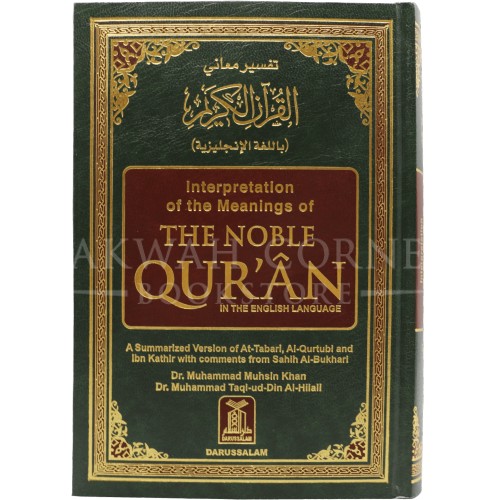
The Noble Quran (Tall Version English Text Only) (RANDOM COLOR)
Interpretion of the meanings of The Noble Quran in the English Language.
Interpretation of The Meanings of The Noble Qur’an- A5 (23x15cm)
Interpretation of the Meanings of The Noble Qur’an in the English Language
927 black and white pages
The Meaning of The Holy Qur’an -Pocket Size (P/B) (IBT)
This very handy pocket-sized edition contains the complete meaning of the Holy Qur’an, without the Arabic text and the commentaries. Weighing just under 170 grammes, sized 9.5 cm X 13 cm and with a thickness of 1.5cm, it is intended as a handy travel companion as well as a gift to friends and colleagues.
Tafseer Soorah Al-Hujurat (H/B)
Tafseer Soorah al-Hujurât: A Commentary on the 49th Chapter of the Qur’an is a treasury of divine advice, commandments, and prohibitions regarding common problems in social relations, including gossip, spying, arguing, and bigotry. To make the best use of this chapter, the believer needs a detailed explanation of the meanings of the verses.
Dr. Bilal Philips has based his tafseer (exegesis) on the methodology used in the classical works of tafseer. He has relied first of all on the explanations found within the Qur’an itself, then on explanations found in the Sunnah and related incidents which occurred at the time of the revelation of the verses in question. Beyond these primary sources, Dr. Philips has relied on the interpretations made by the Prophet’s Companions (may Allah be pleased with them) who were noted for their ability to interpret and comment on the Qur’an. ‘Abdullâh ibn ‘Abbâs, for example, was called ‘The interpreter of the Qur’an’ by Prophet Muhammad (blessings and peace of Allah be upon him). Finally, the author has made use of the grammatical explanations given in the classical tafseer works. Wherever possible, Dr. Philips has tried to apply the derived meanings of the verses to the problems of contemporary society.
Recently Viewed
In Pursuit of Allah’s Pleasure
In this book the authors outlined a complete methodology for Islamic work today. From `Aqeedah to Da’wah, Jihad to Khilafah and Taqwa to Sabr (patience), they explained how all of these parts of Islam come together for the sole objective of each and every Muslim: to seek the Pleasure of Allah ( SWT ), the Irresistible. It was written in a manner portraying the true situation of the Muslims today and, coming from imprisoned scholars: a realistic portrayal.
This book is an excellent read by itself and an even better guide if used as a syllabus in learning Islam in an organised, collective manner. It is ideal as a basis for study circles and acts as a comprehensive manual. Coupled with the supplementary reading of some other books in the English language and memorisation of the Holy Quran, it can consolidate the knowledge of anyone seeking to work for Islam in this day and age.
Contents
Preface
Introduction
Part One: Our Ultimate Goal
Part Two: Our `Aqeedah
Part Three: Our Understanding
Part Four: Our Aim
Part Five: Our Path
Part Six: Our Provisions
Part Seven: Our Walaa’ (Loyalty)
Part Eight: Our ‘Adaa’ (Animosity)
Part Nine: Our Gathering
Glossary of Arabic Trems
The Twentieth Century has witnessed one of the fiercest blows inflicted upon our Ummah by our enemy: the collapse of the Khilafah. If only their conspiracy had stopped at the demise of Khilafah. But they went on to indoctrinate Muslims with strange, foreign ideas and concepts, in order to confuse our understanding of our Deen. Once we wake up and try to return to our original Deen, we will be confronted with an intellectual perplexity, in which evil and good is mixed. Hence, the truth will be ambiguous and we will go astray, and lose the true understanding of Islam.
And hold fast, all of you together, to the Rope of Allah (this Qur’an) and be not divided among yourselves.” [Surah Ale-Imran (3), Ayah 103.]
by Dr. Naahah Ibrahim, Asim Abdul Maajid and Esaam-ud-Deen Darbaalah


There are no reviews yet.