| Weight | 0.31 kg |
|---|---|
| Product Type | Book |
| Author | |
| Publisher | IIUM Press |
| ISBN | 9789674182366 |
Contemporary Issues In Islamic Communication
RM37.00
The book contains a collection of essays on issues that are of concern to Muslim media and scholars and practitioners. The issues are those that are constantly highlighted in the mass media in the Muslim world. All the issues are discussed from the Islamic perspective. The main purpose of the book is to give readers a clear understanding of how Muslims view contemporary issues that are reported and discussed in present day mass media. The book is written for students majoring in communication at the International Islamic University Malaysia. It is also useful for students taking courses on communication issues in other universities.
Be the first to review “Contemporary Issues In Islamic Communication” Cancel reply
You must be logged in to post a review.
Related Products
An Islamic Paradigm In Economics Vision And Mission
This book emphasises not only thoughts and theoretical concepts, but also discusses their application.
in the real world. Hence, it suggests that a holistic approach to economic development, which harmonises between material and spiritual well-being is not entirely idealistic but is, in fact, pragmatic and applicable.
Banking: The Root Cause Of The Injustices Of Our Time (Revised Ed.)
The original 1987 Norwich seminar Usury: The Root Cause of the Injustices of Our Time, whose proceedings form the core of this work, had an extraordinary effect.
After the endless analyses and altercations of left and right to which we were accustomed, here was an argument that went to the core of the matter in one bound, and yet did so with a degree of scholarship and indeed erudition that was not cavalier. The result was electric. It was also well before its time.
Public Policy: Beyond Traditional Jurisprudence A Maqasid Approach (IIIT)
This work charts new territory in Islamic scholarship by attempting to address the field of public policy from a maqasid (higher objectives of the Shariah) perspective. Public Policy is an independent discipline from both law and politics. Thus, Public Policy in Islam is introduced here as a qualitatively different enterprise from both fiqh (Islamic jurisprudence) and siyasah shar’iyyah (Shariah-oriented politics). The book deals with a number of critical topics that include methodology, governance, human rights, ethics, political power, and reform and renewal. It highlights how the maqasid approach is indispensable to the theory and practice of public policy in Islam, how it could resolve some of the most persistent governance dilemmas throughout Muslim history, but more significantly, how it forces a re-conceptualization of the wealth of knowledge available in Islam s primary sources to introduce Public Policy in Islam to mainstream policy studies.
A Mini Guide to Takaful (Islamic Insurance)
This Mini Guide will prove useful and constructive to readers who want a better understanding of the takaful industry in contemporary Islamic finance.
Islamic Finance : A Practical Introduction
Islamic finance and banking is governed by the tenets of Islam and is based upon the principles of the Shariah, a code of conduct for Muslims to adhere to when managing their lives, including their finances. This slim volume breaks down this code and teaches readers how it is practically applied in business, personal finances, and the global economy.
Islamic Legal Maxims & Their Application in Islamic Finance (2nd Ed.)
Islamic Legal Maxims and Their Application in Islamic Finance is one of the most comprehensive compilations of Islamic legal maxims available in English. The most important feature of this book is that it explains each maxim in a way comprehensible to both Shari’ah experts and Islamic finance practitioners. Another feature is its emphasis on the application of the maxims in the actual practice of Islamic finance.
Riba: Usury or Interest
The Noble Qur’an states: {… Fear Allah, and give up what remains of your demand for usury/interest, if you are indeed believers. If you do not do so, then take notice of war from Allah and His Messenger.} (Qur’an 2: 278-279) Despite this obvious prohibition, the practice of ribâ (usury and interest) has polluted the global economy completely. This booklet explains the awful consequences of dealing in usury and interest in a summarized but convincing manner.
A Mini Guide to Accounting for Islamic Financial Products – A Primer (Pocket size) (P/B)
This “A Mini Guide to Accounting for Islamic Financial Products” starts with the development of Islamic finance as well as accounting standards and development of AAOIFI which aims to develop standards on accounting, auditing, ethics and governance and disseminate them on the target market.
The guide also highlights selected accounting issues addressed by AAOIFI : substance over form, prudence, mudarabah investment accounts and asset valuation. This is followed by how information of financial statement of an Islamic bank helps its major users, like equity holders, holders of investment accounts, regulatory agencies and others.
The guide also points out the main differences in the presentation of financial statements of Islamic Financial Institutions. Among them are: how assets are defined and inclusion of equity of unrestricted investment account holders. The differences arise as a result of utilizing a Shari’ah compliant contract to bring into effect a particular product.
The last section discusses some of the more popular contracts such as murabahah, istisna’, ijarah, mudarabah and musharakah. A few case studies are also incorporated for different contracts to give more understanding on the topic to the readers.
Recently Viewed
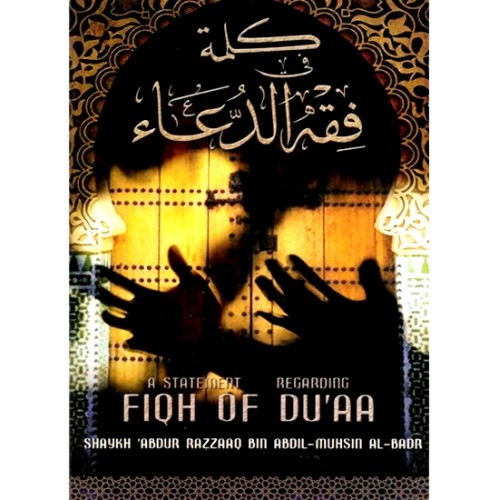
A Statement Regarding Fiqh Of Du’aa (P/B)
He who reviews the Qur’aan will find that the Book of Allaah, the Mighty and Majestic, is replete with many verses and a number of texts indicating the virtue of Du’aa and the loftiness of its status. When you read the Qur’aan, you will find that the first Soorah with which the book of Allaah, the Mighty and Majestic, begins with it; Soorah Al-Faatihah contains this tremendous act of worship, and the last of the Qur’aan Soorah An-Naas as well, contains this tremendous act of worship.
So the Book of Allaah, the Mighty and Majestic, begins with Du’aa and ends with it. The Du’aa, which is within Al-Faatihah, is the greatest of supplications hands down. (It contains) asking Allaah, the Blessed and High, for guidance to the straight path and that the servant avoids the paths of those who are astray and those upon whom is the Anger of Allaah. The last of the Book of Allaah, the Mighty and Majestic, contains the Du’aa of seeking refuge with Him, Glorified and Exalted be He, from the evil of the one who whispers and withdraws; the one who whispers into the hearts of mankind; from the Jinn as well as men, in order to make them deviate from the straight path of Allaah and the upright way.
Allaah informs us that Shaytaan says:
Then I will come to them from before them, and behind them, from their right and their left, and You will not find most of them as thankful ones (i.e., they will not be dutiful to You).[1]
So there is no firmness upon the straight path of Allaah, nor safety from the accursed Shaytaan-who calls mankind to deviation from the straight path-except by way of Du’aa and seeking refuge with Allaah, the Majestic and High; and a good manner of taking refuge with Him. This beginning and ending contain an indication of the importance of Du’aa from different perspectives; and the need of mankind for Du’aa to be firm upon the straight path of Allaah. When you reflect upon the other verses of the Qur’aan, you find the great status of Du’aa and lofty station of it within the Qur’aan.


There are no reviews yet.