| Weight | 0.23 kg |
|---|---|
| Product Type | Book |
| Author | |
| Publisher | Goodword |
| Pages | 32 |
| ISBN | 9788178988573 |
I Love Arabic: Alphabet
RM18.00
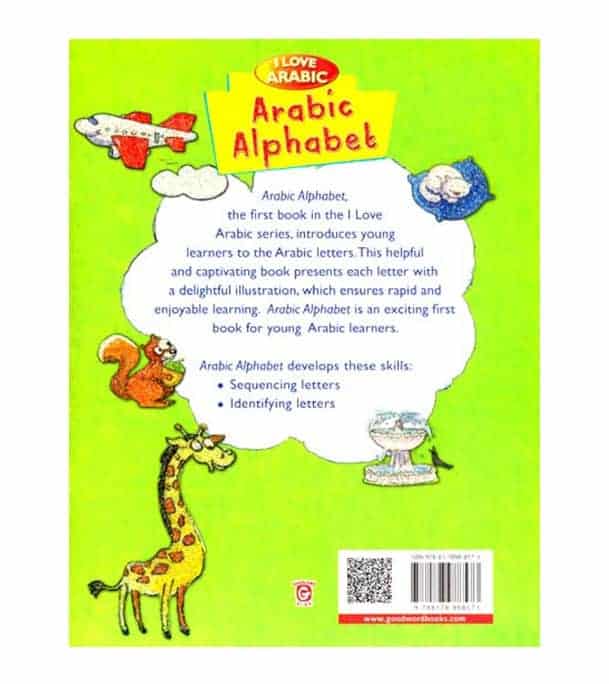
Arabic Alphabet, the first book in the I Love Arabic series, introduces young learners to the Arabic letters. This helpful and captivating book presents each letter with a delightful illustration, which ensures rapid and enjoyable learning. Arabic Alphabet is an exciting first book for young Arabic learners. Arabic Alphabet develops these skills: * Sequencing letters * Identifying letters.
Be the first to review “I Love Arabic: Alphabet” Cancel reply
You must be logged in to post a review.
Related Products
I Love Arabic: Arabic Numbers
Arabic Numbers, the third book in the I Love Arabic series, introduces young learners to identifying, counting and writing Arabic numbers. This colourful book presents each number along with delightful illustrations, which the young learner has to identify, count, say aloud and then practice writing. Arabic Numbers is an exciting first book for young learners who want to master Arabic numbers. Arabic Numbers develops these skills: * Identifying numbers * Counting numbers * Writing numbers.
Madinah Arabic Reader (Book 4)
Professor Abdur Rahim, Director of the Translation Centre of the King Fahd Quran Printing Complex and former Professor of Arabic at the Islamic University of Madinah, Saudi Arabia, has authored texts designed to impart a knowledge of classical Arabic through applied grammar. Each lesson, based on a conversation, illustrates distinctive language patterns. These patterns are elucidated by a variety of helpful exercises. The vocabulary ranges from classical and Quranic Arabic to modern Arabic. This series of books is currently being utilized at various schools to prepare students for the University of London (UK) GCE O-Level and A-Level examinations.
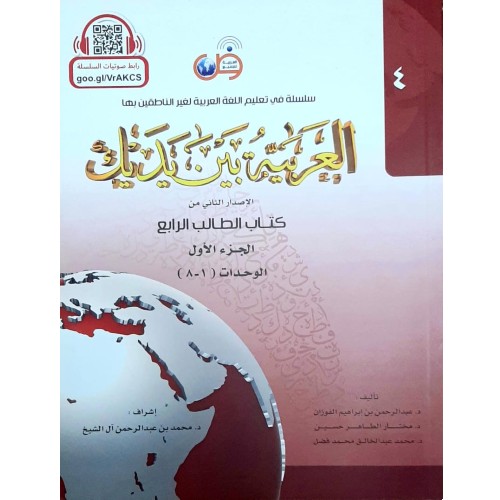
[AR] Al-Arabiyyah Bayna Yadayk Book 4 Part 1
Al-’Arabiyyah bayna yadayk Means Arabic in Your Hands.
The great thing about these books is that it covers a lot of vocabulary through pictures, Images and using Arabic Only, introduces the students to grammar later and gradually rather than pushing them at the deep end before they can swim.
Much like Arabic Course for English Speaking Students 3 Volumes Set, UKIA, it is more Islamic inclined and fulfils the desire for the student of knowledge to learn the language of the Qur’an.
Students who had completed all three books wanted something else to reach higher competency, which has given rise to volume 4, which is available in 2 Parts.
Al-’Arabiyyah bayna yadayk series comes in 3 Basic Student Books and a further study Book 4 Parts 1 & Book 4 Part 2
Arabic Through The Qur’an
Whether used as a means of self-instruction or as part of higher learning coursework, this language primer is ideally suited for those wishing to learn classical Arabic and for Muslims who wish to learn Arabic exclusively for use in their religious and spiritual practice. Designed to enhance the understanding of the Qur’an and its vocabulary that has infiltrated the whole of Arabic and Islamic literature, this workbook provides 40 easy-to-follow lessons for learning Qur’anic rather than modern Arabic. Beginning with a section on the Arabic alphabet, the text moves on to individual lessons that address one or more grammatical topics, ranging from the basics of nouns, adjectives, and prepositions to the more complex concepts of the imperative, the passive, and conditional sentence, introducing new vocabulary in the process. Accompanying translation exercises, a glossary of technical terms, and an index supplement the main text.
[AR] Al-Arabiyyah Bayna Yadayk Book 1 Part 2
Al-Arabiyyah Bayna Yadayk, Arabic At Your Hands Series (Students Level 1- Book 2) – With QR
This series is designed for the non-Arab speaking, senior level student. It helps the student learn Arabic through listening and conversation along with reading and writing. The series stresses communication and also offers glimpses into the Arabic culture, both Islamic and national.
The first level consists of two parts (books), each of which includes 8 units (total of 16 units). Each unit consists of 9 lessons, constituting a total of 144 basic lessons in this level.
[AR] Al-Arabiyyah Baynah Yadayk Book 4 Part 2
Al-’Arabiyyah bayna yadayk Means Arabic in Your Hands.
The great thing about these books is, that it covers a lot of vocabulary through pictures, Images and using Arabic Only, introduces the students to grammar later and gradually rather than pushing them at the deep end before they can swim.
Much like Arabic Course for English Speaking Students 3 Volumes Set, UKIA, it is more Islamic inclined and fulfils the desire for the student of knowledge to learn the language of the Qur’an.
Students who had completed all three books wanted something else to reach higher competency, which has given rise to volume 4 which is available in 2 Parts.
Al-’Arabiyyah bayna yadayk series comes in 3 Basic Student Books and a further study Book 4 Parts 1 & Book 4 Part 2
Recently Viewed
The Bible The Quran and Science (P/B) by Dar Al Wahi
In his objective study of the texts, Maurice Bucaille clears away many preconceived ideas about the Old Testament, the Gospels and the Qur’an. He tries, in this collection of Writings, to separate what belongs to Revelation from what is the product of error or human interpretation. His study sheds new light on the Holy Scriptures. At the end of a gripping account, he places the Believer before a point of cardinal importance: the continuity of a Revelation emanating from the same God, with modes of expression that differ in the course of time. It leads us to meditate upon those factors which, in our day, should spiritually unite rather than divide-Jews, Christians and Muslims.
As a surgeon, Maurice Bucaille has often been in a situation where he was able to examine not only people’s bodies, but their souls. This is how he was struck by the existence of Muslim piety and by aspects of Islam which remain unknown to the vast majority of non-Muslims. In his search for explanations which are otherwise difficult to obtain, he learnt Arabic and studied the Qur’an. In it, he was surprised to find statements on natural phenomena whose meaning can only be understood through modern scientific knowledge.
He then turned to the question of the authenticity of the writings that constitute the Holy Scriptures of the monotheistic religions. Finally, in the case of the Bible, he proceeded to a confrontation between these writings and scientific data.
The results of his research into the Judeo-Christian Revelation and the Qur’an are set out in this book.
What Every Christian Should Know About Islam (P/B)
Of the many books explaining Islam, few specifically address the concerns and questions of those from a Christian background. Moreover, the commonalities between the Abrahamic faiths—Judaism, Christianity, and Islam—are too often ignored. Set out in an easy and informative question-and-answer format, the book addresses the specific theological points of agreement and difference between Christianity and Islam, explains the core religious beliefs and practices of Islam, and answers today’s most common questions of Islam and Muslims in an age when there is much conflict and misunderstanding. Islam is best judged not by the limitations and transgressions of its most extreme, ignorant, and outlandish followers, but by the example of its moderate majority, and Ruqaiyyah Waris Maqsood presents this introduction to the theology and practice of Islam in an attempt to explore some of the false impressions that surround it.
Table of Contents:
Section 1: The Religious Beliefs of Islam Explained
Section 2: the Religious Duties of Islam Explained
Section 3: Miscellaneous Questions
Section 4: Christianity and Islam
Ruqaiyyah Waris Maqsood gained an honors degree in Christian Theology from the University of Hull in 1963 and then taught religious studies at various state schools until her retirement in 1996. She converted to Islam in 1986 and now lectures and writes on Islam.


There are no reviews yet.