The discussions in this book will, Allah willing, not only enlighten the readers about various natural remedies but also stimulate scientific research on the medicinal plants mentioned in authentic hadiths. We hope that this book serves as an invaluable reference guide for Muslims and non-Muslims in every home, country, and age, especially those working in health sciences, pharmacy, alternative medicine, and biomedical research.
Medicine And Pharmacy In The The Prophetic Traditions (H/B)
RM85.00
Medicine and Pharmacy in the Qur’an and Prophetic Traditions aims to integrate the science of healing into the religion of Islam. It provides advice and guidance on maintaining sound health and preventing diseases and ailments in compliance with the Qur’an and the Sunnah of Prophet Muhammad (blessings and peace be upon him). It also discusses the Qur’anic verses related to health, sickness, and cure, as well as the spiritual and physical remedies recommended by the Prophet (blessings and peace be upon him) in light of modern knowledge.
Frequently Bought Together
| Weight | 0.6 kg |
|---|---|
| Dimensions | 22 × 14.7 × 2 cm |
| Product Type | Book |
| Author | |
| Pages | 409 |
| ISBN | 9786035014830 |
| Publisher | IIPH |
Be the first to review “Medicine And Pharmacy In The The Prophetic Traditions (H/B)” Cancel reply
You must be logged in to post a review.
Related Products
The Sevens
A concise guide for lecturers and trainers. It includes 70 Sevens which are among the strongest assistant to you in life. They are the extract of the experiments and experiences of successful scholars, within intensified points and concentrated pivots
Contemplation: An Islamic Psychospiritual Study (IIIT) (Book in Brief Series)
IIIT Books-In-Brief Series is a valuable collection of the Institute’s key
publications written in condensed form to give readers a core under-standing of the main contents of the original.
Scientific Facts Revealed In The Glorious Quran
Scientific Facts Revealed in the Glorious Qur’an : Selected examples from the area of Earth Sciences, by geologist Prof. Dr. Z. R. El-Naggar. This small book includes has 16 pages with color illustrations to help the reader visualize what the author explains. He discusses verses in the Qur’an with the supporting scientific facts.
Cyber-Counseling For Muslim Clients
A Muslim psychologist addressing psychospiritual problems faced by Muslims
Mind, Brain, & Free Will (P/B)
Mind, Brain, and Free Will presents a powerful new case for substance dualism (the idea that humans consist of two parts–body and soul) and for libertarian free will (that humans have some freedom to choose between alternatives, independently of the causes which influence them). Richard
Psychology From The Islamic Perspective
Islam offers a precise, uncomplicated, and comprehensive theory of our spiritual nature, our purpose and priorities in life, and how we can attain serenity and happiness in this life and the next. In Psychology from the Islamic Perspective, Dr. Aisha Utz Hamdan includes specific references to scientific research that corresponds to, or builds upon, what is already known from revelation.
Scientific Wonders on the Earth and in Space (H/B)
Every Prophet had a miracle which he showed to his people and challenged them with. Some of the Prophets even had more than one sign as a definite proof that. they were sent by Allah; challenging their nations to bring anything similar to it if they denied it. Every sign given to any of the Prophets was exclusively meant for his people and when he died, his signs ceased to exist.
However, one such miraculous sign shall remain, complete and preserved with the command of Allah, until the Day of Resurrection. This miracle is the inimitable Qur’an, the everlasting Book of Allah given to Prophet Muhammad (peace and blessings be upon him). Anyone who lives after the death of this Prophet of Mercy will be able to see it, read it, and realize for themselves the truth that it contains.
Who was the teacher who taught Prophet Muhammad the scientific facts described by the Qur’an? Did he possess tools of scientific research that enabled him to discover all that? Did he have airplanes and rockets that enabled him to discover what was beyond the sky?
The answer is that He possessed such knowledge that could never be affected by falsehood because it is the word of God. All that he informed us – of the past and present signs in the Universe and within ourselves – has been discovered by science as proven fact, and no doubt, the future signs will be discovered, just as he predicted.
The Problem Of Corruption (P/B) (IBT)
“Corruption is a disease that can sweep through society like a tidal wave, leaving in its wake a trail of negligence, lethargy, inefficiency and callous disregard of man’s inhumanity to man. What is it like to live inside such a society? Why has it taken such strong root in so many countries? Is there no sense of outrage and shame against such a phenomenon among our elite? What can be done to stem the tide? Is it corruption as it is known in the West? These disturbing questions and more are answered in this book. Corruption in all its forms, bribery nepotism, and extortion, is shown for what it is – a major cause of the dehumanization and victimization of innocent people. The corrupt have no aspirations for the betterment of their societies. For this reason, all decent people must be gravely concerned with the problem and nurture the next generation to confront the corrupt and disrupt their way of life.”
Recently Viewed
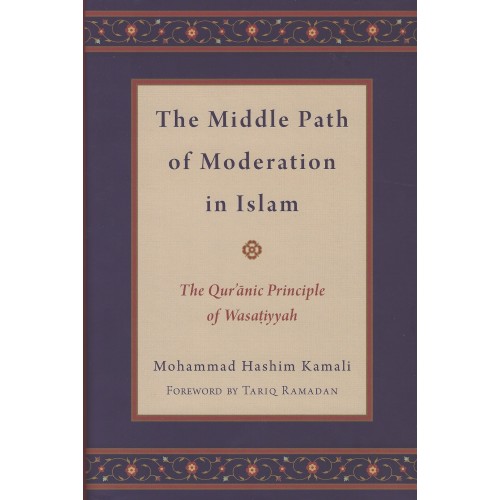
The Middle Path of Moderration in Islam (H/B)
In The Middle Path of Moderation in Islam, leading Islamic law expert Mohammad Hashim Kamali examines the concept of wasatiyyah, or moderation, arguing that scholars, religious communities, and policy circles alike must have access to this governing principle that drives the silent majority of Muslims, rather than focusing on the extremist fringe. Kamari explores wasatiyyah in both historical/conceptual terms and in contemporary/practical terms. Tracing the definition and scope of the concept from the foundational sources of Islam, the Qu’ran and Hadith, he demonstrates that wasatiyyah has a long and well-developed history in Islamic law and applies the concept to contemporary issues of global policy, such as justice, women’s rights, environmental and financial balance, and globalization.
Framing his work as an open dialogue against a now-decades long formulation of the arguably destructive Huntingtonian “clash of civilizations” thesis as well as the public rhetoric of fear of Muslim extremism since the attacks of September 11, 2001, Kamali connects historical conceptions of wasatiyyah to the themes of state and international law, governance, and cultural maladies in the Muslim world and beyond. Both a descriptive and prescriptive meditation on a key but often neglected principle of Islam, The Middle Path of Moderation in Islam provides insight into an idea that is in the strategic interest of the West both to show and practice for themselves and to recognize in Muslim countries.
Ibn Taymiyyah’s Essay on Servitude
“An enlightening book written by one of the most famous scholars of Islaam on the important subject of servitude. In this book, Shaykh Ibn Taymiyyah defines the concept of worship in Islaam and explains that to be a true “slave of Allaah” is a status of both virtue and nobility. The author proves that the title “slave of Allaah” is one of great honor which Allaah bestowed upon the best of creation, Muhammad (pbuh). While elaborating on the issue of servitude, the author highlights the prevalent traps which people fall into, when becoming enslaved by, or allowing their hearts to become attached to worldly objects. The emphasis is on servitude to Allaah which is adorned with the true love we hold for Him in our hearts — a matter of central importance for every Muslim.
Umar ibn al-Khattâb: His Life and Times (2 Vols.) -IIPH
The second caliph of Islam, ‘Umar ibn al-Khattâb faced more struggles than any other Muslim leader in the early onset of Islam. His life began in a time of ignorance and ended during the Golden Age of Islam. Under his leadership, the Muslim world was witnessing some of its most notable conquests in the history of Islam. The strength and resilience of Islam’s leaders were being tested, and ‘Umar ibn al-Khattâb’s true commitment to Allah shone to reveal an Islamic spirit unlike that found in any other Muslim leader. The standards by which he lived can teach us a lot about determination, hardship, and success. The two books which compose ‘Umar ibn al-Khattâb: His Life and Times are sold together as a set. They belong in Part II of the Islamic History Series, as the second set of The Rightly Guided Caliphs. The Table of Contents for Volume 1 of ‘Umar ibn al-Khattâb: His Life and Times may be viewed via the ‘View Table of Contents’ link located above. This book was translated into English by Nasiruddin al-Khattab. From the Translator: For those who would be leaders, this book offers the model of an ideal Muslim leader, one who felt responsible before Allah for the well being of all those under his rule, including his troops, women, infants, non-Muslim subjects and even animals. ‘Umar was a ‘hands on’ leader who kept himself informed and consulted scholars and experts before every major decision. For the rest of us, this book offers a window into an exciting and important period of Islamic history, and it also reminds of an important lesson, that our strength comes not from wealth or money or status, but from our submission to Allah and our commitment to the path of Islam.


There are no reviews yet.