| Weight | 0.55 kg |
|---|---|
| Dimensions | 16 × 21 cm |
| Product Type | Book |
| Author | |
| Publisher | IIPH |
| Pages | 341 |
| ISBN | 9789960672793 |
The Minor Resurrection – Islamic Creed Series 5
RM75.00
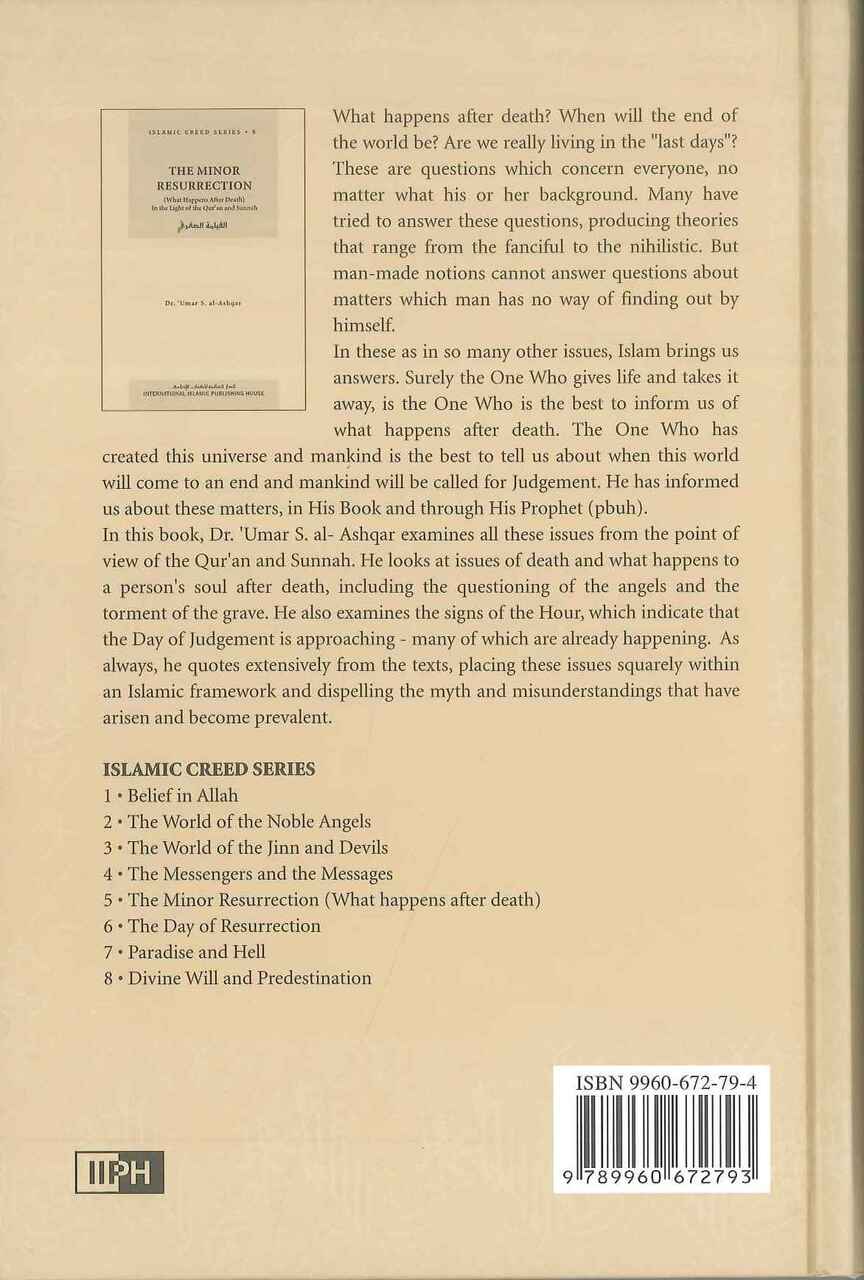
What happens after death? When will the end of the world be? Are we really living in the ‘last days’? These are questions which concern everyone, no matter what his or her background. Many have tried to answer these questions, producing theories that range from the fanciful to the nihilistic, but manmade notions cannot answer questions about matters which the human has no way of finding out by himself or herself. In these as in so many other issues, Islam brings us answers. Surely the One who gives life and takes it away is the One who is the best to inform us of what happens after death. The One who has created this universe and humankind is the best to tell us about when this world will come to an end and humankind will be called to judgement. He has informed us about these matters, in His Book and through His Prophet (blessings and peace be upon him).
In this book, Dr. ‘Umar al-Ashqar examines all these issues from the point of view of the Qur’an and the Sunnah. He looks at issues of death and what happens to a person’s soul after death, including the questioning of the angels and the torment of the grave. He also examines the signs of the Last Hour, which indicate that the Day of Judgement is approaching – many of which are already happening. As always, he quotes extensively from the texts, placing these issues squarely within an Islamic framework and dispelling the myths and misunderstandings that have arisen and become prevalent. This Islamic Creed Series of books has been translated into English by Nasiruddin al-Khattab.
Be the first to review “The Minor Resurrection – Islamic Creed Series 5” Cancel reply
You must be logged in to post a review.
Related Products
A Concise Presentation Of The Creed Of Ahlul Sunnah Wal Jama’ah
A Concise presentation of THE CREED OF AHLUS SUNNAH WAL-JAMA’AH: is an explanation on the beliefs of the Pious Predecessors of this Ummah. They include the companions, their followers and successors who have followed them in goodness and those who upheld the real and true Islam brought by the last Prophet Muhammad SAW.
Indispensable Implication of Sunnah (P/B)
The author has discusses the topic of innovation in Islam. For example, he proves that celebrating the Prophet’s birthday is not right according to the Qur’an and Sunnah.
Belief In Allah – Islamic Creed Series 1
Aqidah and Creed
Stages & Means of Seeking Knowledge (P/B)
a small excerpt from the book:
“And those who disbelieve say: “Why is not the Quran revealed to him all at once?” Thus (it is sent down in parts), that We may strengthen your heart thereby. And We have revealed it to you gradually, in stages.”[1]”[2]
Al-Zarnooji -rahimahullah- said, “Imam Sharf ul-Din al-Uqayli – rahimahullah- used to say, “My opinion regarding learning knowledge is in agreement with what our teachers taught us. They used to teach beginners level one books because they are understandable, easy to memorize, enjoyable, and common. A beginner should not write down something he does not understand because it numbs the intelligence and is a waste of time. Instead, a beginner should focus on the task of understanding his teacher through deep thinking and repetition. Significantly, the smaller the portion in one class with repetition the more progress in understanding. A famous saying states: Memorizing two letters is better than hearing two loads, and understanding two letters is better than memorizing two loads.”[3]
Paradise Its Blessings and How To Get There (P/B)
Paradise and its inhabitants as portrayed in the Qur’an and the Hadith, then discusses the various rewards and blessings that are promised to those who make it there. Finally, the author lists the many and myriad deeds that a Muslim can do that will help him or her to achieve the Garden of Eden.
Who Is Allah? (H/B)
Who is Allah? is more than just a book about Allah’s names and attributes. It aims to build a bridge between knowledge of Allah and practical application of this knowledge in a person’s daily life. By delving into why knowledge of Allah is important and how to apply this knowledge, the reader is given a means upon which to act in his or her quest for a close and rewarding relationship with Allah.
Over 100 of Allah’s names are individually discussed, providing proof from the Qur’an and Sunnah, explanation of their meanings, useful applications, and supplications utilizing each from the Messenger of Allah. Over 60 of Allah’s attributes are given specialized attention as well, all for the sake of providing a thorough and comprehensive approach to the most important subject matter that a person can learn about – Allah, the Mighty and Majestic.
The Three Fundamentals, The Four Precepts & The Conditions Of Prayer (P/B)
(I have only created Jinn and men, but to worship me)
And the most common and lofty way of worship Allah, as we all know, is to pray. Pray, pray, pray.
But how will we react if we find out that after years and years of praying, our prayer is performed incorrectly?!?!
Some of us would be angry… actually, very very angry… while some will be dissappointed and wishing that they knew the correct way of praying earlier…
This book covers all of the guidelines of prayer, and what you need to do before, after, and during prayer, to keep you from that humiliating moment of “learning it the hard way.”
So once this book is between your hands, flip through its thin pages and earn the knowledge of your deen as you sit on the cushions of a warm, comfortable couch.
Sharh Al-Aqeedat-il-Wasitiyah (H/B)
Sheikh-ul-Islam’s book Al-Aqeedah-il-Wasitiyah deals with the perfect and undefiled Islamic Faith and Creed of the As-Salaf-As-Salih (the pious predecessors) particularly in regards to Allah’s names and attributes, with solid arguments in brief words and terminology. The book is highly appreciated by the scholars for its brevity as well as comprehensiveness; and for its contents produced perfectly in line with the Qur’an and Sunnah in an appealing and manifest manner.
The eminent scholar of Islam, Sheikh-ul-Islam Imam Ibn Taimiyah, discusses the real & original faith of Islam according to the Qur’an & Sunnah. The real faith in Allah and his religion Islam is to follow the Qur’an and Sunnah strictly. Any scholar who adds or attributes or alters any basic fundamental of Islam is wrong & deviates from the teachings of Islam. Every Muslim must read this book to get the real light of Faith.
Recently Viewed
The Evil of Craving for Wealth and Status – Al Hidayah UK
This is the first English translation of the book Sharh Hadeeth Maa Dhi’baan Jaai’aan… written by the great scholar Ibn Rafab al-Hanbalee (d.795H) in explanation of the prophet. An excellent book , warning us about the dangers of expending our energies in chasing after the transitory things of this world at the expense of the rewards of the Hereafter. It shows the correct perspective that a Believer should have of this world in comparison to the Hereafter which is especially important in this age when the people’s vision have become so blurred and their priorities mixed up “wealth and children are the adornment of this world. But the good righteous deeds that last are better in your Lord’s Sight for rewards and better in respect of hope. And remember the Day we shall cause the mountains to pass away and you will see the earth as a leveled plain, and we shall gather them all together so as to leave not one of them behind.”
This book is a warning to believers about the dangers of expending our energies in chasing after the transitory things of this world at the expense of the rewards of the hereafter. It shows the correct perspective that a believer should have of this world in comparison to the hereafter, which is especially important in this age when the people’s visions have become so blurred and their priorities mixed up.
Dunia Jin Dan Setan – Serial Aqidah Islam – 3
The Tree of Faith
In this book appropriately titled The Tree of Faith, Shaykh Abdur-Rahmân Nâsir as-Sa‘di discusses this amazing tree, its roots and branches and how to nourish and feed them for excellent growth. He goes into detail regarding the definition of faith, how it increases and decreases, and its amazing benefits.
Umar ibn al-Khattâb: His Life and Times (2 Vols.) -IIPH
The second caliph of Islam, ‘Umar ibn al-Khattâb faced more struggles than any other Muslim leader in the early onset of Islam. His life began in a time of ignorance and ended during the Golden Age of Islam. Under his leadership, the Muslim world was witnessing some of its most notable conquests in the history of Islam. The strength and resilience of Islam’s leaders were being tested, and ‘Umar ibn al-Khattâb’s true commitment to Allah shone to reveal an Islamic spirit unlike that found in any other Muslim leader. The standards by which he lived can teach us a lot about determination, hardship, and success. The two books which compose ‘Umar ibn al-Khattâb: His Life and Times are sold together as a set. They belong in Part II of the Islamic History Series, as the second set of The Rightly Guided Caliphs. The Table of Contents for Volume 1 of ‘Umar ibn al-Khattâb: His Life and Times may be viewed via the ‘View Table of Contents’ link located above. This book was translated into English by Nasiruddin al-Khattab. From the Translator: For those who would be leaders, this book offers the model of an ideal Muslim leader, one who felt responsible before Allah for the well being of all those under his rule, including his troops, women, infants, non-Muslim subjects and even animals. ‘Umar was a ‘hands on’ leader who kept himself informed and consulted scholars and experts before every major decision. For the rest of us, this book offers a window into an exciting and important period of Islamic history, and it also reminds of an important lesson, that our strength comes not from wealth or money or status, but from our submission to Allah and our commitment to the path of Islam.
Three Messages from God to You
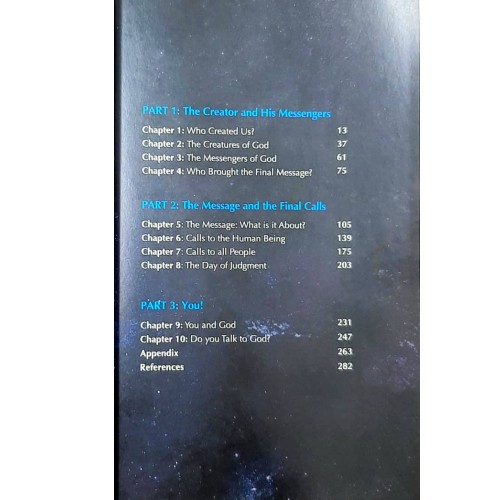
● Who created the universe? Who created us and the beings on the earth? Who gave life to billions of creatures on our plant? Is He our God? What is His name? Are there other creators than Him?
● Why do we live on the earth? What is the purpose of life? Did our creator really send us messages? What does He want to inform us? Are these messages true?
● Are the Torah, the Bible and the Quran true divine books? Are they related? Do they contain true Messages from God to us? Is there a final testament?
● Why all creatures die? Is there another life after death? Do we return to our Creator? Why?
( FREE-eBook) Secrets of Dialogue and Persuasion
Dialogue is the girdle of the intelligent and the habit of the wise. Dialogue has the greatest influence on humans during interactions and is the loftiest method of enlightenment and preaching. Dialogue is like engraving; it engraves on the souls and leaves lasting impressions on the character of the audience.
After the advent of prophethood, our beloved Prophet Muhammad (Sallalahu Alayhe Wassalam)stayed in Makkah for thirteen years without engaging in physical combat with the non-believers, he did not raise a spear nor unsheathe a sword. He was persistently dialoguing with the people of Makkah for thirteen years !
Dialogue was a well established signpost, clearly seen at every stage of the life of the Prophet (Sallalahu Alayhe Wassalam) and at the different points of his call. The most beloved speech to the people and endearing to their hearts, the most easily accepted by them is that which comes in the form of a conversation in which the listener, the addressee, contributes in speech with his tongue and reasoning while employing his intellect.
Secrets Of Dialogue and Persuasion : The Loftiest Dialogues and Most Powerful Methods Of Persuasion From The Life Of The Best Men صلى الله عليه وسلم is a study of the dialogues of our beloved Prophet Muhammad (Sallalahu Alayhe Wassalam) while inviting to the path of Allah SWT.
- How did he communicate his message to the World’s superpowers at the time, considering the and community in which he lived ?
- What responses did he receive and what lines of action did he follow?
- How did he persuade the youths and adolescents to accept his message ?
- How did he converse with his household, including the women and children ?
- What were the major elements of his dialogues that yielded the best results ?


There are no reviews yet.