





Be the first to review “(E-Book) Secret Of Leadership”
You must be logged in to post a review.
RM26.00

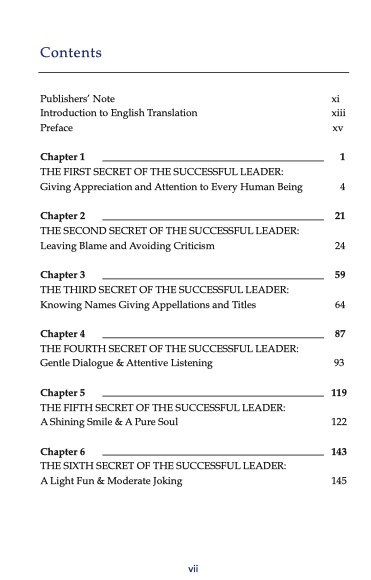
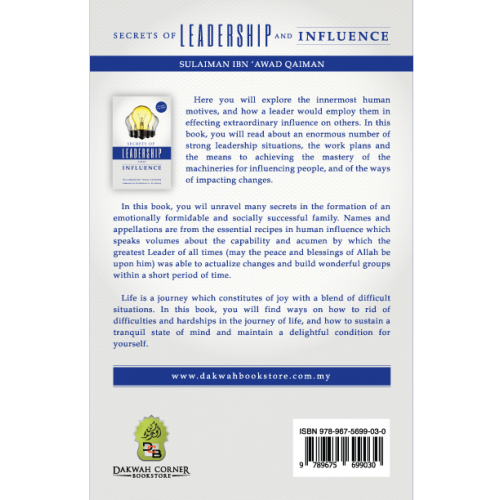
In this book, you will read about an enormous number of strong leadership situations, the work plans and the means to achieving the mastery of the machineries for influencing people, and of the ways of impacting changes. The book presents to you some illustrations from the inside of the human soul to get you acquainted with systems that can provide you with enormous strength and high aptitude toward effective leadership.
You must be logged in to post a review.
Let me say, with full conviction, that there is no chance for us, nor for any nation, to occupy a respectable place among the advanced nations without raising our cultural awareness – we are living in the age of knowledge, and we cannot do without information and books. Therefore, raising children who are really fond of reading is our first and foremost challenge – and it will take all our commitment to succeed there. Having this in mind I propose to tackle this issue in a book; and, as in the previous volumes in the series, I try to come upon solutions for the difficult dilemma – giving special attention to being true to the requirements of accuracy and reliability; maintaing, at the same time, an accessible and smooth reading. In which I hope to bring these concepts within the comprehension of a wide readership as possible.
(E-book FREE)
Ridding children of their psychological disorders, altering their behavior, and changing their habits are complex matters – and they are so in view of the wide differences between children with regard to their responding to the same therapy; we educators are also diverse with regard to our culture and situations. From this we go on to say that educational guidance can work well with a certain child, but not with another. I am often consulted about children’s problems, and I do give my advice: but I am sometimes surprised to hear that the inquirer has actually tried the same method I was suggesting, not only once, but frequently: some say that their child’s condition actually deteriorated rather than improved after applying the recommended method. Therefore, it is crucial that we have more than one approach in store for dealing with any problem; for we may need to try all the methods to help the child get rid of his/her trouble, from which they suffer, and maybe the family suffers as well.
You need to register an account when purchase ESPECIALLY E-Books from dakwahcornerbookstore.com
This will enable you to keep track your links and Password for Ebook, whenever you log in to your account. We will keep your personal information private and ensure it is safe.
You can either register for an account before or upon checking out your order.
Rekindle Your Life centres upon encouragement towards good deeds and noble characters, abstinence from sins by giving reminders in a very beautiful way about Paradise and its delight, the reality of death, turning to Allah in repentance and enlightening faith through inspired, true and wonderful stories from various aspects of life past and present.
It is noteworthy that there exist today, many educational books of good value as well as inferior ones; a fact that has caused many people to be confused in the choice of books to enrich their ability to train their children wisely and successfully.
One the other hand, the list of needs that are considered necessary for education has now expanded very greatly. And we know well that when things considered to be crucial needs have reached a hundred or two, one naturally feels a weakness to confront the challenge of providing them; which may even cause one to turn away partly or completely.
From this standpoint, my thoughts have been arrested by the need for me to discuss the master key in interacting with young people and training them, which is the mother. Perhaps by this, I will help my reader to possess and expand his latitude in understanding the psychology of child upbringing and methodology.
You need to register an account when purchase ESPECIALLY E-Books from dakwahcornerbookstore.com
This will enable you to keep track your links and Password for Ebook, whenever you log in to your account. We will keep your personal information private and ensure it is safe.
You can either register for an account before or upon checking out your order.
You need to register an account when purchase ESPECIALLY E-Books from dakwahcornerbookstore.com
This will enable you to keep track your links and Password for Ebook, whenever you log in to your account. We will keep your personal information private and ensure it is safe.
You can either register for an account before or upon checking out your order.
Endangering the smooth running of its affairs, in relation to its vision, moral values, conducts, inter-relationship, and interests. It is believed that clear apprehension of the drifts and trajectories along which a family should tread would provide the uttermost and worthwhile rectitude and success expected of a Muslim family, as it would also provide an appreciable and remarkable definition for the methodologies and techniques that are necessary for parents to adopt in their children’s upbringing.
It would be noticed that we, individual families and societies, are faced with the problem of how to relate with the overwhelming modern cultures that have been vigorously streamed on us from all nooks and crannies of the world. Moreover, in reality this problem is no more of relationship or management, the effect of those alien cultures has grown to being capable of causing a lot differences among people in our community, in relation to their manners, general practices and traditions, which are the main points of contest.
Also, Muslims generally are faced with the problem of illiteracy, poverty, and unemployment. Even among those who work, a large percentage of them engage in hard corporal jobs.
Consequently, all these have affected the level of attention the parents pay to their families, in terms of planning their family lives and projecting for the upbringing and future of their children. This makes it necessary for us to continue to discuss and write on the matter of child upbringing, as that is the only way out for us. And this is the aim of writing this book.
The present volume of our series deals with adolescence and adolescents. It is true that much of what applies to a five-year-old applies to a fifteen-year-old, but it is equally true that adolescence does involve some real difficulties that are unique to this stage. It is as if an adolescent is passing through a violent storm that needs special training and skill on the part of the adults around him/her.
An adolescent is a child that is approximating or has gone beyond puberty. More specifically, adolescence covers three sub-stages: early-, middle-, and late-adolescence. Early adolescence starts at twelve or thirteen; middle adolescence starts at fifteen or sixteen; and late adolescence lasts until twenty one or twenty two. After this, an individual is a young adult. You can say that adolescence parallels three educational stages: middle school, secondary school, and college.
You need to register an account when purchase ESPECIALLY E-Books from dakwahcornerbookstore.com
This will enable you to keep track your links and Password for Ebook, whenever you log in to your account. We will keep your personal information private and ensure it is safe.
You can either register for an account before or upon checking out your order.
What Allah the Most Exalted and the Most Mighty said concerning the meanings of love between spouses precedes what psychologists do say today. The psychologists emphasize the necessity of love in the human life and the need for every human being to love and feel the love of someone else. They assert that this human need is the foundation of rest of mind for an individual.
But how can one sustain affection throughout the years of marriage? What makes some people happy in their marriages while others fine marriage miserable? What is the real love that should prevail in every marital relationship? And what are the rights of the spouses on each other?
By Allah’s permission – this book provides comprehensive answers to these questions, compiled from a number of sources in order for us to quench the thirst of the thirsty about the issue.
“In this treatise, we wish to present certain concepts, tools and methods that will help the family to establish communication among its members; because next to Allah’s grace, it is communication that a family needs most to have mutual understanding, cohesion and success. And we would be unfair to ourselves if we find our families disintegrating before our very eyes, when there are several books and experiences that should have helped us to protect and make them choice families, happy and strong. I have tried to make this a good addition to what circulates around of literature on child upbringing available to parents. And because this work is addressed to a very wide audience, among whom are the educated and the semi-educated, I have striven to see that my expressions are as simple as possible; even though expressing ideas that have philosophical content in very simple language could do some kind of injustice to their meaning. This is why this attempt of ours is bound to still be imperfect; but sufficient it is that I have tried to aim clearly and closely as best I can.”
Awesome Quran Facts is a collection of hundreds of incredible, heartwarming and inspiring facts about the people, places, and events mentioned in the Quran.
It is ideal for children who are curious to know the facts behind these magnificent and amazing stories of faith and it brings the message of the Quran alive to readers in an easy and fun way. These interesting facts come with stunning photographs and captivating illustrations.
This book is a journey into the art of influencing people positively towards Islam.
The answer to some often asked questions are inside this book:
Can I still propagate Islam if my knowledge is weak? What potential do I have as an advocate of Islam? How do others perceive me? How can I influence someone I ve never met before?
Signature of a Muslim introduces many techniques and concepts that have not previously been associated with the science of advocating Islam. The book uses evidences from the Holy Quran and Hadith to prove that many modern concepts that look at the psychology of influence such as Neuro Linguistic Programming and the Law of Attraction are in many ways in accordance with Islamic Shariah and can even be proven from both sources.
This book has something for everyone and could be the decisive factor that helps someone you know got to Paradise.
In The Cross and The Crescent, Dr. Dirks, a former ordained minister (deacon) in the United Methodist Church, a graduate of Harvard Divinity School and with a doctorate in clinical psychology, reaches out to the Christians and the Muslims for an interfaith dialogue. Drawing on his seminary education and thirty years of interaction with Muslims in America and overseas, the author digs deep into the roots of Christianity to bring out obscure information that highlights what was once common between Christianity and Islam. He envisioned that, “In writing this book, I would like to touch the lives of those Christians who have not been given the knowledge that I have gained both about Islam, from my direct contact with Muslims, and about Christianity from my seminary education. I want to share with those Christians, who are willing to listen, what is so often known by their clergy and church leaders, but seldom finds its way into their knowledge of their own religion. Likewise, I would like to reach out to the Muslims, in order to help them understand the religious commonality that they share with Christians”.
A high contrast book that is best for your baby. Babies positively respond to high contrasting colors and it improves brain growth and visual development.
Get access to your Orders, Wishlist and Recommendations.
Your personal data will be used to support your experience throughout this website, to manage access to your account, and for other purposes described in our privacy policy.
Shopping cart is empty!
Select at least 2 products
to compare


There are no reviews yet.