| Weight | 4.555 kg |
|---|---|
| Product Type | Book |
| Author | |
| Publisher | Darussalam |
| Pages | 500 per Book |
| ISBN | 9789960587608 |
Sunan An-Nasa’i (6 Vol) (H/B)
RM460.00
Sunan An-Nasai has the fewest weak ahadith after the two Sahih collections. This Sunan is one of the six is al-Mujtaba or as-Sunan as-Sughara, which is a synopsis of a large collection of ahadith which he considered to be fairly reliable. In the smaller collection, only those ahadith which he considered to be reliable have been included.
It was compiled by the great scholar of hadith, Abu Abdur-Rahman Ahmad bin Shu’aib bin Bahr An-Nasae (Nasa’ of Khurasan) (214-303AH). Imam An-Nesai, like other great scholars of hadith traveled to Baghdad, Ash-Sham, Egypt, Mecca, and many other cities to seek knowledge. He received the praises of many scholars including Ad-Daraqutni who said about him: “He is given preference over all others who are mentioned with this knowledge from the people of his time”. Some scholars consider his compilation to have the least number of defective or weak narrations among the four Sunan. This great book of his contains 5761 ahadith, making it as an invaluable addition to anyone’s library.
Be the first to review “Sunan An-Nasa’i (6 Vol) (H/B)” Cancel reply
You must be logged in to post a review.
Related Products
Bulugh Al-Maram (Attainment of the Objective)
Bulugh Al-Maram is based upon the Ahadith of our Prophet which have been the sources of Islamic Jurisprudence. Al-Hafiz Ibn Hajar Al-Asqalani (Hijrah 777-853) has recorded the true significance of the Ahadith and their origins & also made a comparison of the versions, if the sources are more than one
A Treasury of Hadith
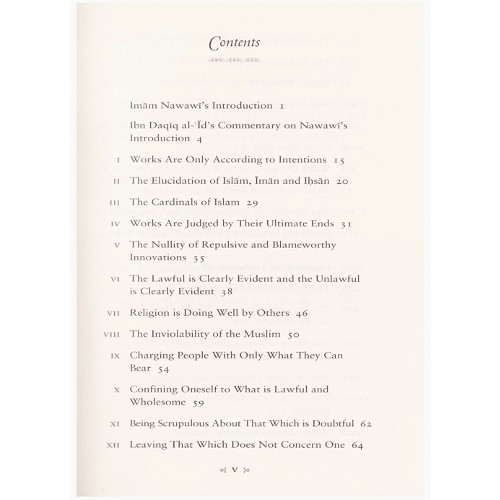
This classical short commentary on Imam Nawawi’s famous collection of forty-two traditions of the Prophet Muhammad, may Allah bless him and give him peace, is an authoritative introduction to key Islamic principles and teachings, Accounted as hadith master, in this collection Imam Nawawi collected together those traditions that he considered were axial to the entire Islamic faith. As the first title in Kube’s new Treasury Series in Islamic Thought and Civilization, this accessible translation is presented in a beautiful gift format.
Ibn Daqiq al-‘Id (d.1302) was a Shafi’i mujtahid imam, who was educated in Damascus, Alexandria, and Egypt. Accounted as one of the greatest scholars in Islam in the fundamentals of law and belief, he wrote extensively in the areas of law, principles of jurisprudence, hadith, and tenets of faith. Imam Nawawi (d.1277) was accounted as an Imam of the later Shafi’i school and was known for his piety and knowledge.
Authority of The Sunnah the Key to Paradise
Allah Most High Said, “And whatever the Messenger has given you, take it; and what he has forbidden you, refrain from it.” [Al-Hashr (59):7]
The Prophet said, “I have not left out anything of which Allah, The Most High has Commanded you with except I have apprised you of it. Likewise, I have not left out anything of which Allah has Prohibited you from it, except I have apprised you of it…” [Al Bayhaqi, 7/76 & others]
Together with the Qur’an, the Sunnah is the pivotal foundation and primary source of the Islamic faith. Following both of them is mandated by Allah Himself and obligated upon Muslims to adhere and live accordingly. Muslim theology is established upon them and remains defective and incomplete should either be forsaken for they both explain and interpret each other.
During his time, Imam al-Suyuṭi felt a genuine need to pen this compelling book in confuting those who either rejected the Sunnah altogether or did not grant it the status and respect it deserves in the religion. He primarily compiled from the works of Imam Al-Bayhaqi elucidating the position of Imam Shafi’i, and firmly laid out the arguments supporting the Sunnah of the Prophet by outlining its critical importance, its authority, and implication to one’s life.
Salvation, therefore, lies in embracing the Sunnah fully, for indeed it is the key to facilitating our worldly lives and thereafter, unlocking the doors of Paradise, as Shadh ibn Yaḥya said perfectly, “There is no better way to Paradise than the way of those who have followed the Sunnah.”
40 Hadiths Relating to Islamic Finance
A comprehensive guide that every Muslim should possess, 40 Hadiths Relating to Islamic Finance by AbdulShaheed Drew untangles some of the intricacies of finance and economics, bringing forth a Sharia-compliant solution to earning and using wealth. This collection presents authentic hadiths and clear explanations, showing how they relate to contemporary circumstances. Read and study it to be empowered with general knowledge relating to wealth in Islam, so that you can earn and spend your money the halal way.
Forty Hadiths On Good Moral Values (H/B)
The statements and actions of our Prophet Muhammad (s) contain much that we need: rules and advice, reminders, examples, warnings and encouragement. The collection of hadiths in Forty Hadiths on Good Moral
Values by Yahya Ondigo contains some of the Prophet?s statements on positive ethics and attributes that all people-Muslims and non-Muslims-should strive to adopt in the way we deal with others; we need to work to incorporate these morals and principles into our daily habits.
Understanding Ramadan
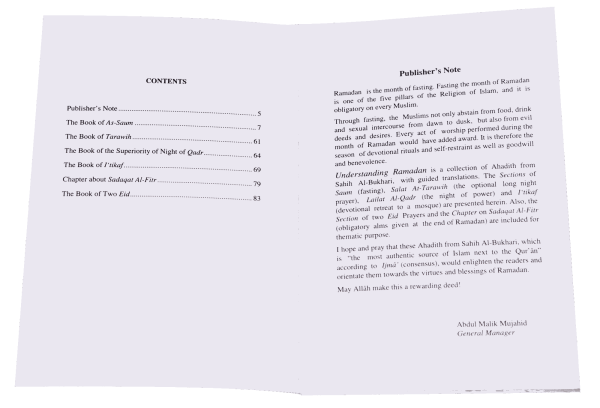
This book covers important aspects regarding Ramadan. The book is a collection of Ahadith from Sahih Al-Bukhari, with guided translations. The topics which are covered are Fasting, Salat at-Tarawih, Lailat Al-Qadr and Itikaf. Also, the section of two Eid Prayers and the chapter on Sadaqat Al-Fitr are included for the thematic purpose. This book is a must-read for all.
44 Ways to Manhood (H/B)
What does it mean for a Muslim man to have a personality that is in accordance with the Islamic guidelines? In this informative and enlightening book, based on the teachings of the Qur’an and Sunnah, Taymullah Abdur-Rahman presents 44 principles that Muslim men need to implement in their lives. This book will be a useful resource for Muslim men of all ages, as well as in study circles and family discussions.
Sunan Ibn Majah (5 Vol. Set) (H/B)
Sunan Ibn Majah is one of the six most authentic collections of the Ahadith and contains 4,341 total Ahadith. Like the other translations of the six books of hadith, Dar-us-Salam Publications, has taken great care in correct translation, simple and clear modern English language, and high quality publishing.
Ahadith in the book are followed by comments to explain issues and to help readers derive lessons. To aid readers further, Dar-us-Salam, has added several features like section on how to benefit from Sunan Ibn Majah, about the Arabic and technical terms used, information about the hadith compilations and a glossary of Islamic terms in the last volume.
Each hadith is also followed by its status in regards to the authenticity. The status is explained more in detail in the Arabic text. The chain is also complete in the Arabic text while it is removed from the English to reduce the length and not being of much benefit to the English readers.
Collection from Riyad-us-Saliheen -Pocket Size (Softback)
This edition of Riyad-us-Saliheen has selected hadith from the full 2 volume edition. It has Arabic text, followed by English translation. It does not contain commentary like the larger editions.
Imam Nawawi was a great scholar of Hadith and Fiqh of his time. He compiled Riyad-us-Saliheen which acclaimed an important position in the Hadith Collections. It is an extremely popular and useful compilation of authentic hadith. Commentaries on the Ahadith were added by Hafiz Salahuddin Yusuf of Pakistan.
Keeping in view the problems of our times, we wished to print a concise volume of Riyad-us-Saliheen. For this volume, Sheikh Safi-ur-Rahman Mubarakpuri has made the selection of Ahddith.
Recently Viewed
Islamic Rulings on Menstruation and Postpartum Condition
The birth of human being is a most amazing phenomenon. The physical cycles that the body of woman must endure in order to maintain this act of creation should be respected to the highest degree. Allah mentions that our mothers have born us with difficulty and struggle and because of this are due the highest respect. one among many of the difficulties that women must brave, are the doubts that these conditions present to the correct obervance of her religion. How is her fassting affected, how are her prayers affected, how is her ability to pursue her studies, and how are her conjugal relations affected by her ever changing physical condition in relation to her as the sole vessel of the birth of man. A really valuable publication by Darussalam for all Muslim woman to study
Development of Science & Technology In Islamic History (P/B)
The objectives of this book are:
1- To examine the argument that there is a contradiction between science and Islam.
2- To highlight some of the great contributionsmade by Muslims to science and technology over a period of 1000 years.
Science has never been separate from Islam. Objective study of this subject will reveal that Islamic texts – Qur’an and the Sunnah, provided a tremendous boost for study of the physical world and the laws that govern it. As a result, discoveries and inventions became the hallmarks of the Islamic civilization. Recently there has been a surge in the number of publications dealing with science and its relationship with Islam.
These books have focused on the various verses on the Qur’an that point to the physical world to prove that science is compatible with Islam. However, areas that are not covered enough for the English reader are the historical development of science and technology in the Muslim world, and the factors that led to its rise and decline. The decline has been so severe, that today’s Muslims are not even aware that their ancestors were the founding fathers of modern sciences. Just consider the common Arabic words used in the English language today like cotton, algebra, aorta, alcohol, chemistry, earth and alkaline. They are a living testimony to the pioneering work of the Muslims.
I am proud to introduce this inspiring book to our readers. It focuses on the strides made by the Muslims in various disciplines of science and technology from the early period of the Islamic State to its last days in the 20t’ century CE. The unique aspect of this book is that it sheds light on the key factors that led to the rapid advances in science and technology. Furthermore, it also analyses the reasons why Muslim World declined in this field, and last but not least, how the Muslim World can achieve the same kind of success as we already have in the past. Abdul Malik Mujahid About the Author Shabeer Ahmad, born in 1966, is a respected technologist by profession. He studied Avionics Engineering at University of London and he is currently an IT Consultant, having worked in Asia, Europe, Middle East and North America. The author has written widely on various subjects in Islam, including science, economics, politics and history.
The author is also a well respected speaker. The current book started as a lecture for a radio station in London. Given the massive interest it generated, and the little information available, the author began to research more into historical developments of science in the Muslim world. The author felt that the contributions of Muslims in this area have not been widely acknowledged, and that there is a need to counter the view that Islam is incompatible with science. The current book is a culmination of his research over the years.
Qur’anic Terminology a Linguistic and Semantic Analysis (IIIT)
There is no way to understand the Qur’an properly, or to elucidate as accurately as possible the meaning of its verses, without studying Qur’anic terminology and concepts. Taken together these sum up the universal truth of the Faith (the great moral code), not only animating the text and giving it incredible life, precision, and flexibility, but also enriching the communication of the Qur’anic message through their beautiful and comprehensive nature.


There are no reviews yet.