| Weight | 0.145 kg |
|---|---|
| Dimensions | 23 × 15 × 0.07 cm |
| Author | |
| ISBN | 9781565646650 |
| Pages | 94 |
| Product Type | Book |
| Publisher |
The Miraculous Language of the Qur’an (IIIT)
RM48.00
This study illustrates why the language of the Qur’an is miraculous, unique, and evidence of divine authority. The author compares the language of the Qur’an with the language of pre-Islamic poetry, the Prophet’s words (hadith), and the language of the Arabs both past and present, to demonstrate that although the Qur’an was revealed in Arabic it was at the same time an Arabic which was entirely new. Original and early Muslim audiences viewed this as miraculous and responded to the Qur’an’s words, sounds, rhythms, etc. in a manner consistent with a deeper appreciation of its beauty and majesty which modern ears, trained by familiarity, and despite being surrounded by all manner of dictionaries and studies, are at a loss to capture. The author attempts to remove this veil and present the Qur’an to readers as if hearing it for the first time, to bring to life some of this wonder. In doing so he guides readers to appreciate the beauty of the Qur’an, to become more immersed in it, and to have a clearer understanding of its structure and flow. Devoting special attention to Surah Al Muddaththir, to underpin his analysis, Saeh thus brings the Revelation to life, to demonstrate that each surah has distinct features and characteristics that make it stand out uniquely within the design and sweep of the whole.
Be the first to review “The Miraculous Language of the Qur’an (IIIT)” Cancel reply
You must be logged in to post a review.
Related Products
The Meaning of The Holy Qur’an -Pocket Size (P/B) (IBT)
This very handy pocket-sized edition contains the complete meaning of the Holy Qur’an, without the Arabic text and the commentaries. Weighing just under 170 grammes, sized 9.5 cm X 13 cm and with a thickness of 1.5cm, it is intended as a handy travel companion as well as a gift to friends and colleagues.
Divine Speech
The Quran, the sacred scripture of Islam, is revered as the spoken word of God by approximately one-fifth of the world’s population. Since its inception, the power of the Quran has derived not only from its message, but also from the inimitable literary style and rhetorical impact that the Arabic scripture has on its audiences. Divine Speech: Exploring the Quran as Literature attempts to make some of the most recent Arabic and European-language scholarship on its literary features accessible to a wider, English-speaking audience. These features include its language and word choice, its use of figures of speech and other rhetorical devices, its manner of narrating parables and stories, and the structure, coherence, and the order of its “chapters”-aspects that typically remain mysterious to readers of English translations of the text. Divine Speech furnishes its readers with a better appreciation of the Quran from a literary perspective, and in the process stimulates interest in, and provides tools and resources for, further study of the scripture.
Four Key Concept of the Qur’an
Four Key concepts oF the Qur’An elucidates these basic Qur’anic concepts Ilah, Rabb, Ibadah and Din in order to bring out fully the Islamic way of life, as distinct from other perspectives. This elaboration goes a long way in developing a sound understanding of the Qur’an. It also explains the man-God relationship in Islam, guiding Muslims on how to lead their lives in total surrender to Allah.
The Light of The Qur’an
The Prophet peace and blessings of Allah be upon him, passed by a person reciting Surah Al – Kafirun and remarked, “He has been saved from shirk”. He passed by another reciting Surah Al – Ikhlas and remarked. Paradise has become obligatory for him. Reported by Muslim.
These two chapters have both been given the title Al-Ikhlas, or purity of faith, because they deal with the topic of Tawhid in all its various aspects. Al – Ikhlas concentrates on the pure, essential faith in Allah that all mankind is required to have. Al – Kafirun deals with purity of deed and disavowal of disbelief and paganism. Both chapters lay out the parameters of mans relationship with his/her lord and creator, as well as his/her relationship those around him/her.
Pure, unblemished monotheism combined with sincerity in belief and deed defines the relationship with Allah. Hi is one and only true God, unique, without peer, equal or opposite, and nothing is like on to him. He is the one who stands in need of nothing whereas everything is in dire need of him.
Maintaining the essential Muslim identity and character defines the relationship between the Muslim and his fellow man. The Muslim is unambiguous about his religion, truthful and upright in speech, deed and his dealings with those around him. Hi is proud of his faith and has unshakable conviction in it. He loves his lord, his Messenger and the Muslims and is loyal to them. Because of this, the dearest thing to him is his religion and he will not compromise it, pleasing Allah comes before pleasing the people.
The prophet would frequently recite these two chapters in prayer because of the commonality of their theme and to stress that success is achieved, in this life and the next, by internalising their message and living by it.
The Sources of the Qur’an
“Who is the author of the Qur’an?” On this subject scholars have flagrantly contradicted each other. This work attempts to make a critical review of the major ‘authorship’ theories by pressing into service logical arguments, historical evidence, textual analysis and scientific data. Probably, the only point of agreement about the Qur’an is that it was uttered for the first time by a man who was born in Makkah (Mecca), a city of Arabia, in the sixth century—a man by the name of Muhammad (blessings and peace be upon him). As to the source of the Qur’an, scholars are divided into three main groups: those who believe that Muhammad (blessings and peace be upon him) himself was the author; those who believe that he was not the author himself but learned it from another human author or authors; and those who believe that the Qur’an has no human author but is rather a word-for-word revelation from God. Hamza Njozi examines the three theories and comes to a firm and logical conclusion.
Paragons of The Qur’an (P/B)
In discussing the unique style, theme and content of the Qur’an – this is the first work of its kind in English literature.
There are a numerous verses in the Noble Qur’an by which Allah, the Most High, brings Greater clarity and insight when explaining things to mankind. This is done through the use of deep and meaningful parables that are clear for human intellect to comprehend, ponder over and understand the message of the Qur’an. It is from his infinite Wisdom that Allah destined these divinely revealed parables to become rooted in His Final Revelation, until the Last Day – through which mankind can increase in knowledge, recognise guidance and embrace the truth.
This book explains many parables in the Qur’an, in such depth – exquisitely and beautifully. It is an amazing work that will get the intellect thinking and pondering over the beauty and precisions of the Magnificent Qur’an, guiding mankind to the straight path. Not only is this work an intellectual discourse, but also a spiritual enlightenment for every Muslim.
It is a timely translation of one on the finest, yet concise books written on the topic. Not only is this work an intellectual discourse, it also provides inspiration and instils spiritual enlightenment for every Muslim who seeks to create a stronger bond with the Mighty Book Of Allah.
In discussing the theme of some of these verses, this book exquisitely and beautifully explains many parables found therein, the depth of which will stimulate the intellect to ponder over the beauty of the articulated literary style and precision of the Magnificent Quran, guiding mankind to the straight path.
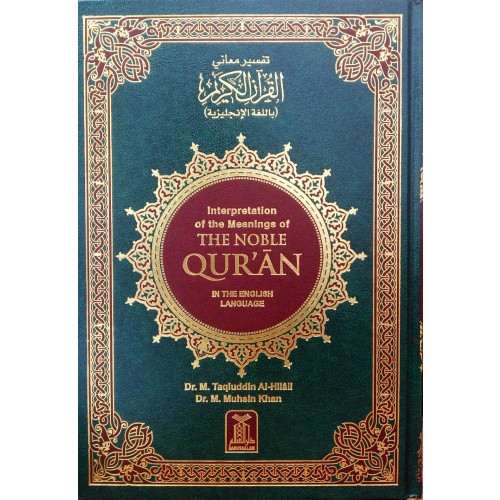
Interpretation of the Meanings of the Noble Qur’an in the English Language (17x24cm)
Note: Any order for this item, Please send to us your information details at sale@dakwahbookstore.com.
This item will be shipped directly from Dawah Corner Bookstore, Makkah to your address.
New type of Noble Quran with Arabic Mushaf Uthmani 15 lines/page print on the right side and English translation on the left side of every page. It also includes tafsir footnotes on the bottom of the English page.
Interpretation of the meanings of The Noble Quran with Arabic text in the modern English language.
The Magnificence of the Qur’an is a book that relates to us the countless miracles and benefits of the Holy Book of Islam. It expands on numerous aspects of the Quran, all of which point to its magnificence, as signified by the apt title. The author discusses everything from the methodology of studying the Qur’an to its characteristics, qualities and the manners with which one should approach it. It is much like a user’s manual that opens up a world of knowledge and facts about the Qur’an. For all audiences, this book is an invaluable companion to the Qur’an and one which serves to remind us of its eminence and its superiority to all other books. By discussing a series of seemingly miscellaneous topics, the author manages to create a whole picture of the Qur’an which surpasses any other guide of this academic nature.
114 Tips to Help You Finally Memorize The Qur’an (P/B)
“114 Tips to Help You Finally Memorize the Qur’an is a concise book that aims to equip readers of all backgrounds with the information and techniques necessary in order to begin, continue with, and complete the memorization of the Qur’an, eliminating thereby the common excuse and reasons for not memorizing.”
The Noble Quran Word-By-Word Translation & Color Coded Tajweed A5 Size (Arabic-English)
Al-Quran Al-Kareem is a translation learning method of word-by-word Al-Quran with every word and sentence is colored differently, in Arabic and English.
Every word in the Quran was translated literally so that the reader could understand the meaning of every single word. It needs to be remembered that not all literal translation represents the exact meaning of the word since the Quran uses varied Arabic language style and sometimes metaphor.
Accordingly, to understand the full or intended meaning of the word or the verse, Muhsin Khan’s the Holy Quran Translation had been included in this edition. However, to comprehend more of the meaning of the Quran, reading the commentary of the Quran from trusted scholars would be necessary.
Approved by the Department of Islamic Development of Malaysia (JAKIM) and Malaysian Ministry of Home Affairs (KDN).
Features:
● Rasm Uthmani script in English
● Word-by-word translation Arabic-English
● Color coded tajweed
● Thematic Index
Daily Wisdom: Selections from the Holy Qur’an (H/B)
This beautiful presentation of a selection from the Holy Qur’an engages the reader in a moment of daily reflection. Edited for ease of comprehension, English-speaking readers will find this compilation both spiritually enriching and easy to understand. With 365 verses covering the whole year, this is a must for every home.
An introduction to the Qur’an and its eternal message for humanity is included, giving the reader an insight into its origin, purpose, and style.
Abdur Raheem Kidwai is professor of English at the Aligarh Muslim University in India and the well-known author of many works on the Qur’an and Islam.
Recently Viewed
( E-Book) A Child Reads (Successful Family Upbringing Series-06)
Let me say, with full conviction, that there is no chance for us, nor for any nation, to occupy a respectable place among the advanced nations without raising our cultural awareness – we are living in the age of knowledge, and we cannot do without information and books. Therefore, raising children who are really fond of reading is our first and foremost challenge – and it will take all our commitment to succeed there. Having this in mind I propose to tackle this issue in a book; and, as in the previous volumes in the series, I try to come upon solutions for the difficult dilemma – giving special attention to being true to the requirements of accuracy and reliability; maintaing, at the same time, an accessible and smooth reading. In which I hope to bring these concepts within the comprehension of a wide readership as possible.
In The Shade Of The Qur’an (18 VOLS)
This is volumes 1 to 18 (Surahs 1 to 114, the entire Qur’an) of Qutub’s Shade.
In the Shade of the Qur’an is more than ‘just another’ commentary; yet it is not too over-reaching or outlandish to be a completely new interpretation. It is an earnest, sincere, and sober look at man’s contemporary achievements and difficulties in the light of the message of the Qur’an. It is an effort to vigorously explore its rich wisdom, and expand its invaluable guidance for the benefit of an increasingly ‘sophisticated’, yet highly perplexed modern society. The work, which is by far Sayyid Qutb’s largest and most profound, spans the whole of the text of the Qur’an. It was written, and party re-written over a period of more than 15 years, most of which the author had spent in Egyptian prisons, during the 1950s and 1960s. In it is embedded Sayyid Qutb’s insight, highly esteemed intellectual vigor, and his widely-acclaimed literary prowess. This book has been universally recognized as an outstanding contribution to Islamic thought and scholarship, to which students and scholars, as well as contemporary Islamic revivalist movements all over the world, owe a great deal. Now that it is available in English, it will continue to enlighten and inspire millions more. It will take its rightful place as an indispensable work of reference for a proper understanding of contemporary Islamic thinking.


There are no reviews yet.