| Weight | 0.57 kg |
|---|---|
| Dimensions | 14 × 21 cm |
| Product Type | Book |
| Author | |
| Publisher | Darussalam |
| ISBN | 9786035000475 |


The Valley Came Alive (H/B)
RM60.00 RM42.00
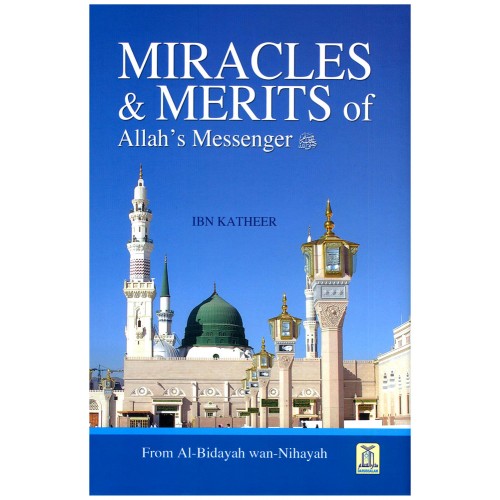
Darussalam is proud to present the abridged English translation of the classic work: Al-Bidayah wan Nihayah, focusing exclusively on the life of Prophet Muhammad (peace be upon him). This volume contains a detail account of the life and times of the Messenger of Allah taken from a number of historical and traditional sources. The book reports the events of his blessed life, his battles, military campaigns, the delegations that met him, and sheds light upon the unique exemplary qualities, virtues and signs of his Messengership that make him a guide and role-model for all of humanity until the end of time.
A1-Bidayah wan Nihayah (The Beginning and The End) by the renowned scholar Abu Al-Fida ‘Imad ad-Deen lsma’eel bin ‘Umar ibn Katheer, is considered one of the most authoritative sources on Islamic history.
Be the first to review “The Valley Came Alive (H/B)” Cancel reply
You must be logged in to post a review.
Related Products
Bayt al-Hikmah The House of Scientific Wisdom (IIPH)
This book, authored by Luqman Nagy, is an introduction to the history and legacy of the great translation movement that began at the Bayt al-Hikmah in ninth century Abbasid Baghdad and culminated centuries later in Spain, with teams of Muslim, Christian and Jewish scholars translating works of Greek and Islamic science from Arabic into Latin. These translations became the first scientific textbooks to be used at many European universities. This wealth of knowledge that was made available in Latin helped initiate the Renaissance, or ‘rebirth’ of learning in the West.
Let Us Remember Allah And Praise Him
Remembrance, praise and supplication – dhikr and du‘â’ – are the core of worship of the Divine. The Noble Qur’an and the last Prophet (blessings and peace of Allah be upon him) have stressed this point and taught us how to attain Allah’s pleasure through calling on Him and remembering Him in words of praise and thankfulness. This small book is a valuable collection of daily supplications from the Qur’an and the authentic hadiths. It contains the Arabic text, full transliteration and clear translation of the meaning of dozens of phrases of remembrance (dhikr) and supplication (du‘â’). This new and revised edition of Let Us Remember Allah and Praise Him is designed to be easy to use: its full-sized page format ensures that the print is large enough to read effortlessly, and yet its ultra-slim volume makes it no trouble to slip into a handbag
or backpack. It is truly a practical handbook for every Muslim desiring to seek peace in this earthly life and salvation in the hereafter.
Fatawa-fatawa Tentang Wanita (H/B)
Buku ini merupakan kumpulan fatwa-fatwa pilihan yang berkaitan dengan masalah wanita, yang dihimpun dari fatwa-fatwa Syaikh Abdul Aziz bin Baz, Syaikh Muhammad al-Utsaimin, Syaikh Abdullah al-Jabrain, dan fatwa-fatwa Lajnah Da’imah lil-Ifta’. Buku ini penting dimiliki setiap muslimah, karena di dalam buku ini terdapat jawaban-jawaban atas persoalan-persoalan yang dihadapi atau dialami oleh wanita muslimah dalam kehidupannya, di mana banyak dari persoalan-persoalan tersebut yang tidak didapatkan jawabannya dalam buku-buku klasik.
This is the Indonesian translation of Fatawa: Rulings for Muslim Woman. Acquiring knowledge of Islam is incumbent upon every Muslim – male and female – in order to live one’s life according to the commands and recommendations of the Qur’an and the Sunnah of Allah’s Messenger (blessings and peace of Allah be upon him). Naturally, women have some specific issues that concern them and that are different than those that concern all Muslims or only men. In this book, these rulings, or fatâwa, have been compiled from the religious verdicts of well-known and respected Islamic scholars, both past and present — Shaykh ‘Abdul-‘Aziz ibn Baz, Shaykh Muhammad ibn ‘Uthaymeen, Shaykh Ibn Jibreen, and the Standing Committee for Scholarly Research and Issuing Fatwas (Saudi Arabia). The rulings are derived from the Qur’an and the Sunnah. The rulings were compiled in this book by Muhammad al-Musnid and translated into Indonesian/Malay by Uril Bahruddin. This book is a compendium of such rulings in a question-and-answer format, catering to the special needs of the Muslim woman. It is a concise and readily accessible reference, and an invaluable addition to the Muslim woman’s personal library.
Islam and The World (IIPH)
Despite the world’s tremendous advances in the fields of science and technology, almost all communities have been led into the wilderness of fear, greed, loneliness and spiritual despair. Professor Nadwi explicitly asserts that the achievements of science and technology did not match humanity’s moral or spiritual aspirations. Should a corresponding improvement is attained in human behaviour by applying the teachings of Islam, such as advances would have conferred benefits on all parties.
Wahhabi Islam From Revival And Reform To Global Jihad
Until September 11, 2001 few Westerners had ever heard of “Wahhabism.” Now most of us recognize the word as describing an austere and puritanical type of Islam, mentioned frequently in connection with Osama bin Laden and Saudi Arabia and often named as the inspiration behind the 9/11 terror attacks. The word “Wahhabi” stems from the name of the founder of this system of thought, Muhammad Ibn Abd al-Wahhab (1702-1791), companion and religious adviser to Muhammad Ibn Saud, founder of the House of Saud. In this book Natana DeLong-Bas offers an in-depth study of the written works of al-Wahhab. She focuses on four areas: theology, legal theory, proselytizing through education and jihad, and law on women. Through a close reading of al-Wahhab’s texts she demonstrates that many aspects of 20th- and 21st-century Wahhabi extremism do not have their origins in his writings. Examples of this extremism include the emphasis on jihad, martyrdom and militancy, and misogyny. The strict division of the world into dar al-Islam and dar al-kufr, according to which only Wahhabi adherents are considered to be true Muslims and all others are non-Muslims who must be fought, is entirely absent from al-Wahhab’s work. Instead, argues DeLong-Bas, all of these themes were only added to Wahhabi teachings in the 19th century following armed engagement with the Ottoman Empire. DeLong-Bas’s study fills an enormous gap in the literature about Wahhabism by returning to the original writings of the founder of the movement. She debunks the common journalistic portrayal of Muhammad Ibn Abd al-Wahhab as an illiterate, rural bumpkin with no scholarly formation. Her revisionist reading of al-Wahhab’s thought will be controversial but impossible to ignore. The book will be essential reading for students and scholars of Islam as well as for those interested in the background of this dangerous modern ideology.
Making Sense of the Portents of the Hour (H/B) – IIPH
Are things inevitably getting worse and worse, year after year, century after century, with no way to alter the course of events? Is the Muslim Ummah doomed to experience failure and humiliation until the Mahdi arrives? Will he restore its former glory and bring victory over all its enemies? Are all our efforts to support Islam destined to end in failure? Instead of taking action, should we simply wait for the return of Jesus (peace be upon him) towards the end of time? Is the Dajjâl (Antichrist) alive today? Does he have secret connections with some prominent world figures? Is the hour very close? Could it come upon us at any moment, on any day? If so, what is the point of striving to improve our situation?
Using evidence from the Qur’an and the Sunnah, the author explains the true Islamic teachings on the portents of the hour, clearing up some of the misconceptions about them and giving advice on how Muslims should respond to them. The book is an interesting and informative read that will leave the reader empowered with knowledge.
Atlas on the Prophet’s Biography Places, Nations, Landmarks
Seerah and Biographies
Umar ibn Abdul-Azeez The Just Caliph (IIPH)
This book, written by Luqman Nagy, highlights the life and times of ‘Umar ibn ‘Abdul-‘Azeez, a truly exceptional Muslim ruler who, during his twenty-nine months in office, governed the Ummah totally in accordance with the Qur’an and the Sunnah. His sincere devotion to the religion of Islam enabled ‘Umar ibn ‘Abdul-‘Azeez to bring prosperity and contentment not only to the Ummah but to all those residing within the Umayyad state.
The Purity of Muslim (P/B)
According to a well-known hadith, cleanliness and purity are half of the faith. It is obligatory for a Muslim to be clean and in a state of purity in order to offer formal prayer and recite the Quran by way of ablution, a ritual shower, or dry ablution. Purity and cleanliness encompass both physical and spiritual aspects. Physical impurities can be removed by clean, pure water or dry, clean earth or stone, and this is a beginning step for spiritual cleanliness. In the Purity of the Muslim, Saeed al-Qahtani explains in a clear and comprehensive manner the types of various impurities and the ways to attain purity and cleanliness according to the teachings of the Quran and of the final prophet, Muhammad (blessings and peace of Allah be upon him).
A Mercy to the Universe
Mercy is clemency and forbearance; mercy is the disposition to forgive or show compassion; mercy means a favor or a blessing; mercy further denotes the qualities of kindness, sympathy, generosity, and beneficence. Suffice is to say that all of these qualities were present in abundance in the character of the Prophet Muhammad (May Allah have his peace and blessings on him).
He was a mercy not just to believers, but to disbelievers as well, for he would invite them to come out of darkness and into the light of true guidance. He is a favor and blessing for mankind, not just the Arabs, the people among whom he was sent, but for people of all races and colors. His staunchest enemies became his closest followers when the cloud of blind prejudice was removed from their sight and when they were able, for the very first time, to see with clarity the true nature of the Prophet’s character.
This book deals with many of the qualities that the Prophet possessed that made him the mercy to everyone. It starts with His perfect lineage, His noble upbringing, and his fully dedicated worship. This book then gives many of the qualities of the Prophet including his generosity, humbleness, bravery, patience, and leadership to name a few. Each chapter includes examples from the life of the Prophet on how he was the perfect living example of that quality. The book ends with the perfection of life of the Prophet with his farewell sermon and even his noble death where he demonstrated some of those qualities as well.
Recently Viewed
Principles of Islamic Jurisprudence (2nd Revised Edition)
This book offers a detailed presentation of the theory of Muslim law (usul al-figh). Often regarded as the most sophisticated of the traditional Islamic disciplines, Muslim jurisprudence is concerned with the way in which the rituals and laws of religion are derived from the Qur’an and the Sunna – the precedent of the Prophet. Revelation, which is given to man to restore unity and help him achieve a just and devout order in society as well as in the soul, must be interpreted so as to render it practicable in every culture, while not betraying its spirit and immutable provisions. To achieve this, additional sources of legal authority are recognized, including consensus (ijma), analogical deduction (qiyas), public interest (maslaha) and local customary precedent (urf). In employing these, the jurist guards the five principles which it is the purpose of Islamic law to uphold, namely, the right to life, sound mind, property, lineage and religion.
What Every Christian Should Know About Islam (P/B)
Of the many books explaining Islam, few specifically address the concerns and questions of those from a Christian background. Moreover, the commonalities between the Abrahamic faiths—Judaism, Christianity, and Islam—are too often ignored. Set out in an easy and informative question-and-answer format, the book addresses the specific theological points of agreement and difference between Christianity and Islam, explains the core religious beliefs and practices of Islam, and answers today’s most common questions of Islam and Muslims in an age when there is much conflict and misunderstanding. Islam is best judged not by the limitations and transgressions of its most extreme, ignorant, and outlandish followers, but by the example of its moderate majority, and Ruqaiyyah Waris Maqsood presents this introduction to the theology and practice of Islam in an attempt to explore some of the false impressions that surround it.
Table of Contents:
Section 1: The Religious Beliefs of Islam Explained
Section 2: the Religious Duties of Islam Explained
Section 3: Miscellaneous Questions
Section 4: Christianity and Islam
Ruqaiyyah Waris Maqsood gained an honors degree in Christian Theology from the University of Hull in 1963 and then taught religious studies at various state schools until her retirement in 1996. She converted to Islam in 1986 and now lectures and writes on Islam.


There are no reviews yet.