| Weight | 0.36 kg |
|---|---|
| Product Type | Book |
| Author | |
| Publisher | IIUM |
| Pages | 222 |
| ISBN | 9789674180119 |
Zakat and Poverty Alleviation (P/B)
RM66.00
This edited book aims to raise issues pertaining to the topic of zakat and its primary goal of poverty alleviation. It portrays the dynamism of zakat by highlighting pertinent issues on the management of zakat institutions and innovative programmes that are designed as effective distribution mechanisms. Discussions include zakat payment motives, ways to measure the efficiency of zakat disbursement, economic development initiatives, housing programme, microfinancing, and actual impact on poverty alleviation. The discussions raised put emphasis on policy-orientation with dedicated sections on policy implications and recommendations. This approach is deemed necessary since it could guide the thought process of interested parties towards the creation of new ideas to actualize zakat as a very reliable tool in addressing the massive problem of poverty among Muslim communities. This special feature also significantly adds to the much-needed reference materials in courses on zakat at the intermediate level of undergraduate studies and introductory level of postgraduate programmes.
Be the first to review “Zakat and Poverty Alleviation (P/B)” Cancel reply
You must be logged in to post a review.
Related Products
Tajdid, Islah and Civilization Renewal in Islam
The history of Islamic thought is marked by a continuous tradition of internal revitalisation and reform embedded in the principles of islah, and tajdid. The ultimate purpose has been to bring existing realities and social change in line with the transcendent and universal standard of the Qur’an and Sunnah through a process of restoration and reform. The tradition of islah-tajdid has thus consistently challenged the Muslim status quo and prompted fresh interpretation of the Qur an and Sunnah, understood and implemented through the methodologies of interpretation and ijtihad, as well as the rejection of unwarranted accretions to the original messages of Islam. The basic theme of the paper is that civilisational renewal is an integral part of Islamic thought. The paper looks into the meaning, definition and origins of tajdid and islah and their relationship with ijtihad, and how these have been manifested in the writings and contributions of the thought leaders of Islam throughout its history. It also develops tajdid-related formulas and guidelines that should lead the efforts of contemporary Muslims in forging the objectives of inter-civilisational harmony and their cooperation for the common good.
Sukuk: Principles & Practices (P/B)
Sukuk are an important asset class which has captured the attention of a wide range of issuers and investors, regulators and sovereigns, and academics and market players. The sukuk industry has made remarkable leaps since its modern inception in the 1990s. It has grown in size and volume, evolved in structural possibilities, and successfully expanded the boundaries of the Islamic capital market to far-flung jurisdictions worldwide. Its promising future has led the International Shari’ah Research Academy for Islamic Finance (ISRA) and Securities Commission Malaysia (SC Malaysia) to collaborate to provide essential and comprehensive knowledge on this key instrument of the Islamic capital market.
Public Policy: Beyond Traditional Jurisprudence A Maqasid Approach (IIIT)
This work charts new territory in Islamic scholarship by attempting to address the field of public policy from a maqasid (higher objectives of the Shariah) perspective. Public Policy is an independent discipline from both law and politics. Thus, Public Policy in Islam is introduced here as a qualitatively different enterprise from both fiqh (Islamic jurisprudence) and siyasah shar’iyyah (Shariah-oriented politics). The book deals with a number of critical topics that include methodology, governance, human rights, ethics, political power, and reform and renewal. It highlights how the maqasid approach is indispensable to the theory and practice of public policy in Islam, how it could resolve some of the most persistent governance dilemmas throughout Muslim history, but more significantly, how it forces a re-conceptualization of the wealth of knowledge available in Islam s primary sources to introduce Public Policy in Islam to mainstream policy studies.
The Hard Truth of Islamic Finance
What is the book all about? It seeks to strike a balance between objectives and expectations. While expectations are easy, meeting objectives is hard.
The book also aims at unlocking the real face of Islamic finance without any make-up or cosmetic touch-up. The moment it is linked to something external and artificial, it becomes cluttered.
For all intents and purposes, every discipline has its core torso and fabric. Islamic finance should have its own ‘DNA’ and identity. The book is simply about bringing Islamic finance back to its basics. You may add on additional verticals and layers but it cant be on the expense of its core foundation.
Riba: Usury or Interest
The Noble Qur’an states: {… Fear Allah, and give up what remains of your demand for usury/interest, if you are indeed believers. If you do not do so, then take notice of war from Allah and His Messenger.} (Qur’an 2: 278-279) Despite this obvious prohibition, the practice of ribâ (usury and interest) has polluted the global economy completely. This booklet explains the awful consequences of dealing in usury and interest in a summarized but convincing manner.
Economic concepts of Ibn Taimiyah
This valuable work presents Ibn Taimiyah’s thoughts on the concept of Islamic economics, the state in the economy, on public finance, money, interest, prices, partnership, and profit-sharing, and offers a comparison of his ideas with those of some medieval scholars in Europe, along with a study of his influence on Islamic thinkers in later periods.
Islamic Capital Markets: Principles and Practices (P/B)
KEY FEATURES OF THE BOOK
* It elucidates the principles and practices of the Islamic capital market with academic rigours.
* It sheds light on the cutting-edge practical issues faced by the industry.
* Every chapter contains relevant case studies and supportive illustrations.
* Multiple Choice Questions (MCQs) and discussion questions are provided at the end each chapter.
KEY SUBJECTS
Shari’ah framework, Regulatory framework, Corporate and Shari’ah governance, Risk management, Accounting and taxation, Sukuk Islamic equity market, Islamic unit trust, REITs and ETFs, Islamic private equity and venture capital, Islamic derivatives and hedging and Islamic structured investment products.
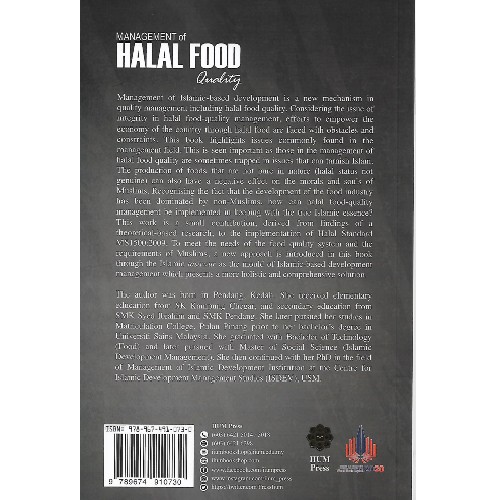
Management of Halal Food Quality
Management of Islamic-based development is a new mechanism in quality management including halal food quality. Considering the issue of integrity in halal food-quality management, efforts to empower the economy of the country through halal food are faced with obstacles and constraints. This book highlights issues commonly found in the management field. This is seen important as those in the management of halal food quality are sometimes trapped in issues that can tarnish Islam. The production of foods that are not pure in nature (halal status not genuine) can also have a negative effect on the morals and souls of Muslims.
Islamic Legal Maxims & Their Application in Islamic Finance (2nd Ed.)
Islamic Legal Maxims and Their Application in Islamic Finance is one of the most comprehensive compilations of Islamic legal maxims available in English. The most important feature of this book is that it explains each maxim in a way comprehensible to both Shari’ah experts and Islamic finance practitioners. Another feature is its emphasis on the application of the maxims in the actual practice of Islamic finance.
Banking: The Root Cause Of The Injustices Of Our Time (Revised Ed.)
The original 1987 Norwich seminar Usury: The Root Cause of the Injustices of Our Time, whose proceedings form the core of this work, had an extraordinary effect.
After the endless analyses and altercations of left and right to which we were accustomed, here was an argument that went to the core of the matter in one bound, and yet did so with a degree of scholarship and indeed erudition that was not cavalier. The result was electric. It was also well before its time.
Recently Viewed
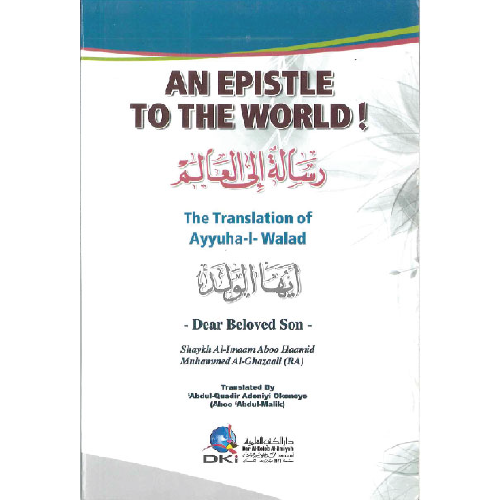
An Epistle To The World!
This book offers twenty-four pieces of valuable advice to seekers of knowledge. It touches on all aspects of life, from material wealth and the love of this life to Islamic etiquette and acquiring knowledge.
The Relief From Distress : An Explanation to the dua of Prophet Yunus (P/B)
Shaykh al-Islam Ibn Taymiyyah, may Allah sanctify his soul, was asked about the saying of the Prophet (pbuh),
The invocation of my brother Yunus, “none has the right to be worshipped save You; glory be to You, far removed are You from any imperfection; I have been amongst the wrong-doers,” none who is experiencing difficulty employs it except that Allah would relieve him of his difficulty.
What is the meaning of this du’a (prayer, supplication)?
Are their any unstated conditions that have to be met when one articulates it?
What is the connection between belief in the heart and the meaning of this supplication such that it leads to the removal of difficulty?
Why did he explicitly confess, ‘I have been amongst the wrong-doers’ when it is known that tawhid in itself leads to the removal of difficulty?
Is it sufficient to acknowledge ones’ sin alone, or must this be accompanied by repentance and the firm resolve not to repeat that sin in the future?
Why is it that difficulty and harm is removed only when a person relinquishes any hope, reliance and dependency upon the creation?
How can the heart relinquish the characteristic of putting hope in the creation and depending on them, and instead put its hope in Allah, Exalted is He, and turn to Him in its entirety?
What are the methods that would aid the heart in doing this?
The author replies to these questions in the form of this book.
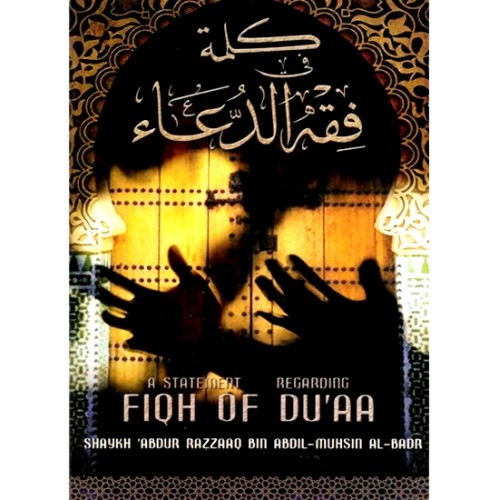
A Statement Regarding Fiqh Of Du’aa (P/B)
He who reviews the Qur’aan will find that the Book of Allaah, the Mighty and Majestic, is replete with many verses and a number of texts indicating the virtue of Du’aa and the loftiness of its status. When you read the Qur’aan, you will find that the first Soorah with which the book of Allaah, the Mighty and Majestic, begins with it; Soorah Al-Faatihah contains this tremendous act of worship, and the last of the Qur’aan Soorah An-Naas as well, contains this tremendous act of worship.
So the Book of Allaah, the Mighty and Majestic, begins with Du’aa and ends with it. The Du’aa, which is within Al-Faatihah, is the greatest of supplications hands down. (It contains) asking Allaah, the Blessed and High, for guidance to the straight path and that the servant avoids the paths of those who are astray and those upon whom is the Anger of Allaah. The last of the Book of Allaah, the Mighty and Majestic, contains the Du’aa of seeking refuge with Him, Glorified and Exalted be He, from the evil of the one who whispers and withdraws; the one who whispers into the hearts of mankind; from the Jinn as well as men, in order to make them deviate from the straight path of Allaah and the upright way.
Allaah informs us that Shaytaan says:
Then I will come to them from before them, and behind them, from their right and their left, and You will not find most of them as thankful ones (i.e., they will not be dutiful to You).[1]
So there is no firmness upon the straight path of Allaah, nor safety from the accursed Shaytaan-who calls mankind to deviation from the straight path-except by way of Du’aa and seeking refuge with Allaah, the Majestic and High; and a good manner of taking refuge with Him. This beginning and ending contain an indication of the importance of Du’aa from different perspectives; and the need of mankind for Du’aa to be firm upon the straight path of Allaah. When you reflect upon the other verses of the Qur’aan, you find the great status of Du’aa and lofty station of it within the Qur’aan.


There are no reviews yet.